Optimizing the Human Element: Next-Generation Workforce Scheduling for Dynamic Industries

The Unfolding Challenge of Workforce Management
In today’s fast-paced business landscape, effective workforce scheduling is no longer just an administrative task—it’s a strategic imperative. From the critical demands of healthcare to the fluctuating foot traffic of retail, organizations across service-driven industries grapple with a complex balancing act: how to meet dynamic customer or patient needs, control escalating operational costs, and simultaneously foster a productive and satisfied workforce, eliminating burnout.
Traditional, manual scheduling methods, often reliant on spreadsheets and intuition, are simply not equipped to handle this intricate challenge. They struggle to account for real-time demand shifts, diverse employee skill sets, regulatory compliance, and individual staff preferences. The result? Suboptimal outcomes that manifest as understaffing during peak hours, overstaffing during lulls, increased overtime costs, and, critically, employee burnout and high turnover rates. This directly impacts service quality, financial viability, and organizational morale.
Quantiphi’s Intelligent Patented Approach: Beyond Conventional Scheduling
At Quantiphi, our dedicated R&D team has developed and deployed an innovative, in-house solution designed to transform this operational bottleneck into a competitive advantage. We recognized that effective scheduling is inherently a multi-objective problem, requiring a sophisticated approach to navigate competing priorities. Our advanced algorithmic framework, honed through extensive research and real-world deployments, models this complexity to deliver truly optimized schedules.
Our solution specifically addresses key challenges such as:
- Volatile Demands: Adapting staffing levels precisely to real-time fluctuations in demand, whether it’s patient appointments in healthcare or customer footfall in retail. In addition, the solution includes workload-based demand forecasting, ensuring staffing aligns with actual task volumes and intensity.
- Modular Shifts: Effectively managing complex and varied shift structures to maximize coverage and efficiency.
- Multi-Skilled Workforce: Optimally deploying employees with diverse skills, certifications, and seniority levels to meet specific operational requirements. This includes skill and certification-based employee scheduling to ensure the right expertise is always available.
- Multi-unit scheduling with transfers: Facilitating efficient movement of staff between departments or units within an organization to meet immediate needs and optimize resource allocation.
It moves beyond single-minded objectives like just cutting costs. Instead, it intelligently balances three critical dimensions:
- Operational Efficiency: Minimizing labor costs by precisely aligning staffing levels with dynamic demand patterns, ensuring optimal resource utilization.
- Service Quality & Coverage: Guaranteeing that the right number of skilled personnel are available at all times to meet customer or patient needs, upholding service standards.
- Employee Satisfaction: Incorporating staff preferences for shifts and leave, significantly reducing burnout, improving morale, and boosting retention.
By considering these interconnected goals simultaneously, our system explores a vast array of possibilities to identify a set of high-quality, balanced scheduling options. This empowers decision-makers with a comprehensive view of the trade-offs, allowing them to choose the schedule that best aligns with their strategic priorities at any given moment.
Tangible Impact Across Industries
The efficacy of Quantiphi’s advanced workforce scheduling solution has been rigorously demonstrated and validated in diverse, demanding environments:
- Healthcare: In hospital units, where patient loads fluctuate hourly and diverse clinical skills are paramount, our solution has consistently outperformed conventional, manually generated schedules by an average of 66%. This translates into significant cost savings, improved patient care coverage, and a more satisfied nursing staff. Nurse managers and hospital administrators now have a powerful decision-support tool to navigate surges in demand or periods of cost containment with agility and precision.
- Retail: The principles are equally transformative in retail. Our solution enables retailers to align staffing levels with dynamic customer footfall, optimizing service during peak shopping times without incurring unnecessary labor costs during quieter periods. By accommodating employee preferences, it also plays a crucial role in reducing turnover in a sector known for its staffing challenges.
The core strength of our framework lies in its adaptability. While initially refined in the complex healthcare sector, its fundamental principles are universally applicable. Any service-driven industry characterized by fluctuating demand, diverse skill sets, and the critical need to balance cost, service, and employee well-being can leverage this powerful solution. This includes, but is not limited to, warehouse logistics, call centers, hospitality, and manufacturing.
Solution Spotlight: Healthcare
The Challenge of Healthcare Scheduling
Healthcare workforce scheduling is a complex problem. Hospitals need to balance competing goals:
- Minimizing costs: Reducing payroll and avoiding overstaffing.
- Ensuring patient care: Having the right staff with the right skills available at all times.
- Improving staff satisfaction: Accommodating staff preferences to prevent burnout.
Manually creating schedules that balance these three factors is extremely difficult and often results in sub-optimal outcomes.
Our Solution & Outcomes
Our Multi-objective Genetic Algorithm (MOO-GA) is an R&D solution designed to solve this complex scheduling problem. The algorithm models the challenge as a multi-objective optimization task, finding a set of high-quality, balanced schedules.
Our key findings from a hospital unit case study include:
- Significant Improvement: Our MOO-GA generated schedules that outperformed conventional manual schedules by 66%.
- Optimal Patient Care: The solution achieved an overall required patient coverage rate of 98%, with minimal understaffing and overstaffing.
- Cost Efficiency: Operational costs were optimized by minimizing overstaffing and achieving a high staff utilization percentage (over 40% for most staff).
- High Staff Satisfaction: The schedules respected staff unavailability requests and promoted operational stability, resulting in an overall staff satisfaction score of nearly 98%.
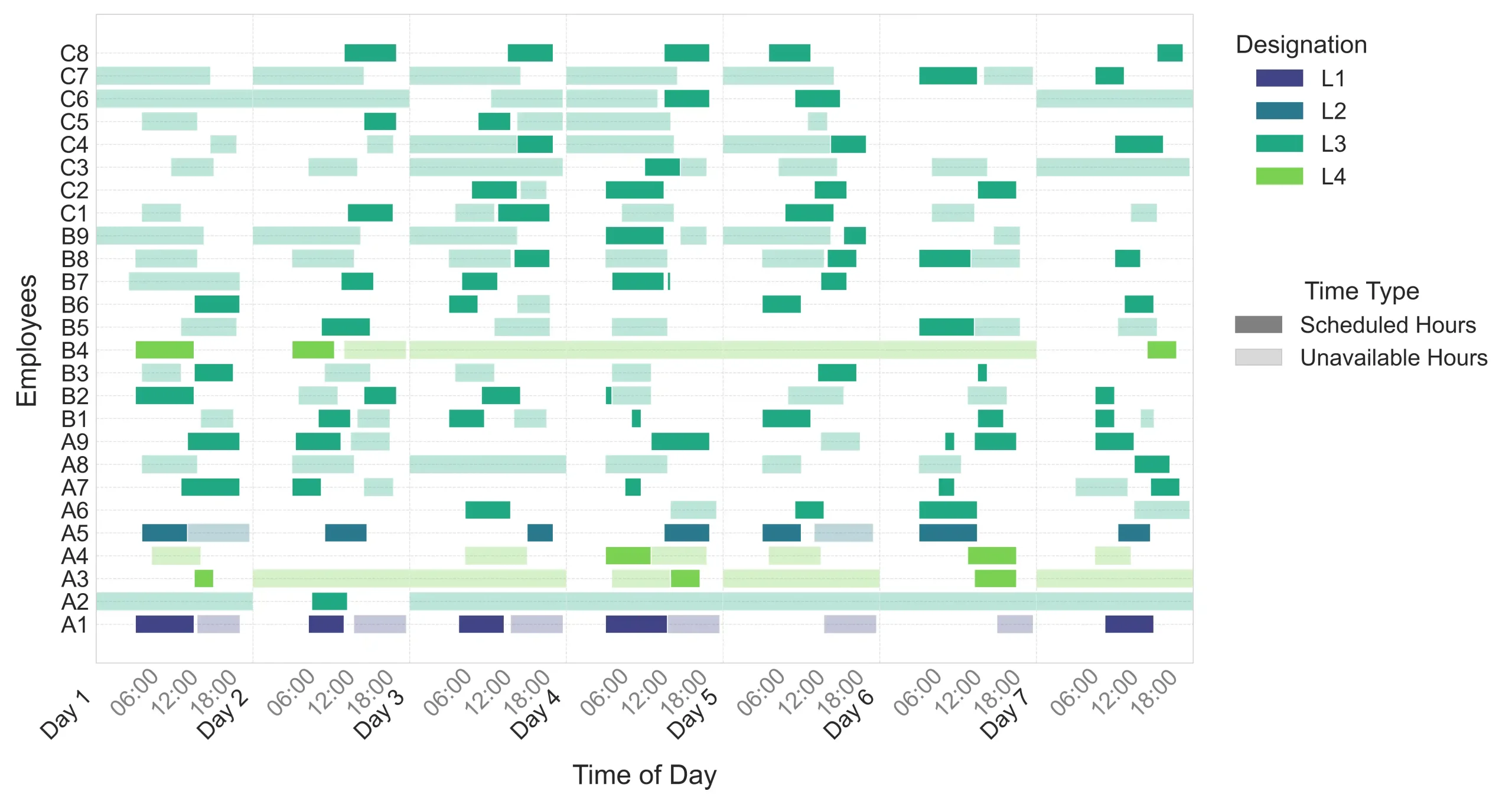
Example schedule generated by the scheduler
The Impact
This solution provides hospital administrators and nurse managers with a powerful decision support tool. Instead of a single rigid schedule, they receive a set of high-quality, balanced schedules. This empowers them to make informed, data-driven decisions that can be adapted to changing priorities, such as focusing on patient coverage during a surge or on cost containment during a quieter period. Ultimately, our MOO-GA approach helps healthcare organizations save money, improve patient care, and enhance staff satisfaction.
Other Applications
The fundamental principles and advanced algorithmic framework of Quantiphi’s workforce scheduling solution are highly adaptable and can be applied across a wide array of service-driven industries, including but not limited to:
- Retail: Optimizing staff schedules for sales associates, cashiers, stockroom personnel, and customer service representatives to match customer traffic patterns, seasonal peaks, and store-specific operational needs, enhancing customer experience and sales performance.
- Entertainment Industry: Optimizing staffing for live events, theme parks, stadiums, and production crews, considering variable attendance, diverse roles, and specific event requirements.
- Manufacturing: Scheduling production line workers, technicians, and quality control staff to meet production targets, manage machine uptime, and accommodate varying product demands and shift patterns.
- Hospitality: Managing hotel staff (front desk, housekeeping, food and beverage), restaurant employees, and event teams to ensure optimal service levels based on occupancy rates, reservation forecasts, and event schedules.
- Call Centers: Efficiently scheduling agents to manage fluctuating call volumes, ensuring minimal wait times and optimal customer service, while accounting for agent skills and language proficiencies.
- Logistics & Transportation: Optimizing schedules for drivers, warehouse personnel, and dispatchers to ensure timely deliveries, efficient route planning, and adherence to regulatory requirements.
- Field Services: Scheduling technicians and field agents for installations, maintenance, and repair services, considering geographical locations, skill sets, and customer appointment windows.
Why Quantiphi?
Quantiphi’s commitment to in-house R&D is driven by a singular purpose: to deliver innovative, impactful solutions that solve our customers’ most pressing challenges. Our advanced workforce scheduling solution is a testament to this philosophy, showcasing our capability to translate complex algorithmic research into practical, scalable, and high-impact business tools. We empower organizations to move beyond reactive scheduling to proactive, data-driven workforce optimization, fostering efficiency, enhancing service, and cultivating a more engaged workforce.
Partner with Quantiphi to unlock the full potential of your workforce and transform your operational efficiency.