Quantum Computing for the Enterprise: Exploring the First Mover Advantage

Quantum computing is no longer a distant academic concept; it is an emerging technology with tangible implications for enterprise-scale problem-solving. It offers a solution path for specific high-value challenges currently intractable even for the most powerful supercomputers, appearing in the fields of simulation, optimization, and machine learning. Quantum is not intended to replace existing compute stacks, however, there is potential in gaining a decisive advantage on critical business challenges where classical methods face fundamental limits. As a result, organisations are now exploring and piloting to build early capabilities and future-proof their competitive edge in a rapidly evolving landscape
In this article, we provide a structured journey through the quantum landscape, beginning with the historical context and the fundamental limits of classical computing that create the quantum imperative. We then dissect the core principles that give quantum its computational power and the benefits associated. We categorize the potential areas of exploring quantum based on the feasibility of computation and problem complexity, and also cover the foreseen growth in the field. The central premise of this post is to highlight that the era of passive observation is concluding, and a period of active, strategic engagement with quantum technology has begun.
Background
The initial thought about a quantum computer began with the 1981 proposal to build computers based on quantum principles to overcome classical simulation limits. This foundational idea spurred decades of theoretical progress, including the formalization of a universal quantum computer, algorithms for factoring and search in the mid-90s, and requirements and criteria for building the physical implementation of quantum hardware. A pivotal hardware breakthrough occurred in 2007 with the invention of the transmon qubit, which significantly improved qubit stability and catalyzed a new wave of industrial investment. After nearly a decade (and a century after the first occurrence of the term ‘quantum mechanics’), this brings us to today, where a global convergence of momentum—marked by the UN designating 2025 as the International Year of Quantum Science and Technology—is driving unprecedented progress. The landscape is rapidly evolving with advancements like Google’s Willow QPU, Microsoft’s Majorana-1, and AWS’s Ocelot chip, a major focus on the intersection of AI and quantum highlighted at events like Nvidia’s GTC 2025, and continued innovation from dedicated hardware providers like D-Wave, IonQ, Quantinuum, etc. to name a few. This confluence of mature theory, improving hardware, and intense enterprise interest signals that quantum computing is finally transitioning from a scientific curiosity to a technology with strategic business implications.
Why a New Computational Paradigm Is Needed
To appreciate why quantum computing is gaining traction, one must first understand the boundaries of classical computing. For decades, Moore’s Law provided a predictable path of growth in computing power. However, that path is narrowing, and for a certain class of problems, even today’s most powerful supercomputers are insufficient. This limitation stems from the challenge of exponential scaling, manifesting as the curse of dimensionality in simulation and combinatorial explosion in optimization. In quantum simulation cases like molecular biology, the computational resources needed to track the state of a molecule grow exponentially with the number of electrons, making an exact simulation of even moderately sized molecules computationally impossible. This forces classical methods to use approximations which simplify the physics but sacrifice the accuracy needed for many complex molecules where subtle quantum effects are critical. Similarly, in optimization problems like job shop scheduling, the solution space expands rapidly as the number of jobs and machines increases, quickly overwhelming classical solvers. As the problem size increases, exact methods are replaced in favor of approximate methods or heuristics. While faster, these approximations often yield suboptimal results, leaving significant value in efficiency and discovery unrealized.
Revisiting Quantum Principles
Before understanding how quantum computing circumvents the classical wall, let us first take some time to know about the core principles. The following concepts and terminologies, while not an exhaustive list in Quantum Information Science (QIS), will help us understand the essential foundations from which quantum-driven benefits are derived:
- Qubit and Superposition: The fundamental unit is the qubit. Unlike a classical bit, it can exist in a superposition of both 0 and 1 simultaneously. A system of N qubits can therefore represent all 2^N (2 raised to the power N) possible classical states at once. This exponential state space is a key reason why quantum computers hold potential for solving problems that are intractable for classical systems.
- Entanglement: Qubits can be entangled, forming a single, correlated quantum state. The state of one qubit is intrinsically linked to the others, creating complex, high-dimensional correlations that are a key resource for quantum algorithms.
- Interference and Measurement: The wave-like nature of particles such as electrons and photons in a superposition of multiple states gives rise to interference, which can be either constructive or destructive. A quantum algorithm operates by manipulating the probability amplitudes associated with the various states in superposition, causing paths leading to wrong answers to destructively interfere (cancel out) and the paths leading to the correct answer to constructively interfere (amplify). Finally, a measurement collapses the superposition into a single classical outcome, with a high probability of it being the desired solution.
- Hamiltonian: Every quantum system is described by a Hamiltonian (H), an operator representing its total energy. The central challenge in many quantum problems is to find the system’s ‘ground state’ (configuration of minimum energy), as described by the time-independent Schrödinger equation, H∣ψ⟩=E∣ψ⟩.
- Gate-Based vs. Annealing: Related to quantum architecture and hardware, Gate-based computers use a sequence of logical operations (gates) to actively transform a quantum state to find the solution, and have the benefits of being used for universal purposes. Quantum annealers, in contrast, represent a specialized metaheuristic based on quantum mechanical effects. They identify optimal or near-optimal solutions by finding the energy-minimal states of an optimization problem. This is achieved by physically encoding the problem into the Hamiltonian of the qubits and letting the system naturally relax or anneal into its lowest energy state.
- Hybrid quantum-classical approaches, which are dominant today in the Noisy Intermediate Scale Quantum (NISQ) era, often make use of variational quantum algorithms. They use a quantum device to prepare and measure a state’s energy, while a classical optimizer adjusts the parameters of the quantum circuit to guide the search for the ground state, which represents the problem’s solution.
Quantum-Driven Benefits
The following benefits are obtained as a result of the principles:
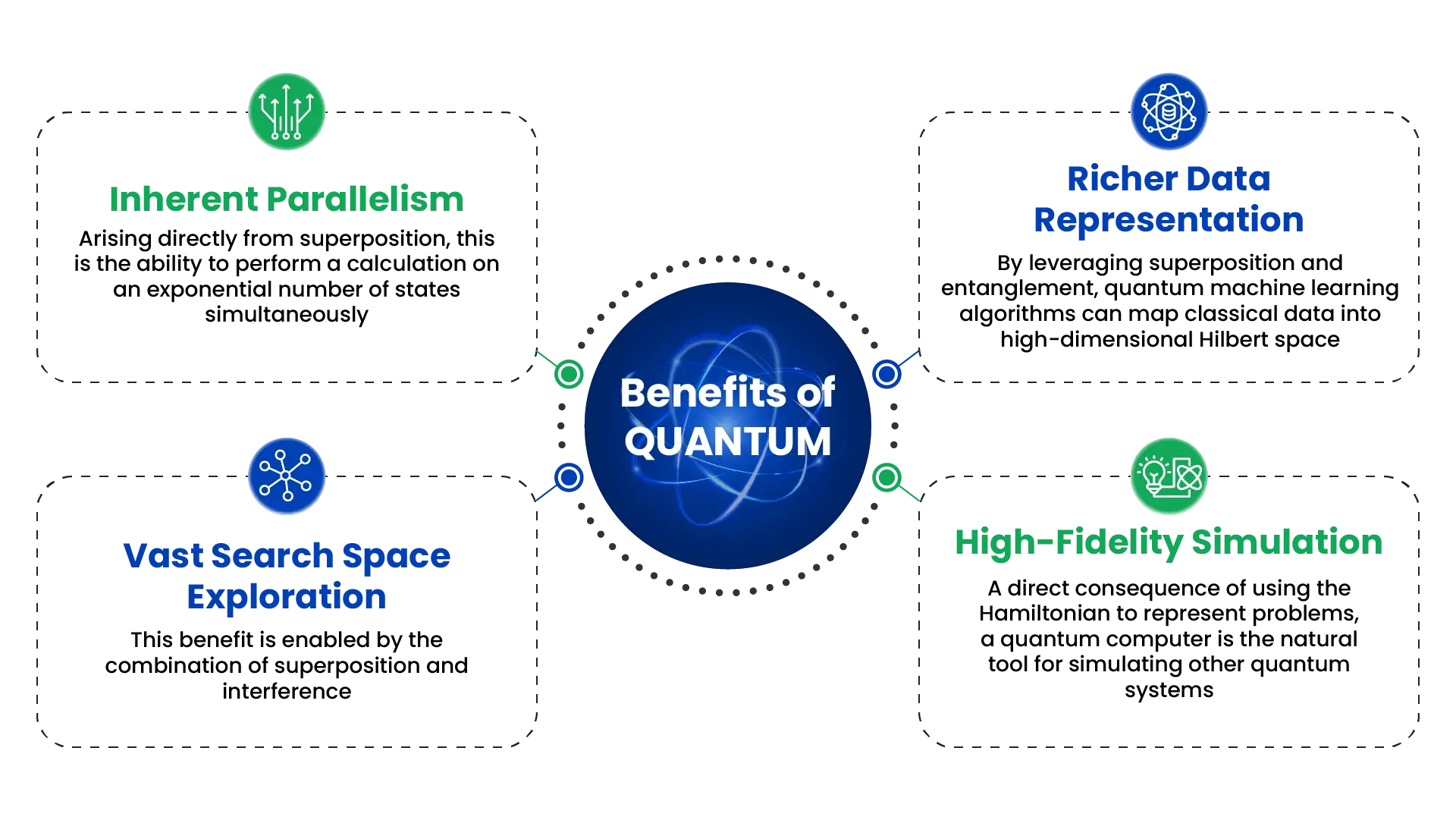
- Inherent Parallelism: Arising directly from superposition, this is the ability to perform a calculation on an exponential number of states simultaneously. A single quantum operation on an N-qubit register acts on all 2^N states it represents, providing the foundational source of quantum computing’s potential speedup.
- Vast Search Space Exploration: This benefit is enabled by the combination of superposition and interference. For optimization problems, a quantum computer can hold all potential solutions in superposition, and then use the principles of interference to systematically cancel out bad solutions and amplify good ones, allowing for a more effective exploration of the solution landscape than classical heuristics.
- Richer Data Representation: By leveraging superposition and entanglement, quantum machine learning algorithms can map classical data into high-dimensional Hilbert space, creating potential to develop far more expressive models, uncovering complex patterns and correlations that are difficult to represent with classical algorithms operating in lower-dimensional spaces.
- High-Fidelity Simulation: A direct consequence of using the Hamiltonian to represent problems, a quantum computer is the natural tool for simulating other quantum systems. By mapping the Hamiltonian of a target molecule onto the QPU, it can find the ground state energy with an accuracy that is unattainable with classical approximation methods, enabling true in silico discovery.
While detailing these benefits, it is important to clarify the following key terms with respect to what is attainable today. Although slightly different interpretations exist, ‘quantum supremacy’ generally refers to showcasing the potential of quantum computing in a selected area and for a particular task that no classical computer can solve in any feasible amount of time, while ‘quantum advantage’ refers to the practical realization through rigorous demonstration that a programmable quantum device can solve that problem significantly better than classical counterparts. At the present era, a more practical goal is achieving a quantum-driven benefit or ‘quantum utility’, which occurs when a quantum or hybrid system can reliably provide solutions that are equivalent to or better than the available classical approximation methods for a specific business problem, delivering a faster, accurate, or more cost-effective result.
The Classical–Quantum Quadrant
To frame the journey from today’s capabilities to future potential, the computational landscape can be viewed as a four-quadrant roadmap. The figure below provides a strategic overview of what is feasible now, what comes next, and what remains a long-term goal, highlighting the transition from the current Noisy Intermediate-Scale Quantum (NISQ) era towards Fault Tolerant Quantum Computing (FTQC) (the mentioned areas may shift between the feasibility levels depending on hardware improvements in the coming years).
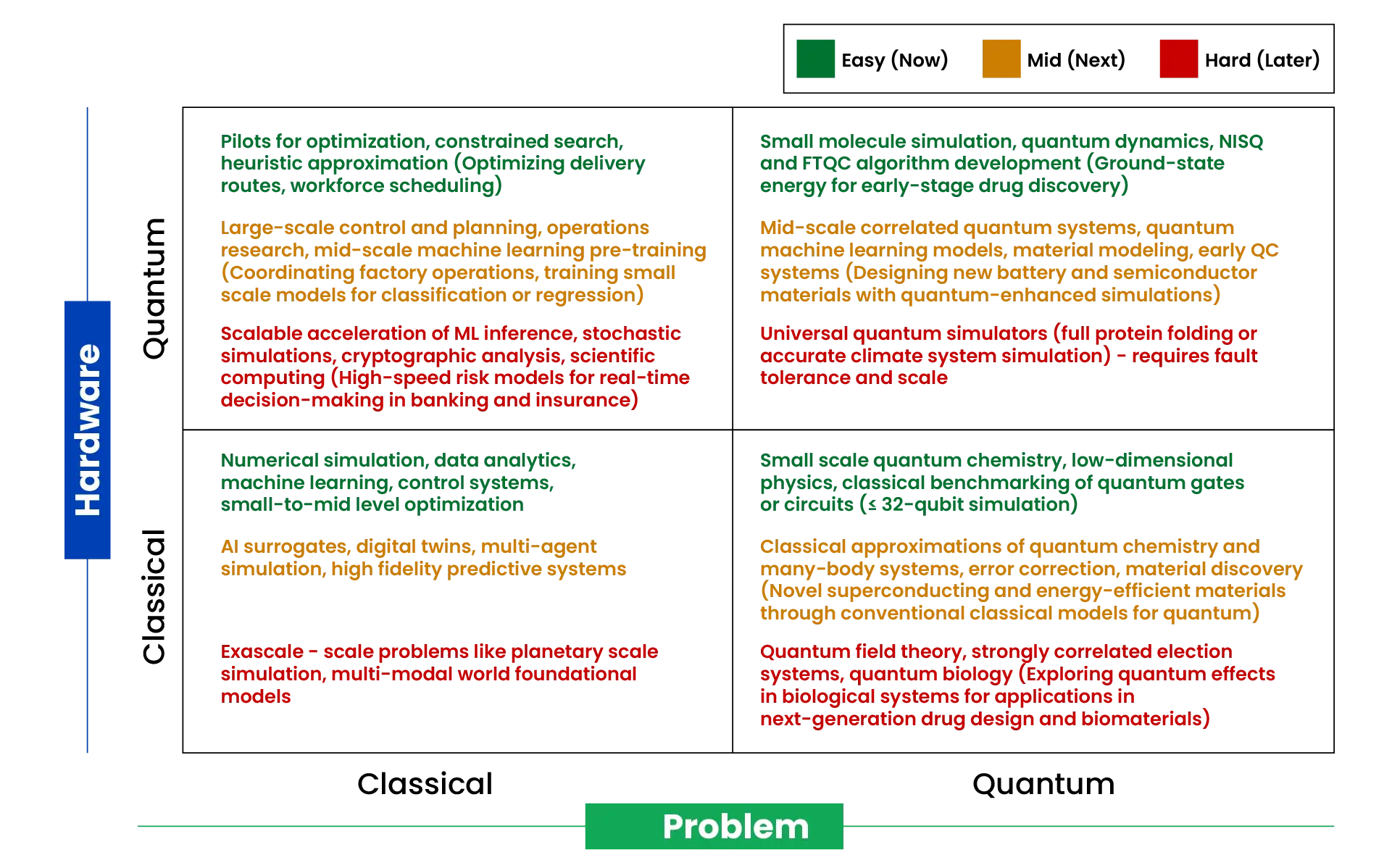
- Classical Computations (CC/CQ): Today, CC (using classical hardware for classical problems) is the workhorse of industry, powering mature applications from engineering simulations to AI-driven analytics. The next frontier is defined by acceleration: using AI-driven surrogates to replace compute-intensive simulations, and pushing into real-time digital twins, multi-agent simulations, and high-fidelity predictive systems. Adjacent to this, the quadrant CQ (tackling quantum problems with classical) leverages classical supercomputers to simulate small-scale quantum systems, supporting research in quantum chemistry and circuit verification. However, they hit a fundamental wall against complex, entangled phenomena, necessitating a new approach.
- Hybrid & Quantum-Native Computations (QC/QQ): The current Noisy Intermediate-Scale Quantum (NISQ) era enables early work in the quantum quadrants. In QC (using quantum to solve otherwise intractable classical problems) hybrid quantum-classical systems are being piloted for constrained optimization problems like scheduling and portfolio analysis, with the goal of tackling more dynamic tasks as hardware matures. In parallel, in QQ (using quantum for solving quantum) variations of the hybrid methods are already simulating small molecules for R&D, with an ambition towards quantum-native. While the near-term goal is to address more complex catalysts and proteins, achieving the ultimate vision of full-scale quantum simulation requires future fault-tolerant hardware.
Rationale for Engagement: From Early Benefits to Long-Term Advantage
Given that many applications are still in the ‘Next’ and ‘Later’ phases, the natural question will be why should an organization invest in quantum today? The answer lies in building foundational capability and capturing early, strategic value. The ‘Now’ activities in the QC and QQ quadrants such as small-scale optimization pilots and basic molecular simulations are not about immediate ROI. They are about building ‘quantum readiness’. By tackling these simpler problems today, organizations develop the internal expertise to formulate problems for quantum hardware, understand the nuances of different platforms, and build the talent pipeline required for the future. These early projects serve as the training ground for the more complex and valuable applications of tomorrow. The learnings from optimizing a small logistics network today directly inform the approach for managing a global supply chain in the future.
The next question one might ask is, ‘How Long Until Next and Later?’ The transition from today’s NISQ era to tomorrow’s fault-tolerant systems is being driven by distinct, aggressive roadmaps from major technology players. While not exhaustive, we list some of the exciting progress planned: IBM’s latest Heron processor released in 2024 supports 5K gate operations on 156 qubits, and is aiming for a fault-tolerant system with ~200 logical qubits by 2029. Google Quantum AI is focusing on solving error-correction at scale, while creating logical qubits and gates as the primary building block, with their Willow chip demonstrating improved error reduction with more qubits. In parallel, AWS is pioneering a novel hardware approach with its Ocelot chip, using cat qubits designed for inherent error suppression to potentially lower the overhead for fault tolerance. NVIDIA, while not building QPUs, is creating a critical acceleration layer, developing the CUDA-Q platform and infrastructure like the NVAQC research center to tightly couple QPUs with their powerful GPUs. IonQ is targeting a Cryptographically Relevant Quantum Computer (CRQC) by 2028 through high-fidelity trapped-ion hardware. Quantinuum plans to achieve a universal and fault-tolerance computer by 2030. Meanwhile, D-Wave continues to scale the specialized field of quantum annealing, with its next-generation Advantage2 system aimed at larger optimization workloads. The consistent theme across all players is a multi-pronged, industry-wide push toward systems with the scale and quality needed to tackle the ‘Next’ generation of problems within the next half-decade.
High-Impact Industry Applications
The potential of quantum computing is currently not evenly distributed; certain industries with computationally intensive R&D and optimization challenges stand to benefit first. Market analysis reports from 2024-2025 highlight several key sectors where early adoption is already underway. According to the Quantum Economic Development Consortium’s (QED-C) 2025 State of the Global Quantum Industry report, the total global quantum computing market is estimated to reach $2.2B in 2027, representing a 27% annual growth rate from $1.07 billion in 2024. By the next decade, McKinsey expects quantum computing to grow to $72 billion in 2035. While quantum is expected to affect almost all the industries, the chemicals, life sciences, finance, and mobility industries are expected to see the most growth (but do note that this list is not exhaustive). The fundamental challenges of simulation, optimization, and better representations for machine learning are present across many sectors, and any industry facing these problems may find significant value in quantum approaches.
- Pharmaceuticals & Life Sciences: This sector is leading the near-term quantum wave, with quantum chemistry applications poised to significantly cut R&D time and cost. While adoption is early, industry leaders are already investing in quantum pilots to transform their R&D pipelines.
- Chemicals & Materials Science: The ability to design advanced catalysts, next-generation battery materials, and anti-corrosion coatings via quantum simulation can accelerate innovation and sustainability goals. Research on corrosion-resistant alloys, for example, highlights the potential for massive real-world savings, given that global corrosion costs are estimated at approximately $2.5 trillion per year.
- Financial Services: Key applications include portfolio optimization, risk modeling, and derivatives pricing, all of which rely on quantum-enhanced scenario analysis and combinatorial optimization. Finance is consistently identified among the first industries to gain substantial quantum benefits, with an estimated $622 billion value by 2035.
- Manufacturing and Supply Chain: Quantum and quantum-inspired methods are demonstrating early wins in complex manufacturing schedules, logistics, and production planning. This growth is underpinned by academic research confirming the near-term value of quantum for job-shop scheduling and industrial optimization.
Overall, the global quantum technology market is signaling a profound, long-term economic shift driven by quantum capabilities.
Conclusion: From “Why” to “How”
By now, the strategic rationale for enterprise engagement with quantum at present might have become clear. We explored the limits of classical computation and detailed how the unique properties of quantum mechanics provide a powerful new pathway for realizing benefits in areas such as simulation, optimization, and machine learning. The natural next question for any organization is, ‘How do we get started?’, Translating this vast potential into practical application requires a structured approach, from identifying the right business problems to building a quantum-aware team and engaging with the hardware ecosystem. These topics are substantial and warrant their own detailed exploration. Therefore, this post serves as the first in a series dedicated to enterprise quantum adoption. Future posts will provide a detailed ‘how-to’ guide for building quantum readiness by showcasing use cases and comparing classical and quantum approaches, specifically in today’s NISQ era.