Slash Review Times & Reduce Risk: The Ultimate Guide to Policy Review Automation

Manual policy reviews are notoriously slow, labor-intensive, and prone to costly human error. By adopting AI-driven automation, organizations can instantly evaluate complex insurance guidelines and legal contracts with pinpoint accuracy. Dive into how transitioning to scalable, intelligent workflows protects your enterprise from compliance risks while freeing up your team for higher-value work.
What Is Policy Review Automation?
Policy review automation relies on AI-driven analysis to rapidly evaluate, audit, and manage insurance guidelines. While manual review is notoriously slow, labor-intensive, and prone to human error, automated systems instantly flag risks and ensure strict compliance with high precision. This critical shift is powered by Natural Language Processing (NLP) and Generative AI (GenAI). By enabling computers to extract meaning and context from human language, NLP and GenAI drive deep document understanding. Together, they effortlessly interpret complex insurance clauses, transitioning businesses from tedious manual bottlenecks to intelligent, scalable automation
Why Is Policy Review Automation Important for Enterprises?
As regulatory complexity grows, manual policy reviews are becoming inefficient. Organizations are adopting AI-powered policy review automation to streamline compliance, accelerate decision-making, and reduce risk. By extracting insights from complex documents, AI helps businesses stay agile while maintaining strong governance.
- Helps enterprises efficiently manage increasing volumes of policy documents and customer data without scaling manual operations
- Accelerates policy assessments, renewals, compliance checks, and underwriting workflows through AI-driven automation
- Improves consistency and accuracy in identifying coverage gaps, exclusions, and policy deviations across large portfolios
- Reduces operational and compliance risks associated with fragmented, manual review processes
- Enables faster decision-making by extracting and summarizing insights from complex policy documents using NLP and GenAI
- Supports audit readiness and regulatory adherence through standardized documentation and traceable review workflows
- Strengthens enterprise risk management with proactive anomaly detection and intelligent policy monitoring
- Enhances customer experience through quicker servicing, personalized recommendations, and faster response times
How Does AI-Powered Policy Review Automation Work?
Stage 1: Sales, Submission & Qualifying Prospects
- The Process: The Broker gathers prospect information and sends collated data to the Carrier/MGA based on ACORD and supplemental documents.
- Key Documents: Applications, Exposures, Submissions.
- Dociphi Impact: Automates data extraction from unstructured applications and ACORD forms to accelerate submission intake.
Stage 2: Assessing Risk & Quoting
- The Process: Underwriting decisions are made. The Carrier/MGA prepares the quote cover letter and sends it to the Broker. The Broker reviews and compares quotes, and the shortlisted Carrier submits the finalized Proposal.
- Key Documents: Quotes, Proposals.
Stage 3: Binding & Issuing the Policy
- The Process: The prospect accepts the proposal. The Carrier reviews the binding request, issues the binder, and ultimately issues the policy. Finally, the Broker reviews the policy for accuracy and stores the information for future reference.
- Key Documents: Binders, Policies.
- Dociphi Impact: Automates the painstaking broker review process, cross-checking massive policy documents against original proposals for accuracy.
Stage 4: Service & Modifying Policy Clauses
- The Process: Mid-term changes occur. The Broker sends an endorsement request, which the Carrier processes to issue relevant paperwork. The Broker then reviews the endorsement and policy, giving the final go-ahead.
- Key Documents: Adjustments/Endorsements, Updated Policies.
- Dociphi Impact: Instantly ingests and audits complex endorsement requests and updated clauses.
Stage 5: Assessing Risk for Renewal (or Non-Renewal)
- The Process: After policy expiry, the Carrier sends a renewal notification and performs an audit. The Broker creates Loss Runs to aid this audit. Post-audit, the outcome is either Automated Renewal, Renewal with the same carrier, or Renewal across a different carrier.
- Key Documents: Loss Runs.
- Dociphi Impact: Rapidly parses dense, multi-page loss run reports to speed up the renewal audit.
What Are the Key Features of Policy Review Automation Tools?
Enterprises modernize operations with specialized document tools that use AI-driven clause detection to identify key terms, exclusions, and obligations. Automated compliance checks validate documents against regulations, while intelligent risk scoring prioritizes high-risk files. Version comparison tracks changes over time, and comprehensive audit trails ensure transparency and regulatory readiness.
-
AI-driven clause detection:
Automatically identifies key policy clauses, exclusions, endorsements, obligations, and coverage terms from large volumes of unstructured insurance documents
-
Automated compliance checks:
Validates policies against internal guidelines, regulatory requirements, and underwriting standards to reduce compliance risks
-
Risk scoring and prioritization:
Uses predictive analytics and AI models to assess policy risk exposure, flag anomalies, and prioritize high-risk cases for review
-
Version comparison and change tracking:
Detects differences between policy versions, renewals, and endorsements to identify coverage modifications or inconsistencies
-
Comprehensive audit trails:
Maintains traceable records of policy reviews, recommendations, approvals, and document changes to support governance and audit readiness
-
NLP-powered document understanding:
Leverages Natural Language Processing (NLP) and Generative AI (GenAI) to interpret complex policy language and summarize findings
-
Workflow automation and alerts:
Automates repetitive review tasks, escalations, and notifications to improve operational efficiency and turnaround time
-
Searchable knowledge repositories:
Enables users to quickly retrieve policy insights, historical decisions, and regulatory references across documents
-
Integration with core insurance systems:
Connects with policy administration, underwriting, claims, and CRM platforms for seamless enterprise workflows
-
According to Gartner, Intelligent Document Processing (IDP) platforms are increasingly being adopted to automate extraction, classification, and validation of enterprise documents at scale, especially in document-intensive industries such as insurance and financial services
What Are the Benefits of Policy Review Automation?
-
Accelerates policy review processes:
Automates document analysis and policy evaluation to significantly reduce turnaround times for underwriting, renewals, and compliance reviews
-
Reduces manual effort and operational overhead:
Minimizes repetitive document handling and data extraction tasks, allowing teams to focus on higher-value decision-making activities
-
Improves accuracy and consistency:
AI-powered clause extraction and validation help reduce human errors, inconsistencies, and missed policy details across large document volumes
-
Enhances regulatory compliance:
Enables standardized review workflows, audit trails, and automated compliance checks to support evolving regulatory and governance requirements
-
Supports scalable enterprise operations:
Allows insurers and enterprises to process growing policy volumes efficiently without proportionally increasing staffing costs
-
Strengthens risk management:
Identifies policy gaps, anomalies, and high-risk exposures early through predictive analytics and intelligent risk scoring
-
Enables faster and smarter decision-making:
Provides underwriters and operations teams with AI-generated summaries, recommendations, and actionable insights in real time
-
Improves customer experience:
Faster policy servicing, quicker response times, and more personalized recommendations contribute to better customer satisfaction and retention
-
Increases operational transparency:
Comprehensive audit trails and version tracking improve accountability, traceability, and governance across policy review workflows
What Are the Key Steps to Implement Policy Review Automation?
-
Identify and classify document types
Start by identifying the types of documents that need to be reviewed, such as insurance policies, compliance records, endorsements, and renewal documents. Categorizing structured and unstructured data helps establish the foundation for automation.
-
Define review rules and business criteria
Establish the review parameters, including compliance requirements, risk thresholds, clause validation rules, underwriting guidelines. Clear business rules improve consistency and governance.
-
Train AI and NLP models
Use historical documents and review outcomes to train AI, Natural Language Processing (NLP), and Generative AI (GenAI) models for clause extraction, document understanding, summarization, and risk identification. Continuous learning improves accuracy over time.
-
Integrate automation into enterprise workflows
Connect policy review automation tools with policy administration systems, underwriting platforms, claims systems, CRM tools, and document repositories to enable seamless end-to-end operations.
-
Automate review and decision-support processes
Configure workflows for document ingestion, exception handling, compliance validation, alerts, and AI-generated recommendations to reduce manual intervention and accelerate decision-making.
-
Monitor performance and optimize continuously
Track metrics such as review turnaround time, accuracy, compliance adherence, exception rates, and operational efficiency. Regular monitoring helps refine AI models and improve business outcomes.
-
Ensure governance, security, and auditability
Implement audit trails, explainability mechanisms, access controls, and regulatory governance processes to maintain transparency, accountability, and compliance across automated review operations.
-
Scale automation across business functions
Expand automation capabilities across underwriting, legal, compliance, customer servicing, and risk management functions to maximize enterprise-wide operational efficiency and scalability.
What Are the Challenges in Policy Review Automation?
While policy review automation offers undeniable benefits in speed and accuracy, transitioning from manual to AI-driven processes is rarely without friction. Organizations must navigate a landscape of technical, operational, and regulatory hurdles to achieve seamless processing. From decoding complex document structures and fixing underlying data quality issues to addressing valid model accuracy concerns, the path to intelligent automation requires a careful strategy. Furthermore, ensuring continuous regulatory compliance and driving effective change management to align internal teams are critical roadblocks organizations must master before realizing the technology’s full potential.
-
Complex and unstructured document formats:
Insurance policies, legal agreements, and compliance documents often contain inconsistent layouts, handwritten annotations, endorsements, and highly technical language that make automated extraction challenging
-
Poor data quality and fragmented systems:
Incomplete, duplicated, or inconsistent data across legacy systems can reduce automation effectiveness and impact AI model performance
-
Model accuracy and explainability concerns:
AI and NLP models may misinterpret clauses, policy language, or contextual nuances if not trained properly, creating challenges around trust, transparency, and decision explainability
-
Evolving regulatory and compliance requirements:
Frequent regulatory updates require automation systems to continuously adapt review rules, governance standards, and audit requirements
-
Integration with legacy enterprise systems:
Connecting automation platforms with underwriting, claims, policy administration, and document management systems can be technically complex and resource-intensive
-
Handling exceptions and edge cases:
Policies with unusual clauses, industry-specific terminology, or incomplete information may still require human review and oversight
-
Data privacy and security risks:
Sensitive customer and policyholder information must be protected through strong governance, access controls, and compliance with data privacy regulations
-
Organizational change management:
Employees may resist automation initiatives due to concerns around process changes, adoption complexity, or perceived job disruption, making training and stakeholder alignment critical
-
Scalability and operational consistency:
Scaling automation across multiple business units, geographies, and document types while maintaining accuracy and governance can be difficult
Gartner highlights that organizations implementing Intelligent Document Processing (IDP) and AI automation initiatives often face challenges related to data quality, governance, integration complexity, and operational change management
How Does Policy Review Automation Improve Compliance?
Policy review automation strengthens compliance by combining AI, business rules, and workflow orchestration to review policies consistently and identify potential risks before they impact operations.
Step 1: Ingest and Analyze Policy Documents
AI-powered systems automatically ingest policy documents from multiple sources and extract key information, including coverage terms, exclusions, endorsements, conditions, and compliance-related clauses.
Step 2: Compare Against Regulatory and Internal Requirements
The extracted content is automatically validated against:
- Regulatory requirements
- Internal compliance policies
- Underwriting guidelines
- Product-specific business rules
This ensures every policy is reviewed against the same standards.
Step 3: Identify Missing Clauses and Policy Deviations
Intelligent rule engines and AI models detect:
- Missing mandatory clauses
- Inconsistent language
- Coverage gaps
- Regulatory non-compliance
- Deviations from approved policy templates
Potential issues are flagged immediately for further review.
Step 4: Route Exceptions for Human Review
Complex cases, low-confidence findings, or high-risk deviations are automatically routed to compliance officers, underwriters, or legal teams for validation and decision-making.
Step 5: Maintain Audit Trails and Compliance Records
Every review, recommendation, approval, modification, and decision is automatically recorded, creating a complete audit trail that supports regulatory reporting and compliance audits.
Step 6: Continuously Improve Compliance Monitoring
As regulations and internal policies evolve, rule sets can be updated centrally, ensuring future policy reviews remain aligned with the latest requirements without requiring extensive manual effort.
How Does AI Reduce Risk in Policy Review?
AI effectively minimizes risk in policy review by providing early risk detection through the continuous analysis of documents for coverage gaps, inconsistencies, and compliance issues. While manual reviews often suffer from discrepancies between different teams, AI-powered systems guarantee a consistent evaluation by applying strict, standardized criteria across every assessment. Furthermore, advanced machine learning models enable scenario-based analysis to forecast potential underwriting, operational, and financial vulnerabilities under varying conditions. By uniting GenAI, Natural Language Processing, and predictive analytics, enterprises can proactively manage emerging threats, strengthen governance, and make smarter decisions across massive contract portfolios.
What Are Real-World Use Cases of Policy Review Automation?
Automated Policy Comparison & Discrepancy Detection
Compare policies, quotes, and binders automatically to identify discrepancies and ensure alignment.
- Detect mismatches across coverage, limits, and clauses
- 95%+ extraction and comparison accuracy
- Reduce policy review time by 30%+
- Ensure consistent and accurate policy validation
Renewal Policy Review Automation
Compare expiring and renewal policies to identify changes and accelerate renewal decisions.
- Identify deviations in coverage, pricing, and terms
- Reduce review effort by 70%+
- Speed up renewal decision-making
- Ensure consistent and accurate policy reviews
Compliance & Clause Validation
Validate policy clauses automatically to ensure compliance with regulatory and internal standards.
- Detect missing or non-compliant clauses
- Improve accuracy and audit readiness
- Minimize risk across high-volume policy reviews
- Flag compliance issues with traceable outputs
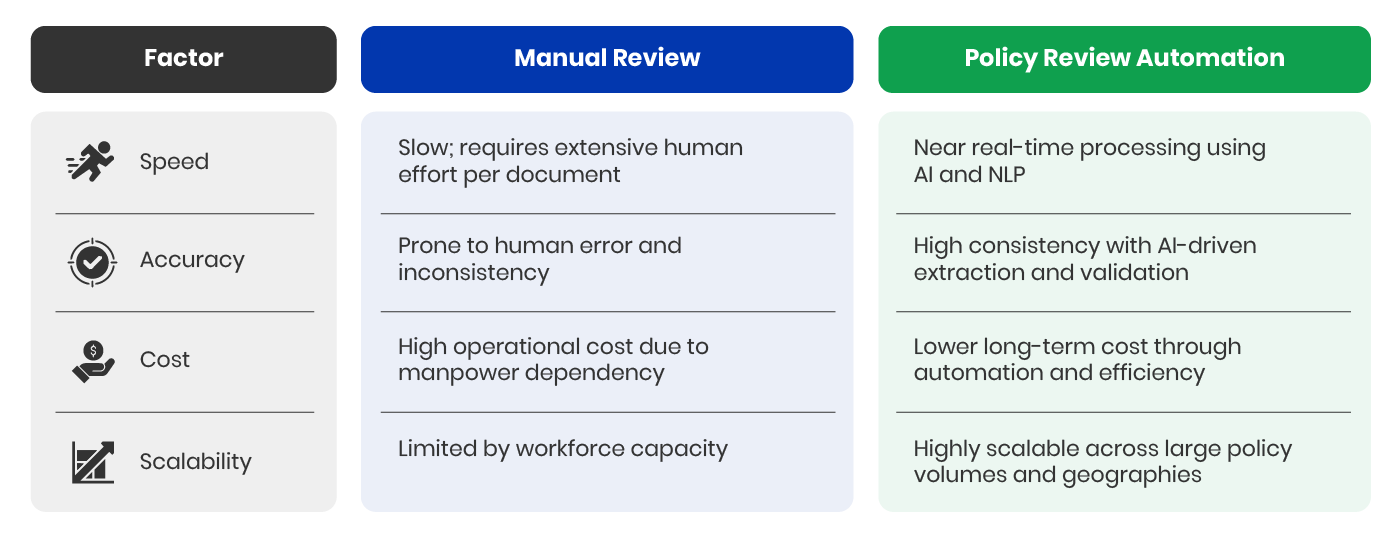
How Does Policy Review Automation Compare to Manual Review?
What Is the ROI of Policy Review Automation?
Policy review automation delivers measurable business value by improving efficiency, reducing costs, and strengthening compliance across policy evaluation workflows.
-
Time Savings:
AI-powered systems significantly accelerate policy reviews by automating document analysis, clause validation, and compliance checks. This reduces review cycles from days to hours, enabling faster decision-making and policy approvals.
-
Cost Reduction:
By minimizing manual review efforts and streamlining repetitive tasks, organizations can reduce operational costs while allowing compliance, underwriting, and legal teams to focus on higher-value activities.
-
Error Reduction and Risk Mitigation:
Automated rule engines consistently identify policy deviations, missing clauses, and compliance gaps that may be overlooked during manual reviews. This helps reduce human errors, prevent financial leakage, and minimize the risk of regulatory penalties.
-
Improved Compliance and Governance:
Standardized review processes and comprehensive audit trails ensure policies are evaluated consistently against regulatory requirements, internal guidelines, and underwriting standards, helping organizations remain audit-ready and compliant.
To illustrate this, consider an example ROI scenario: if a mid-sized insurer processing 100,000 policy documents annually uses automation to reduce review time by 60% and cuts manual effort costs by $5 to $10 per document, they can achieve annual savings between $500,000 and $1 million. Beyond these direct financial benefits, AI-driven automation unlocks additional long-term value through faster renewals, increased overall operational efficiency, and improved customer retention through faster policy servicing.
What Is the Future of Policy Review Automation?
The future of policy review automation points toward a completely frictionless, intelligent operating model that reshapes how enterprises interact with critical documents. This evolution is driven by AI copilots for reviewers, which act as cognitive assistants to instantly summarize clauses, highlight hidden risks, and suggest real-time remediation strategies for underwriting and compliance teams.
Over time, this will pave the way for true autonomous document processing, where end-to-end pipelines handle ingestion, deep validation, and risk analysis with minimal human intervention. To fully unlock this value, organizations will prioritize the deep integration with enterprise workflows, embedding these analytical engines directly into core CRM, claims, and underwriting platforms. Finally, powered by continuous learning systems, these AI models will grow progressively smarter with every user interaction and regulatory update, shifting enterprise risk management from a reactive chore to a predictive edge.
-
AI copilots for reviewers:
Intelligent assistants will support underwriters and compliance teams by summarizing policies, highlighting risks, and recommending actions in real time.
-
Autonomous document processing:
End-to-end automation will enable systems to ingest, analyze, and validate policies with minimal human intervention.
-
Integration with enterprise workflows:
Policy review will become embedded into underwriting, claims, CRM, and compliance systems for seamless decision-making.
-
Continuous learning systems:
AI models will evolve continuously based on reviewer feedback, regulatory changes, and historical outcomes, improving accuracy over time.
-
Real-time risk intelligence:
Future systems will enable dynamic monitoring of policy risk exposure as external conditions change.
Gartner highlights that AI-enabled document intelligence and automation are evolving toward autonomous decision-support systems that continuously learn and improve enterprise workflows
How Does Dociphi Enable AI-Powered Policy Review Automation?
Dociphi takes the friction out of policy evaluation by leveraging advanced Intelligent document processing to extract, structure, and analyze complex enterprise and insurance documents with exceptional accuracy.
What makes Dociphi uniquely capable of simplifying this process is its reliance on domain-specific AI models. Because these models are explicitly trained to understand intricate insurance terminology, policy clauses, and regulatory language, they do the heavy lifting for your teams.
A standout feature is Dociphi’s automated comparison screen capability. The platform can instantly cross-reference multiple critical documents such as the initial quote, the binder, and the final issued policy to automatically catch hidden discrepancies, verify coverage details, and flag anomalies. This saves reviewers from tedious, line-by-line comparisons across different files and drastically reduces Errors and Omissions (E&O) risks.
Furthermore, Dociphi is built for scalable deployment, enabling organizations to effortlessly manage growing volumes of policies across multiple business units without adding headcount. To ensure these capabilities fit naturally into your daily operations, Dociphi provides seamless integration with enterprise systems, connecting directly with your existing underwriting platforms, policy administration tools, and compliance software. By bridging these gaps, Dociphi transforms fragmented manual tasks into a unified, end-to-end automated workflow that accelerates decision speed and boosts operational efficiency.
Learn how Dociphi is transforming policy review in the real world:
- Policy Review Automation for a Leading Broker
- Automating Policy Verification and Discrepancy Detection with Dociphi