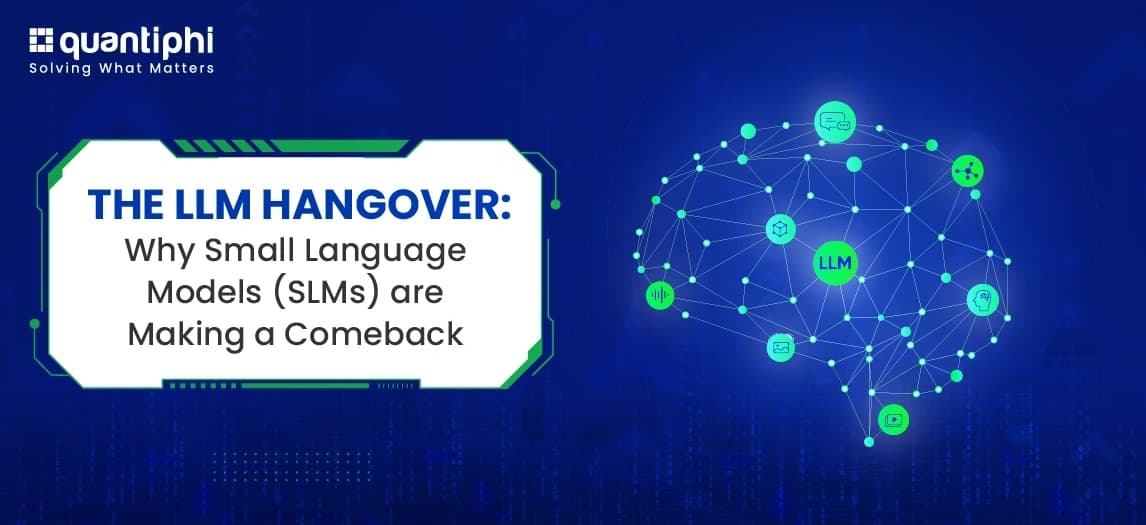
The LLM Hangover: Why SLMs Are Making a Comeback

Introduction
Remember the Great Scaling Gold Rush?
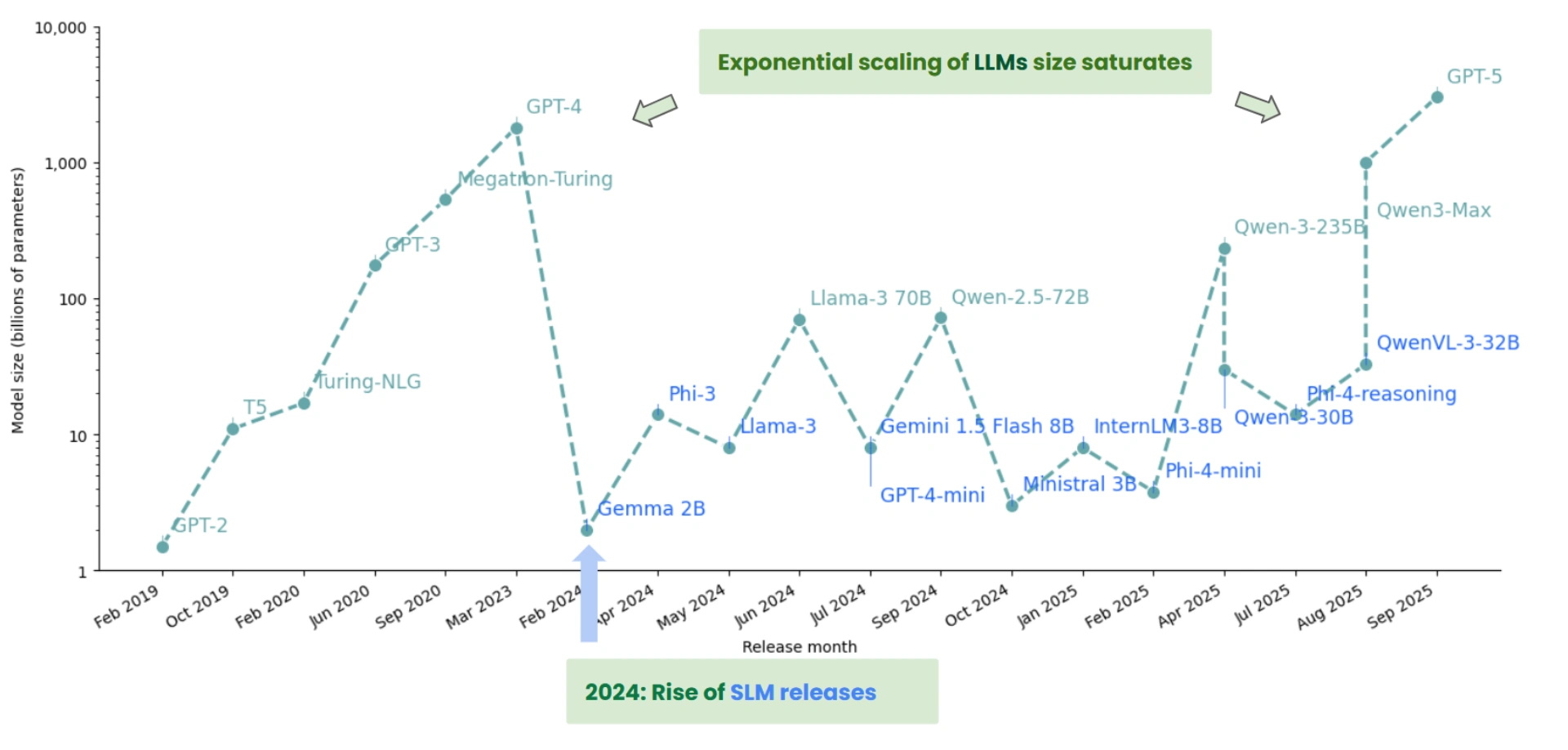
Between 2019 (GPT-2) and mid 2024 (GPT-4o), the AI industry operated under a singular, relentless mantra: Bigger is Better. The chart above perfectly illustrates this era, showing a near-vertical climb toward models like GPT-4, which industry estimates place in the trillion total parameter range.
This exponential scaling effort was the Pre-Training Era — a race defined by massive corpora and massive compute. Then, something changed.
The Saturation Point
Let’s look closely at the data points after 2024. The curve has flattened:
-
Scaling Saturates
The era of exponential parameter growth has hit a wall. Models like GPT-5 are rumoured to be still in the 1–3 trillion total parameter range, not massively different from its predecessors. The gains from simply adding more parameters are diminishing.
-
The Rise of the Small Models
Simultaneously, a flood of new Small Language Models (SLMs) like Gemma 2, Phi-3, and Qwen 2.5 appeared in 2024, proving they can punch far above their weight. 2024 officially marked the “Rise of SLM releases.”
The industry moat had officially shifted: it is no longer about model size, but about System Building — what we now call Agentic Workflows.
The New Thesis
The role of Language Models has shifted from being an “all-knowing oracle” to becoming efficient orchestrators of tools and planners. For this precise task, industry research suggests that small language models (up to 32B parameters) are highly effective and resource-efficient.
Why Small Models Are Suddenly Smarter
SLMs are not simply “scaled-down” LLMs; they are optimized, high-performance engines capable of matching larger models on specific, task-level performance. This radical shift is due to one primary factor: Post-Training Quality.
It’s no longer about quantity of data; it’s about quality of instruction:
-
Better Data > Bigger Model
Labs have moved from chasing huge pre-training corpora to focusing on small, but extremely high-quality instruction tuning and sophisticated RL-based reasoning training.
-
Efficiency Meets Performance
This “quality over quantity” approach has tipped the scales, allowing smaller models to deliver the required task-specific accuracy and reliability needed for production-grade enterprise agents.
The New Bottleneck (And How Distillation Helps)
While the performance gap has closed, the challenge has only shifted location. The cost is no longer in pre-training compute, but in creating and maintaining continuous, high-quality human annotations for fine-tuning these domain-specific SLMs.
This is where the magic happens.
Distillation offers a highly scalable solution: by using high-performing, large models (say GPT-5 or Claude 4.1 Opus) as scalable, high-quality supervisors for a smaller model, enterprises can train customized SLMs at a fraction of the cost: all while ensuring continuous, scalable updates to their agentic systems.
The Art of Transfer: Whitebox vs. Blackbox Distillation
The core mechanism of Knowledge Distillation (KD) is the transfer of “soft targets” (the probability distribution over all possible next tokens) from a large, expert Teacher model to a smaller, efficient Student model. However, the practical application of this technique bifurcates into two main categories, defined by the level of access you have to the Teacher model’s internal workings:
- Whitebox Knowledge Distillation (Whitebox KD): This approach requires full, internal access to the Teacher model’s architecture, parameters, and—most crucially—its intermediate layers or logits (the raw, unnormalized prediction scores). Whitebox KD methods are highly effective as the Student model can learn from more than just the final answer; it learns the reasoning process and internal representations of the Teacher. The key limitation is that it only works when the Teacher and Student models share either the exact same or highly similar underlying architecture.
- Blackbox Knowledge Distillation (Blackbox KD): This is the game-changer for the enterprise. In a Blackbox setting, you treat the Teacher model as a closed system. You only interact with it via its API—sending a prompt (input) and receiving a generated text response (output). The Student model is trained simply to reproduce the high-quality, nuanced responses of the Blackbox Teacher. It learns the Teacher’s behavior, not its architecture.
The Enterprise Advantage: Blackbox for Cross-Architecture Freedom
For an enterprise system, Blackbox KD is overwhelmingly the more useful strategy, and for a simple, yet critical reason: It enables Cross-Architecture Distillation from proprietary leaders. The best-performing, state-of-the-art models in 2025—like GPT-5, Claude 4.1 Opus, or Gemini 3 Pro—are all proprietary Blackbox APIs. Their internal architecture and parameters are secret. Blackbox KD allows an organization to use the highest-performing model from any provider as the source of truth—the “gold standard” supervisor—without being locked into their architecture. You can take the expert knowledge from a proprietary, trillion-parameter model and effectively compress it into a self-hosted, cost-effective open-source model (like a 8B-parameter Qwen3 or InternLM3).
This provides two massive business advantages:
- Continuous Competitive Edge: You can seamlessly switch or blend the knowledge from the current best-in-class Teacher models. If GPT-6 launches with superior reasoning, you immediately start distilling its knowledge into your existing SLM fleet, bypassing vendor lock-in.
- Cost and Latency Control: You own the deployment. The final, distilled SLM runs on your own GPU infrastructure, transforming a high-cost, high-latency API call into a fast, low-cost internal service.
Distillation vs. Fine-Tuning: A Critical Distinction
It’s crucial to understand that distillation is not just a form of Fine-Tuning. While both are part of the post-training pipeline to adapt existing LLMs to our workflow , their goals and resource requirements are fundamentally different
When to Choose What:
- Choose Fine-Tuning if you need expert-level accuracy on a narrow, domain-specific task and possess a proprietary, human-labeled dataset. FT teaches the model new facts and specific style.
- Choose Distillation if your goal is high efficiency and low latency for general reasoning, tool-use, and planning tasks, or if you need to transfer the expert reasoning quality from an expensive LLM to a cheap SLM.
The Way Forward
At Quantiphi, we are actively developing a Cross-Architecture Distillation Framework designed specifically to help enterprises leverage this strategy, ensuring they capture the maximum possible performance from the latest proprietary LLM teachers while maintaining full control over deployment cost and infrastructure. As a key component of this framework, we introduce ORPO-Distill, a recent work from Phi Labs presented at NeurIPS 2025, demonstrating the substantial performance improvements achieved through contrastive cross-architecture distillation of LLMs, in contrast to traditional fine-tuning methods.