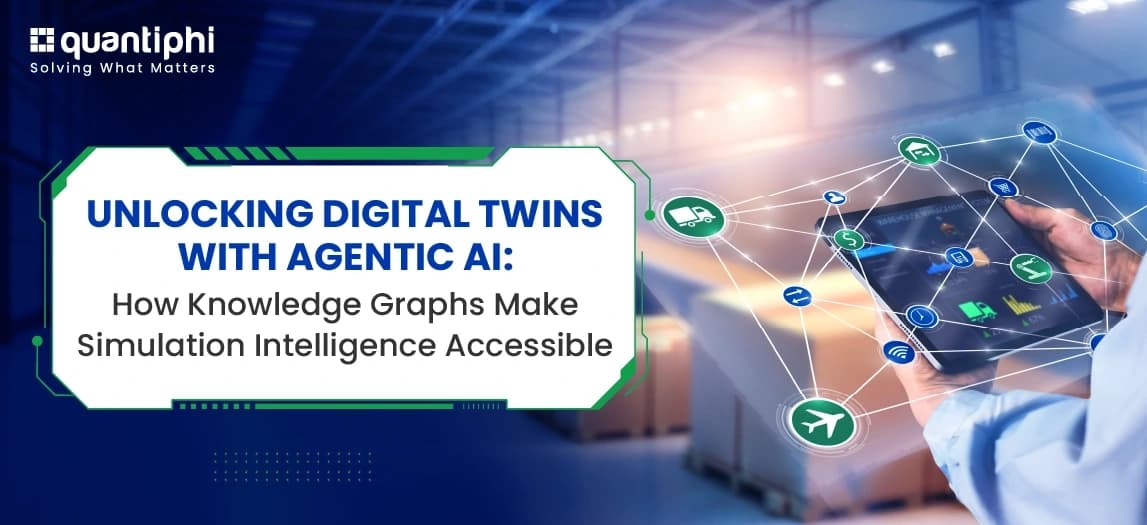
Unlocking Digital Twins with Agentic AI: How Knowledge Graphs Make Simulation Intelligence Accessible

In today’s competitive landscape, industries from manufacturing and logistics to healthcare and finance rely on data to stay ahead. For decades, sophisticated tools like simulations and digital twins have been the gold standard for modeling complex operations. They allow businesses to test new layouts, predict the impact of disruptions, and find hidden inefficiencies in everything from a warehouse floor to a global supply chain.
The promise is immense. But there’s a catch.
The large amount of data generated by these simulations often contains valuable insights that remain inaccessible. Unlocking them requires specialized data scientists and industrial engineers to spend weeks, or even months, manually analyzing complex logs and statistics. This process is slow, expensive, and far from democratized.
On the other hand, we have the rise of Agentic AI, intelligent systems that can reason, plan, and execute tasks. While we’ve seen their power in understanding unstructured data like text and images, a significant gap remains: most critical enterprise data isn’t in a paragraph; it is in structured logs, databases, and spreadsheets. How can we empower business leaders to have a simple conversation with this complex, structured data?
At Quantiphi, we’ve built the bridge to connect these two worlds, creating a new paradigm for data-driven decision-making.
Our Approach: From Raw Data to Rich Insights
We recognized that to make simulation data truly accessible, we needed more than just a dashboard. We needed an intelligent partner that could understand business questions, navigate complex data, and provide clear, actionable answers. Our solution is a powerful two-stage framework that combines the structure of Knowledge Graphs with the reasoning power of Agentic AI.
Stage 1: Building a Dynamic ‘Business Map’ with Knowledge Graphs
First, we take the overwhelming data from a simulation, though this data could be a mix of simulation and real-world measurements — every timestamp, every resource movement, every package journey — and transform it into a Knowledge Graph (KG). Think of a KG not as a static table, but as a dynamic, interconnected map of your entire operation. It doesn’t just store data; it understands relationships. It knows that Forklift-02 moved Package-X from AGV-15 to Storage-Bay-C and it knows precisely how long each step took. This creates a rich, semantically-aware foundation that is perfect for deep analysis.
Critical to this transformation is our custom ontology for KG construction, which serves as the “brain” of the Knowledge Graph. This domain-specific ontology provides the structural intelligence that defines how operational entities like suppliers, workers, equipment, packages relate to each other and interact within complex workflows. Unlike generic data models, our specialized ontology captures the nuanced operational relationships specific to manufacturing and logistics environments. It understands that a “wait time” between an AGV arrival and forklift pickup represents a potential bottleneck, while a “discharge time” encompasses the full end-to-end process across multiple operational stages. This semantic foundation enables the Agentic AI to function as a truly smart analyst, understanding not just what data exists, but what it means in the context of operational performance and efficiency.
Stage 2: The AI Analyst That Speaks Your Language
With this intelligent map in place, our Agentic AI Workflow comes into play. This is not a simple chatbot. It is a cognitive assistant powered by Chain-of-Thought (CoT) reasoning. When a manager asks a complex question, the agent doesn’t just search for keywords, it:
- Decomposes the Problem: It breaks the high-level question into a series of smaller, logical sub-questions.
- Queries the Knowledge Graph: It translates each sub-question into a precise query to retrieve evidence from the business map.
- Self-Reflects and Corrects: If a query fails or the data seems inconsistent, the agent can rethink its approach and try a different path — much like a human analyst would.
- Synthesizes the Answer: It gathers all the evidence and formulates a comprehensive, easy-to-understand answer in natural language.
This approach is a game-changer. Our internal experiments show that this guided, iterative framework is dramatically more reliable than traditional methods. For direct operational questions, our system achieved a 92% first-try success rate, reaching near perfect accuracy with a second attempt on our validated benchmark scenarios, ensuring decision-makers get the right answer, right away. For full methodology, ontology design and evaluation results, see the research paper.
In Action: Solving a Real-World Warehouse Bottleneck
Imagine a busy warehouse manager overseeing the unloading of dozens of trucks a day. They have a gut feeling that shipments from one supplier, “CamelCargo,” are consistently taking longer to process, but they can’t pinpoint why.
The Old Way: A team of analysts would be tasked with a multi-week project, digging through spreadsheets and logs to find the root cause.
The New Way: The manager simply asks our AI assistant:
“Why did CamelCargo’s discharge take so much longer than the other suppliers today?”
In minutes, the AI begins its investigation, narrating its findings as it works:
- Confirming the Problem: The agent first queries the KG and confirms the manager’s suspicion. “You’re right. CamelCargo’s total discharge time was 6,870 seconds, which is 39% longer than the facility average.”
- Investigating Obvious Culprits: The agent then forms hypotheses. Is it the automated equipment? It queries AGV and forklift utilization. The result is surprising: “AGV utilization for CamelCargo was higher than average, while forklift utilization was lower.” This rules out a simple equipment failure and points to an imbalance in the workflow.
- Drilling Down to the Root Cause: The agent decides to analyze the waiting time for packages at each stage of the process. It queries the KG again and finds the “aha!” moment.
- Delivering the Insight: The AI provides a clear, data-backed conclusion: “The primary bottleneck is at the initial worker stage. Packages from CamelCargo waited, on average, more than double the time for a worker to be assigned compared to other suppliers. This initial delay created a downstream ripple effect, causing the equipment imbalance.”
The impact is immediate. Instead of waiting days for an answer, the manager has a precise, actionable insight. They can now take targeted action, such as adjusting worker team assignments for that specific supplier and solve the problem at its source.
[Interactive Demo: Watch our AI assistant diagnose warehouse bottlenecks in real-time through natural language conversation]
Beyond the Warehouse: A World of Applications
This powerful combination of simulation and Agentic AI is not limited to warehouses. Its applications span across any industry that relies on complex operational processes:
- Supply Chain: Proactively identify risks by simulating disruptions (e.g., a port closure) and asking the AI to pinpoint the most impacted product lines and suggest alternative routes.
- Manufacturing: Optimize production lines by simulating new layouts and asking the AI to identify potential bottlenecks and predict throughput before a single machine is moved.
- Quick-Service Restaurants (QSR): Improve drive-thru times by simulating staffing changes or new kitchen workflows and getting instant feedback on customer wait times.
- Airlines: Enhance ground operations by simulating gate assignments and baggage handling processes to find and fix hidden inefficiencies that cause delays.
- Healthcare: Optimize patient flow in hospitals by simulating emergency room admissions or surgical schedules to reduce wait times and improve resource allocation.
- Wealth Management: Create customers’ family-specific context and provide hyper-personalized advice and proactive product recommendations aligning with the user’s life goals. This transforms wealth management from generic product sales into high-touch, context-aware financial planning.
- AML and Fraud Detection: Create a Knowledge Graph that connects accounts with associated datapoints. It can identify complex circular patterns (smurfing or layering) that traditional rule-based systems miss, reducing false positives and accelerating investigations.
Our innovative framework represents a fundamental shift in how organizations can leverage their simulation investments and structured data assets. By combining the semantic richness of Knowledge Graphs with the natural language capabilities of agentic AI, we are not just improving data analysis, we are democratizing operational intelligence and enabling a new era of collaborative decision-making between human expertise and artificial intelligence.
The future of manufacturing intelligence lies not in replacing human insight with automation, but in creating seamless partnerships where advanced AI capabilities amplify human decision-making. Quantiphi’s framework takes a significant step toward that vision, transforming complex operational data into accessible, actionable intelligence that drives measurable business impact.
Phi Labs, Quantiphi’s R&D hub, is applying the magic of cutting-edge science to transform organizations. Explore Phi Labs here.