When AI Starts Making Insurance Decisions, Who Judges the AI?

Imagine an AI agent deciding whether a claim should move forward, interpreting policy language, or responding to a customer after a major accident.
Now imagine it gets the answer wrong.
In insurance, AI isn’t just generating text anymore—it’s influencing decisions that affect customer trust, financial outcomes, and regulatory compliance. A single hallucinated response can trigger an incorrect claim payout, violate policy terms, invite regulatory scrutiny, or permanently damage customer relationships.
As enterprises adopt agentic AI across underwriting, claims processing, and policy servicing, one question has become impossible to ignore:
How do you know your AI agent is making the right decisions at scale?
For one global insurance organization, this wasn’t a theoretical concern. Their AI-powered workflows handled thousands of customer interactions every day, extracting information from complex documents, reasoning over policy language, and generating responses to claimants.
Reviewing every AI-generated output manually wasn’t financially or operationally feasible. The organization needed an evaluation framework that was not only automated, but also accurate, explainable, and defensible under regulatory scrutiny.
That challenge led to a simple realization:
Evaluating enterprise AI requires more than another AI model.
Why “LLM-as-a-Judge” Falls Short
The team’s first approach was straightforward.
Like many organizations, they adopted the increasingly popular LLM-as-a-Judge framework, using a single large language model to evaluate AI-generated responses based on metrics such as:
- Groundedness
- Completeness
- Hallucination detection
- Overall response quality
Compared to traditional rule-based evaluation, this was a major improvement. But over time, an uncomfortable pattern emerged.
Imagine walking into a courtroom where the judge, the jury, and the prosecutor are all the same person.
The same model family responsible for evaluating responses introduces its own preferences and biases into the scoring process.
The insurance organization encountered several critical issues.
-
Egocentric Bias
The evaluator consistently rewarded responses that resembled its own writing style, even when those answers missed important policy details.
-
Position and Formatting Bias
Simply reorganizing information changed evaluation scores—even though the factual accuracy remained identical. In insurance, where policy interpretation matters far more than formatting, this became a significant concern.
-
Inconsistent Hallucination Detection
The model occasionally failed to identify fabricated policy clauses or unsupported reasoning. In a regulated industry, missing even a handful of hallucinations represents unacceptable risk.
-
Poor Auditability
Perhaps most importantly, the organization couldn’t explain why an answer received a particular score.
Regulators don’t accept “the AI said so” as evidence.
The business needed an evaluation framework that mirrored the rigor of the environment it operated in.
Introducing LLM-as-a-Court
Instead of relying on one AI model to judge another, we designed a more democratic evaluation framework:
LLM-as-a-Court.
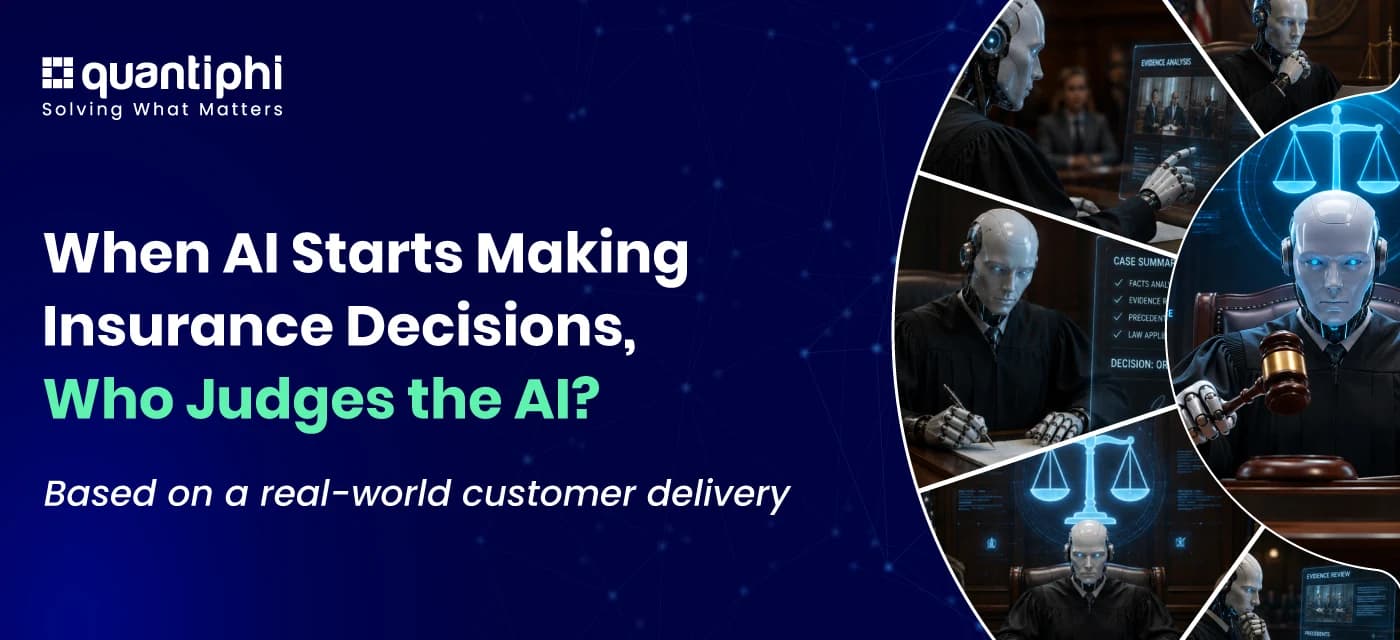
Rather than a single evaluator, the framework recreates the structure of a real courtroom.
Multiple independent models examine the evidence.
An impartial judge reviews their arguments.
A final verdict is delivered only after considering every perspective.
The result is an evaluation process that is significantly more balanced, transparent, and aligned with human judgment.
How LLM-as-a-Court Works?
The Jury
The framework begins with five independent LLMs, carefully selected from different model families to ensure genuine cognitive diversity.
Each juror independently evaluates the AI system’s response against predefined criteria, including:
- Groundedness
- Completeness
- Hallucination detection
- Overall quality
Every juror then:
- Assigns a score from 1 to 5
- Explains the reasoning behind the score
- Records any strengths, weaknesses, or inconsistencies observed
Because each model approaches the task differently, the evaluation captures multiple perspectives instead of a single model’s preferences.
The Judge
Once deliberation is complete, a highly capable state-of-the-art LLM assumes the role of the judge
Instead of generating a fresh opinion, the judge:
- Reviews every juror’s reasoning
- Identifies areas of agreement and disagreement
- Resolves conflicting viewpoints
- Produces a final score with a synthesized explanation
Separating deliberation from final judgment dramatically reduces individual model bias while producing evaluations that closely resemble expert human consensus.
The Business Impact
For the insurance organization, the courtroom approach transformed AI quality assurance.
-
Reduced Evaluation Bias
Combining diverse LLM architectures prevented any single model’s stylistic preferences from dominating the evaluation.
This significantly reduced false-positive scores and produced more balanced assessments.
-
Greater Explainability
Instead of receiving only a numerical score, engineering teams gained a detailed explanation of why each decision was made.
The synthesized reasoning simplified debugging, improved model alignment, and created a transparent audit trail for regulators.
-
Human-Level Evaluation Accuracy
Consensus across multiple models smoothed out statistical anomalies and isolated hallucinations that individual models occasionally overlooked.
The framework consistently produced evaluations closely aligned with human expert reviewers while eliminating the need for exhaustive manual labeling.
-
Faster AI Deployment
With greater confidence in automated evaluation, engineering teams could release updates more frequently, knowing subtle regressions would be detected before production.
This significantly accelerated the deployment cycle for agentic insurance applications.
-
Lower Quality Assurance Costs
By combining LLM-as-a-Court with intelligent sampling strategies, the organization achieved near-human evaluation quality at a fraction of the cost of reviewing every interaction manually.
Best Practices for Building an LLM-as-a-Court Framework
Organizations looking to implement this approach should consider a few key principles.
Build a Diverse Jury
Avoid using multiple versions of the same model family.
Instead, combine models from providers such as OpenAI, Anthropic, and Google to ensure genuinely independent perspectives.
Define Clear Evaluation Rubrics
Every juror should receive explicit scoring guidelines.
Clearly define what distinguishes a score of 1 from a score of 5 across metrics such as groundedness, completeness, factual accuracy, and hallucination detection.
Make the Judge a Synthesizer
The judge should not simply average numerical scores.
Instead, prompt it to identify patterns, reconcile disagreements, and generate an impartial conclusion based on the jurors’ reasoning.
Keep Humans in the Loop
No evaluation framework should operate indefinitely without oversight.
Regularly compare courtroom decisions against expert human evaluations to maintain alignment with business objectives and regulatory expectations.
A Practical Consideration: Managing Cost
Running six LLMs for every production interaction can become expensive.
Fortunately, organizations don’t need a full courtroom for every case.
Two practical strategies help optimize cost without sacrificing quality.
Batch Evaluation
Evaluate a statistically representative sample—typically 5–10% of production traffic—using the complete courtroom process to monitor overall system quality.
Trigger-Based Evaluation
Use a lightweight evaluator for routine monitoring.
Only escalate uncertain, borderline, or high-risk responses to the full LLM-as-a-Court framework for comprehensive review.
This hybrid approach balances evaluation quality with operational efficiency.
Final Thoughts
As agentic AI takes on increasingly critical responsibilities across insurance and financial services, evaluation becomes just as important as generation.
The question is no longer whether AI can make decisions.
The question is whether organizations can trust those decisions.
LLM-as-a-Court represents the next evolution in enterprise AI evaluation. By replacing a single evaluator with a structured, multi-model deliberation process, organizations gain stronger bias mitigation, richer explainability, improved regulatory defensibility, and evaluations that closely mirror human expertise.
In highly regulated industries, that’s not simply a technical advantage.
It’s becoming a business necessity.