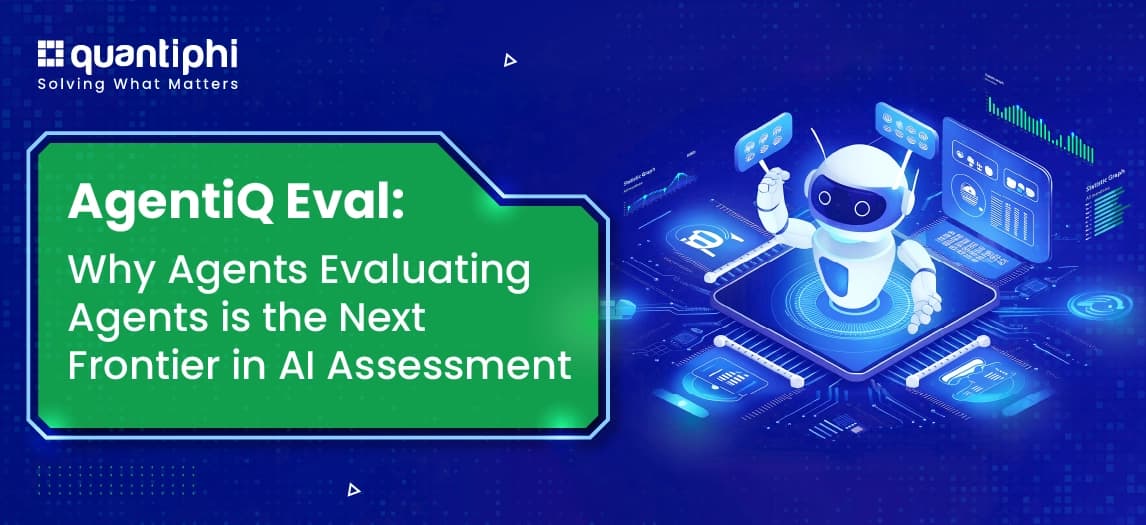
Why Agents Evaluating Agents is the Next Frontier in AI Assessment

The past few years have witnessed an unprecedented surge in the adoption of Large Language Models (LLMs). With GPT-3’s breakthrough in 2020 and the viral success of ChatGPT in late 2022, these systems demonstrated remarkable abilities in language understanding, reasoning, and generation.. Their rapid integration into products and workflows signaled a new era, where AI was no longer confined to static outputs but could handle open-ended, human-like tasks. It was only natural that this progression laid the foundation for something even more ambitious: AI agents; autonomous systems capable of perceiving their environment, making decisions, and executing multi-step actions to achieve complex goals.
The Rise of Agentic AI
Unlike traditional AI models that primarily provide static outputs based on specific inputs, agents exhibit a higher degree of autonomy, can reason over multi-step tasks, and interact dynamically with other systems or even humans. We’re moving beyond simple predictive models to sophisticated entities that can, for instance, autonomously manage intricate data analysis pipelines or even operate as virtual employees. Consider Walmart’s “Super Agents,” an initiative where AI agents are being deployed across various functions, from assisting shoppers with personalized recommendations and event planning to streamlining HR tasks for employees and optimizing operations for suppliers. This demonstrates a clear shift towards AI agents performing real-world, multi-faceted tasks in production.
This shift isn’t just theoretical; it’s a monumental wave of technological change backed by solid market data. Research firm Gartner predicts that by 2028, at least 15% of day-to-day work decisions will be made autonomously through agentic AI, a dramatic increase from virtually none today. The market for agentic AI is projected to soar from just under $14 billion in 2025 to over $140 billion by 2032, with an impressive Compound Annual Growth Rate (CAGR) of over 39%. However, this rapid ascent comes with a critical warning: Gartner also forecasts that more than 40% of agentic AI projects will fail by 2027 due to rising costs, unclear business value, and inadequate risk controls. This makes it clear that rigorous evaluation frameworks are essential to bridge the gap between potential and practical, ensuring agentic AI is deployed safely and effectively.
The urgency for a new evaluation paradigm is underscored by leading researchers who recognize that without it, the entire field is navigating blind. Without a reliable way to measure performance, a subtle flaw in an agent’s design could lead to a cascading failure with significant real-world consequences, eroding both business value and public trust. For instance, Gartner projects that by 2028, 25% of enterprise breaches will be tied to the misuse or abuse of AI agents, a stark reminder of the security and reputational risks at play.
Complex reasoning, emergent behavior, and unpredictable interactions make agents a challenge for conventional evaluation approaches. How do you rigorously assess a system that makes its own decisions over extended periods, whose behavior isn’t always fully predictable, and for which there’s no single “right answer” to compare against, especially when it’s operating in a live, constantly changing operational context? The next logical step, and perhaps the only truly scalable one, lies in the provocative idea of agents evaluating agents.
The Rise of LLMs in Evaluation: LLM-as-a-Judge
The emergence of Large Language Models (LLMs) has revolutionized how we approach evaluation, particularly for other LLMs. The sheer generative power and reasoning capabilities of LLMs allow them to act as “judges.”
LLM-as-a-Judge involves using one LLM to evaluate the output of another LLM (or even itself) based on predefined criteria and prompts. For tasks like summarization, translation, or creative writing, where a single “correct” answer is elusive, an LLM judge can assess:
- Fluency and Coherence: Does the generated text flow naturally and make logical sense?
- Relevance: Is the output pertinent to the given query or context?
- Factuality: Does the output contain factual inaccuracies or “hallucinations”?
- Adherence to Instructions: Does the output follow specific constraints or styles?
This approach offers significant advantages in scalability and speed compared to human annotation, though challenges like inherent biases within the judging LLM itself need careful consideration.
Justification for using LLMs as judges stems from their ability to approximate human judgment, particularly for the nuanced and open-ended nature of generative AI outputs. Traditional metrics like BLEU and ROUGE, while useful for specific aspects like n-gram overlap, often fall short in capturing semantic meaning, overall coherence, and contextual relevance, which are critical for truly evaluating generative models. For example, a generated sentence might use different phrasing than a reference but still convey the same meaning, a nuance that n-gram overlap metrics might penalize.
In contrast, LLMs possess a deeper understanding of language, allowing them to assess quality beyond surface-level matches. Research has increasingly demonstrated that LLM-based evaluations correlate well with human judgments across various natural language generation tasks. Studies show that for high-level quality criteria like relevance and coherence, LLM judges can achieve high agreement with human evaluators, sometimes even comparable to inter-human agreement. This strong correlation, coupled with the scalability that LLMs offer, makes them an increasingly viable and often superior alternative for evaluating the complex and subjective outputs of modern AI systems.
Why Usual Approaches Fail for Modern AI Agents
While LLM-as-a-Judge is powerful, it still operates within a relatively confined scope. The next generation of AI systems, AI agents, presents fundamentally new evaluation challenges that traditional methods struggle to address:
The Intricacies of Agentic Systems:
To understand the unique evaluation challenges of AI agents, it’s helpful to first consider their typical architectural components:
- Perception/Observation: This is how an agent takes in information from its environment, whether it’s reading a webpage, interpreting sensor data, or understanding a user’s natural language query.
- Memory/State Management: Agents need to remember past interactions, keep track of their progress on a task, and maintain a consistent internal state. This can range from short-term context to long-term memory.
- Reasoning/Planning: This is the “brain” of the agent, where it processes observations, consults its memory, formulates a plan to achieve its goal, and decides on the next action. This often involves chaining thoughts or breaking down complex problems.
- Action/Tool Use: Agents execute their decisions by taking actions in their environment. This might involve calling external tools or APIs (e.g., searching the internet, sending an email, interacting with a database, running code), generating a natural language response, or manipulating a physical system.
- Goal/Objective: The overarching aim or task that guides the agent’s entire behavior and against which its performance should ultimately be measured.
Why is Evaluating Agents Complex?
Traditional evaluation often tests these components in isolation: Is the perception module accurate at identifying objects? Does the tool call return the correct data? However, the true challenge arises from the sequential and interdependent nature of these components in a live agentic system. A subtle flaw or unexpected interaction within any single component can have a cascading effect, propagating errors through the entire decision-making process. For example, a minor misinterpretation by the Perception module could lead to a flawed entry in Memory, which then biases the Reasoning component towards an incorrect plan, ultimately resulting in an inappropriate or harmful action. This means that while individual components might appear to function correctly in isolation, their combined operation in dynamic, unscripted scenarios can lead to complex failures or unintended behaviors that are impossible to predict or pinpoint with isolated, static tests. This critical gap highlights why traditional methods, designed for more isolated and deterministic outputs, are fundamentally insufficient for evaluating complex agentic systems. Key reasons for this shortfall include:
Unlike even advanced Large Language Models (LLMs) that typically provide a single, reactive output to a given prompt, AI agents are designed to operate autonomously, making decisions, and performing a sequence of actions in dynamic, open-ended environments to achieve complex, multi-step goals. This means evaluation must consider the entire process an agent takes, its ability to adapt, and how it recovers from errors, rather than just assessing isolated outputs.
- Example: Automated Customer Support Agent.
- Traditional Evaluation (falls short): You might test if it correctly answers a single, isolated FAQ question (output accuracy of a simple query).
- Agent Challenge: The agent’s goal is to resolve customer issues efficiently and to their satisfaction, often across multiple turns and with evolving information. This requires a sequence of actions: understanding the initial problem, asking clarifying questions, searching a knowledge base, attempting initial troubleshooting steps, escalating to a human if necessary, and providing clear resolution. Crucially, its adaptability to unforeseen real-world changes in the environment like a new software bug appearing, a customer providing incomplete information, or a sudden surge in similar complaints is paramount. A static test set with predefined input-output pairs cannot capture this dynamic adaptability. Instead, an agent could be evaluated within a simulated customer service environment, which is simply a robust software system mimicking a real ticketing platform, customer interaction channels (chat, email), and a dynamic knowledge base. This allows for rigorous testing of the agent’s ability to adjust its problem-solving strategy, prioritize different actions, and recover from dead ends in response to continuous, unscripted customer interactions, far beyond what predefined, single-turn test cases can offer.
- Example: Multiple AI agents collaboratively
generating a complex software application.
- Traditional Evaluation (falls short): You might test an individual code generation agent for its ability to produce a correct function for a specific problem, or a single component’s adherence to specifications.
- Agent Challenge: Imagine an “architect agent” designing the system, a “backend agent” writing server code, a “frontend agent” building the user interface, and a “testing agent” writing unit tests. When these agents interact, iteratively generating, refining, and integrating code based on each other’s outputs and tests, unexpected interdependencies, integration bugs, or even novel, unforeseen architectural patterns can emerge from their collective efforts. These emergent issues or innovative solutions aren’t easily detectable with isolated tests on individual components; they arise from the dynamic, multi-agent development process. Evaluating this requires observing the full system’s evolution and functionality as a whole, rather than just individual code snippets.
Interactions between agents and their environment can lead to emergent behaviors that are difficult to predict or evaluate with pre-defined test cases.
Ensuring agents operate safely, ethically, and in alignment with human values in complex scenarios requires more than just checking for explicit biases in static datasets. It requires evaluating their decision-making processes and potential unforeseen consequences.
- Example: Financial Trading Agent with Ethical
Constraints- An investment agent autonomously trades and reallocates
portfolios.
- Traditional Evaluation (falls short): Standard eval measures profit vs. market baseline.
- Agent Challenge: A profit-maximizing agent might exploit insider-like loopholes, amplify market volatility, or recommend socially harmful but profitable investments (e.g., betting on food shortages). Traditional accuracy/profit metrics can’t evaluate whether the agent’s strategy aligns with ethical or regulatory standard, a subtle but critical dimension of safety.
For truly autonomous agents operating in novel situations, a human-annotated ground truth for every possible state and action sequence is practically impossible to obtain.
- Example: Scientific Discovery Agent- Agents
autonomously design experiments, run simulations, and propose new
hypotheses in materials science.
- Traditional Evaluation (falls short): You might benchmark whether it predicts known properties (e.g., tensile strength of tested alloys).
- Agent Challenge: For novel hypotheses, there is no ground truth and the discovery is genuinely new. Evaluating correctness by human-annotated labels is impossible. Instead, evaluation must shift toward plausibility, reproducibility, and usefulness to human scientists. Traditional metrics cannot measure these open-ended outcomes.
Agents Evaluating Agents
The logical progression is to leverage the very capabilities that define AI agents for their own evaluation. Agents evaluating agents proposes a paradigm where intelligent agents, equipped with their own reasoning, perception, and goal-oriented capabilities, become the primary evaluators of other agents.
Imagine a multi-agent simulation where:
- A “Tester Agent / Simulation Agent” is designed to probe the capabilities and limitations of a “Primary Agent.” This could involve creating challenging scenarios, injecting unexpected inputs, or even attempting adversarial attacks.
- A “Metric Agent” observes the interactions and behaviors of the Target Agent within the environment, assessing its performance against higher-level objectives (e.g., efficiency, robustness, adherence to ethical guidelines) that are difficult to quantify with simple metrics.
- A “Feedback Agent” could analyze the Target Agent’s performance and provide targeted feedback for improvement, potentially even suggesting modifications to its policy or architecture.
This paradigm offers several compelling advantages:
- Scalability: Evaluator agents can simulate vast numbers of diverse, dynamic scenarios at a scale impossible for human evaluators. This directly addresses the challenge of open-ended, goal-oriented autonomy, ensuring agents are tested on extended processes and varied conditions, not just isolated prompts.
- Holistic Assessment: Beyond final outputs, evaluator agents can assess how decisions unfold over time; adaptability, error recovery, and pursuit of multi-step goals. This ensures evaluation reflects the full decision-making process, not just endpoint accuracy.
- Probing Emergent Behavior and Edge Cases: By interacting adversarially or collaboratively with the target agent, evaluator agents can expose integration failures, unexpected interdependencies, or novel behaviors that static tests cannot anticipate. This directly addresses the emergence problem in complex systems.
- Safety and Alignment Verification: Evaluator agents can audit not just what decisions are made, but how they are reached detecting misaligned incentives, unsafe strategies, or ethically questionable shortcuts. This fills the gap where traditional metrics overlook unintended consequences.
- Evaluation Beyond Ground Truth: In domains without predefined answers (e.g., scientific discovery, creative design), evaluator agents can judge on dimensions such as plausibility, reproducibility, and usefulness. This makes it possible to evaluate progress even when no human-annotated ground truth exists.
While the concept of agents evaluating agents is still nascent, it represents a crucial shift in our approach to AI assessment. It acknowledges the inherent complexity of advanced AI systems and proposes a solution that leverages AI’s strengths to ensure the safety, reliability, and ultimate value of the intelligent agents we are bringing into existence. The evaluator, in this next era, will increasingly look like the evaluated.
But this raises the next big question: how do we actually begin building such evaluation systems in practice? In Part 2, we’ll explore preliminary approaches, practical design considerations, and early experiments that can guide us toward robust agentic evaluation frameworks.