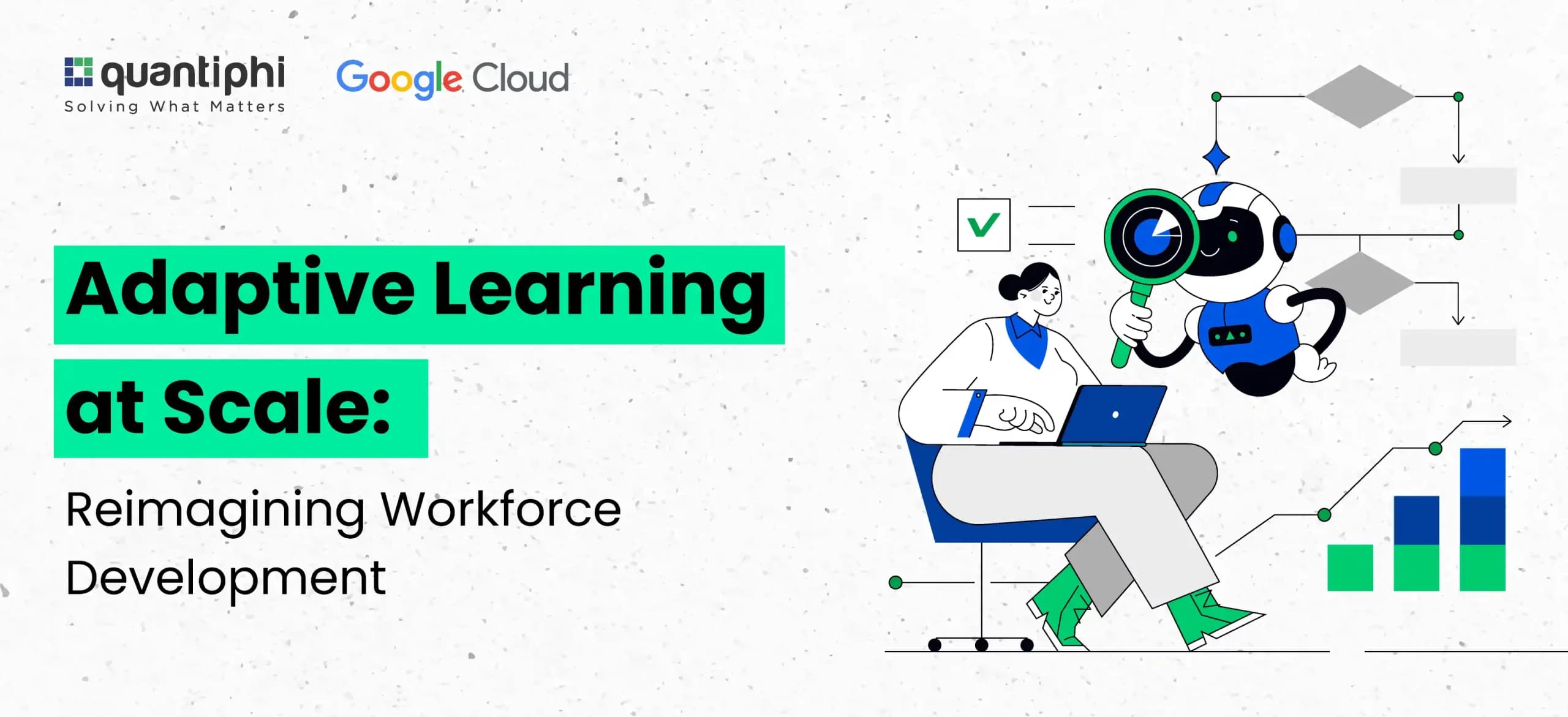
Adaptive Learning at Scale: Reimagining Workforce Development

Education and workforce development are at a turning point. While digital transformation has introduced new tools, most learning ecosystems still operate on standardized models designed for scale, not for people. Participants in workforce development programs often move through a set curriculum, regardless of skill differences, career goals, regional labor demand, or personal circumstances.
In a labor market defined by volatility and rapid skill evolution, this model no longer works.
Quantiphi, in partnership with Google Cloud, is addressing this gap with the Adaptive Workforce Intelligence Platform (AWIP), a data and AI-powered ecosystem designed to deliver dynamic, individualized learning journeys at scale. AWIP shifts the paradigm from program-centered administration to learner-centered intelligence.
The Structural Challenge: Standardization in a Dynamic Economy
Despite significant investment in education and workforce systems, fragmentation persists:
- Disconnected program operations across unemployment insurance, job training, and career services limit coordinated intervention.
- Static learning pathways fail to reflect individual strengths, pace, or long-term career aspirations.
- Data silos between Student Information Systems (SIS), Learning Management Systems (LMS), and workforce databases prevent unified learner visibility.
- Regional labor market variability demands localized skill strategies that many programs struggle to operationalize.
- Limited real-time performance tracking restricts early intervention.
- Minimal on-demand guidance leaves participants unsupported outside structured sessions.
The result is administrative efficiency without learner intelligence — a one-size-fits-all system in a labor market that requires precision targeting.
The Vision: Intelligent, Human-Centered Adaptation
Tomorrow’s workforce ecosystem must adapt to the individual and not force the individual to adapt to the system.
That transformation requires:
- Dynamic learning pathways aligned to career goals, skill gaps, and labor market demand
- Integrated cross-system data architecture to create a 360-degree learner profile
- Administrator intelligence dashboards with real-time visibility into participant progress
- Cross-agency interoperability linking workforce, economic development, and employer demand systems
- AI-powered 24/7 support for guidance, coaching, and contextual assistance
With AI embedded into the core architecture, learning becomes iterative, contextual, and continuously optimized.
The Foundation: A Unified Data and AI Architecture
Personalization at scale is impossible without data modernization.
AWIP is built on a unified data platform powered by Google Cloud, enabling agencies to:
- Aggregate SIS, LMS, unemployment insurance, apprenticeship, and workforce program data
- Build comprehensive learner intelligence profiles
- Leverage embeddings and vector search for contextual retrieval
- Train adaptive AI models on integrated, high-fidelity data
For Departments of Labor, this includes aligning:
- Unemployment Insurance data
- Workforce Innovation and Opportunity Act (WIOA) program outcomes
- Apprenticeship records
- Labor market information systems
By modernizing infrastructure first, agencies create the operational backbone required for scalable AI-driven adaptation.
From Tools to Ecosystem: The Evolution of Intelligent Learning
Early personalization efforts relied on rule-based systems that struggled to scale. Today’s generative AI capabilities unlock a fundamentally different model:
- AI Tutoring Engines that assess coursework, provide adaptive feedback, and recalibrate pathways
- Generative Learning Assistants that provide writing feedback, policy clarification, and service navigation
- Adaptive Workforce Intelligence Platform (AWIP) that orchestrates these capabilities into a unified, continuously learning ecosystem
Rather than layering AI onto legacy systems, AWIP embeds intelligence into the entire lifecycle of workforce engagement.
Measurable Impact Across the Workforce Lifecycle
AWIP delivers tangible outcomes for agencies, participants, and employers:
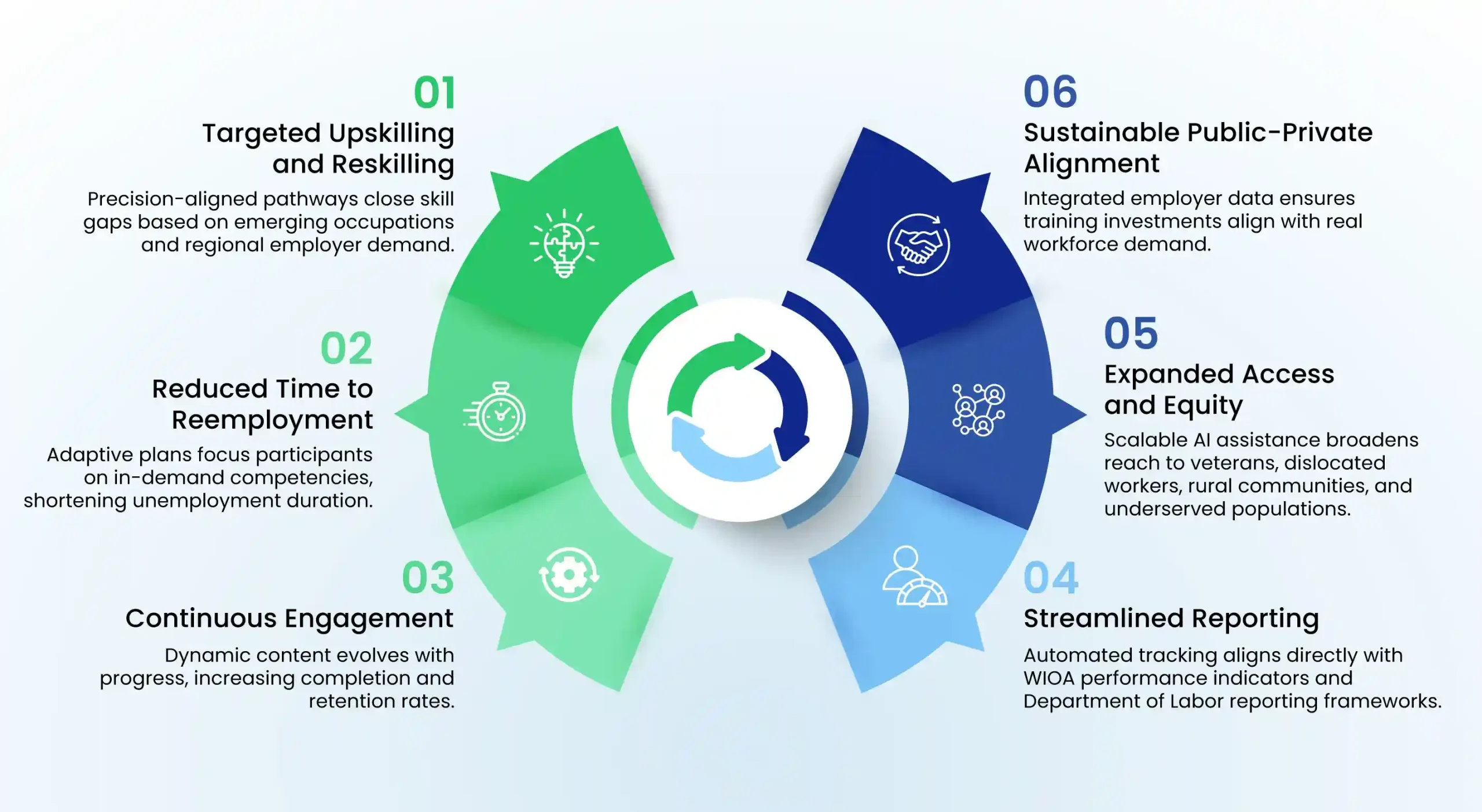
Platform Architecture and Core Components
AWIP is architected as a modular yet unified ecosystem:
-
Unified Data Intelligence Layer
Consolidates education, employment, and workforce datasets into a centralized knowledge base with embedding-driven contextual retrieval.
-
Adaptive AI Orchestration Layer
Uses APIs and generative models to create individualized learning plans, assessments, and feedback loops.
-
Intelligent Agent Framework
Built using Google Cloud’s Vertex AI and Gemini capabilities, enabling contextual support for learners and administrators through conversational interfaces.
-
Intuitive User Experience
Role-based portals allow participants to track progress, access adaptive content, and engage with AI-driven guidance seamlessly.
This architecture ensures scalability, security, interoperability, and compliance with federal standards.
Expected Outcomes for State Agencies
Organizations implementing AWIP can expect:
- Continuously adapting learning pathways
- Clear attribution and explainability of AI-generated guidance
- Built-in confidence scoring and error-handling safeguards
- Improved administrator productivity through actionable insights
- Higher participant engagement and program completion rates
- Stronger alignment between workforce investment and labor market outcomes
This is not incremental optimization, rather it is a structural modernization.
Why Quantiphi and Google Cloud
Quantiphi combines deep public sector modernization expertise with advanced AI engineering capabilities. With more than 50+ Packaged Industry Solutions and 2900+ Google Cloud-certified professionals, we architect platforms that are scalable, secure, and mission-aligned.
Google Cloud provides the secure, enterprise-grade foundation, including Vertex AI, Gemini models, and integrated data services required to operationalize adaptive intelligence at scale.
Together, we deliver not just technology implementation, but strategic workforce transformation.
Learn how Quantiphi and Google Cloud help enterprises engineer AI-native transformation at scale.
Shaping the Future of Workforce Development
Personalized learning is no longer aspirational; it is mission-critical. As labor markets evolve, state workforce agencies must shift from standardized program delivery to intelligent participant orchestration.
The Adaptive Workforce Intelligence Platform empowers agencies to unify data, embed AI, and place individuals at the center of workforce strategy. It transforms fragmented systems into coordinated, insight-driven ecosystems capable of responding to economic change in real time.
For Departments of Labor, this represents more than modernization. It is a strategic advancement of their mission to foster, promote, and develop the welfare of wage earners and job seekers nationwide.
The future of workforce development is adaptive. Learn how Quantiphi and Google Cloud will help reimagine public experience.