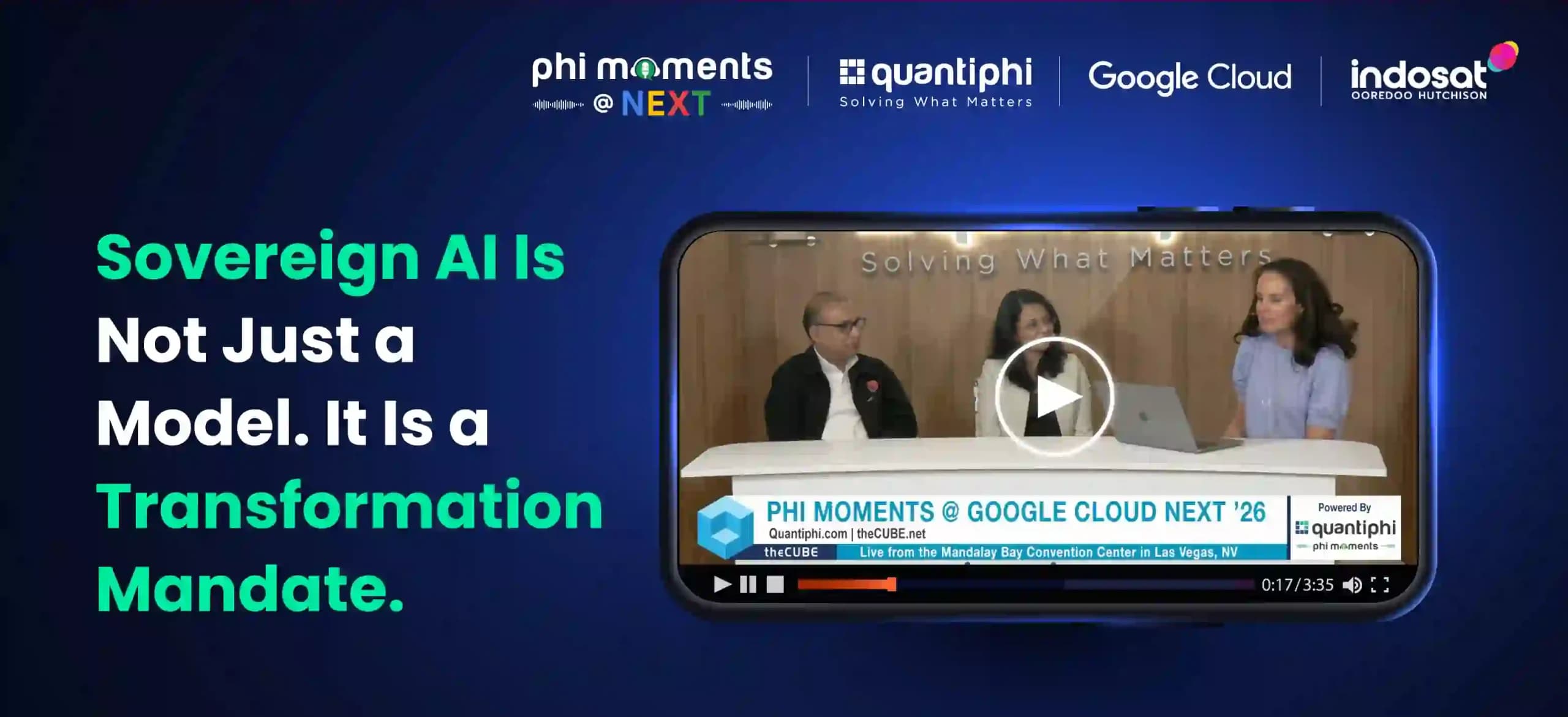
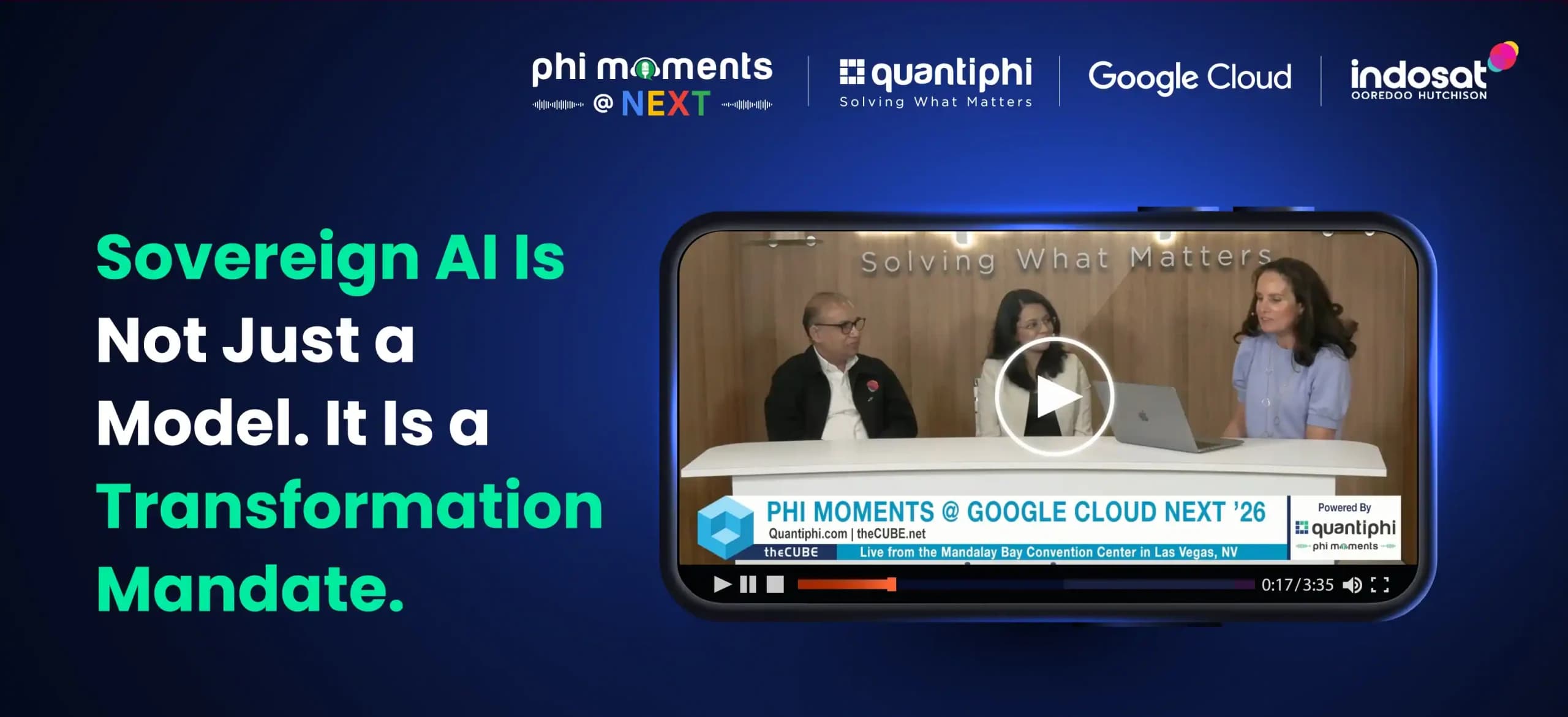
Sovereign AI Is Not Just a Model. It Is a Transformation Mandate

For many enterprises, AI transformation is measured in productivity gains, workflow improvements, customer experience, or operational efficiency.
For Indosat Ooredoo Hutchison, the ambition is larger.
As one of Indonesia’s leading digital telecommunications companies, Indosat serves a country spread across more than 17,000 islands. Its mission is to empower every Indonesian — across communities, businesses, educational institutions, and regions that have not always had equal access to technology.
That mission has shaped Indosat’s shift from a traditional telecom provider into a techco. It is also shaping how the company thinks about AI.
In a Phi Moments @ NEXT conversation from Google Cloud Next ’26, Vishal Gupta, Chief Techco Transformation and Procurement Officer at Indosat Ooredoo Hutchison, joined Harshini Infanta, Associate Practice Lead, Agentic Enterprise Intelligence at Quantiphi, to discuss what it takes to build an AI-first organization at national scale.
Their conversation surfaced a lesson that extends well beyond telecom:
AI-native transformation is not simply about deploying models, launching agents, or automating workflows. At national scale, AI has to reflect the language, culture, and everyday rhythms of the people it serves. It has to be trusted enough to become part of how people learn, work, build, and connect.
That is what makes Indosat’s journey so instructive.
Sovereign AI is not only a technical decision. It is a transformation mandate.
AI at national scale starts with purpose
The strongest AI transformations do not start with a model.
They start with a mission.
For Indosat, that mission is to empower every Indonesian. Historically, technology access was concentrated in major cities. But Indonesia is not a single-market, single-language, single-context operating environment. It is an archipelago with thousands of islands, diverse communities, and a need for technology that can serve people where they are.
That is why AI became central to Indosat’s shift from telco to techco.
In that context, AI becomes more than an enterprise productivity lever. It becomes a way to expand access, accelerate inclusion, and reimagine how digital services reach a national population.
For enterprise leaders, the lesson is clear: capability alone rarely creates transformation. The more important question is what mission the AI system is being built to serve.
When the ambition is national, the AI system cannot be generic.
It has to be deeply contextual.
Sovereign AI is about relevance
Sovereign AI is often discussed in terms of where data is stored, where models are hosted, or how infrastructure is governed.
Those questions matter. But Indosat’s journey points to a broader definition.
For Indosat, sovereignty is also about ensuring AI reflects the language, culture, and lived context of the people it is meant to serve.
At the center of that vision is Sahabat AI. It is not positioned as just a large language model. It is an ecosystem designed to bring Bahasa and AI together, preserve linguistic and cultural nuance, and power Indosat’s own applications as well as third-party use cases.
That nuance is important.
When AI systems are trained, translated, or interpreted primarily through outside contexts, they can miss local meaning. They may fail to capture cultural signals, linguistic subtleties, and the ways people actually communicate. For a country where Bahasa is central to daily life, that can shape whether AI feels relevant, accessible, and trustworthy.
Every enterprise may not be building AI for a nation of 17,000 islands. But every enterprise operates within a specific context — industry, geography, regulation, customer behavior, workforce culture, and business language.
AI systems that ignore that context may work in a demo.
They struggle in the real world.
National-scale AI needs an ecosystem
A powerful model does not create transformation on its own.
At national scale, AI needs an ecosystem around it: compute, data, platforms, governance, reusable components, engineering discipline, and the ability to make AI usable inside the applications and services people interact with every day.
This is where Harshini described Quantiphi’s role as an industrializer and co-architect alongside Google Cloud and Indosat.
Her framing was simple and memorable:
The analogy is easy to understand. Electricity did not transform daily life when it was novel and difficult to access. It transformed daily life when the grid made it dependable enough to become a utility.
AI is entering a similar phase.
The enterprises that create lasting value will not be the ones that simply showcase AI. They will be the ones that make AI dependable, embedded, and accessible enough that it becomes part of how people work, decide, interact, and live.
That requires partnership.
Google Cloud brings the computational foundation and integrated data and AI stack. Indosat brings the mission, local context, and market ambition. Quantiphi brings the engineering depth, accelerators, and implementation discipline to help turn that vision into systems that can scale.
For telecom leaders, this also points to a broader opportunity: AI can reshape customer care, network operations, service assurance, field productivity, and digital experiences when it is built around the realities of telecom operations.
Explore how Quantiphi supports AI-led transformation in telecom
The larger lesson applies across industries: AI transformation scales when the surrounding ecosystem makes the technology usable, trusted, repeatable, and valuable.
AI-first transformation is a leadership challenge
One of the strongest points in the conversation was Vishal’s view that bringing AI into an organization is not merely transformation.
It is reimagining.
AI-first transformation does not stop at adding copilots to existing teams or automating pieces of existing processes. It forces leaders to rethink how work happens, how decisions are made, how humans and agents interact, and how the organization manages control, accountability, and trust.
Vishal described a future where agent workers could outnumber human workers at Indosat within a few years. Whether or not every enterprise sees that exact ratio, the broader direction is clear: AI agents are moving from experiments to participants in enterprise workflows.
That changes the leadership challenge.
If agents can take action, trigger workflows, support decisions, and work across functions, organizations need more than technical deployment plans. They need governance structures. They need human-agent interfaces that feel safe. They need controls and guardrails. They need employees to understand how AI augments their work rather than threatens it.
Indosat approached that change from the top.
The company began with quarterly AI immersion sessions for its CXO group, then expanded the effort to 100 senior leaders, with the next 500 leaders also being brought into the journey. The goal was not simply to explain AI. It was to help leaders understand how the organization itself would behave differently in an AI-first future.
That is a useful reminder for any senior executive.
AI adoption cannot be delegated only to technical teams. If AI is going to change how the business operates, leadership has to understand it, shape it, and model the change.
Trust decides whether agents scale
Agentic AI raises the stakes for trust.
When AI systems are summarizing information or answering questions, trust matters. But when agents begin taking action, coordinating tasks, and supporting decisions, trust becomes foundational.
Harshini used a useful analogy: when driving a high-speed car, people often trust the brakes more than the engine.
That is exactly how enterprises need to think about agentic AI.
The power of the agent matters. But the controls matter just as much. Observability, standardization, governance, and clarity around what agents are expected to do become essential before organizations can scale confidently.
Vishal connected that trust imperative to another business reality: speed.
That is the balance every enterprise has to manage. The organization needs speed, but it also needs confidence.
Do employees trust the system enough to use it? Do leaders trust the controls enough to scale it? Do customers trust the experience enough to rely on it? Does the business trust the outputs enough to act?
Without that confidence, AI remains trapped in experimentation.
With it, AI can begin to reshape how the enterprise works.
Adoption-led engineering makes AI real
The most elegant AI system does not matter if people do not use it.
That is why Harshini’s principle of adoption-led engineering is so important. Engineering is in service of adoption. That does not mean engineering comes later. It means adoption has to be designed into the system from day zero.
Too often, organizations build around technical possibility first and user reality second. They ask what the model can do before asking how the person, team, or process will actually change.
That can produce impressive pilots but weak adoption.
Indosat’s journey points to a more practical approach: start with the user, understand the task, build for trust, design for modularity, standardize where it matters, and measure ROI from the beginning.
This is also where platform-led thinking becomes important.
If every AI initiative is built as a one-off, the enterprise ends up with fragmented experiments. A platform-led approach creates reusable foundations, components, and governance patterns that help teams build faster without starting from scratch each time.
With Gemini Enterprise accelerating this approach, the opportunity is not just to build individual agents. It is to democratize agent development across the enterprise in a way that is governed, modular, and aligned to business outcomes.
That is what separates AI activity from AI transformation.
One creates scattered motion.
The other creates repeatable progress.
What enterprise leaders can take from Indosat
Indosat’s transformation is specific in its context, but the lessons are broadly relevant.
- Start with a mission, not a model.
AI needs a purpose larger than deployment. For Indosat, that purpose is empowering every Indonesian. For another enterprise, it may be improving access to care, transforming customer experience, accelerating claims, modernizing operations, or creating new digital services. - Build for context from day zero.
AI systems need to reflect the realities of the people, markets, workflows, and cultures they serve. Generic AI may start the journey. Contextual AI creates the advantage. - Treat AI-first transformation as organizational redesign.
If AI agents are going to participate in enterprise workflows, the organization has to rethink how humans and agents work together. - Design for trust before scale.
Observability, standardization, guardrails, and human oversight are not barriers to AI adoption. They are what make adoption possible. - Measure adoption and ROI from the beginning.
Enterprise AI cannot rely on excitement alone. Leaders need to know where value is expected, how adoption will be measured, and how ROI will be tracked. - Build with partners who share ownership.
A transformation of this scale cannot be outsourced in the traditional sense. It requires collaborative ownership across the enterprise, technology partners, and implementation teams.
That is what makes the Indosat, Google Cloud, and Quantiphi partnership meaningful. It is not just about delivering technology. It is about co-architecting change at scale.
The next phase of AI-native transformation
Indosat’s story is bold because the ambition is bold.
It is not simply about becoming more efficient. It is about using AI to extend digital capability across a nation, preserve local context, redesign the organization, and build trust in a future where humans and agents work together.
That is what makes it relevant beyond telecom.
Every enterprise leader now faces a version of the same challenge: how to move fast without losing trust, how to scale AI without making it generic, and how to turn ambition into adoption and measurable impact.
The answer is not a single model.
It is a transformation system built on context, platform thinking, governance, adoption, and collaborative execution.
That is the real lesson from Indosat’s AI-first journey.
Sovereign AI is not just about where AI lives.
It is about who it serves, how deeply it understands them, and whether the organization around it is ready to make it real.
Explore more
Read the SiliconANGLE article
For the full interview recap and Indosat’s AI-first transformation story.
Watch the Phi Moments @ NEXT conversation
Hear Indosat and Quantiphi discuss sovereign AI, national-scale transformation, and the operating model shift behind agentic AI.
Explore Quantiphi + Google Cloud
Learn how Quantiphi and Google Cloud help enterprises engineer AI-native transformation.
Explore Agentic AI Solutions
See how Quantiphi helps enterprises design, govern, and scale AI agents across real business workflows.