Apache Iceberg: Building Future-Ready Data Foundations with Quantiphi and AWS


In the rapidly evolving landscape of data engineering, the focus has shifted from merely collecting data to building robust, scalable, and reliable platforms that deliver actionable insights. At Quantiphi, we specialize in architecting and implementing cutting-edge data solutions that transform complex, on-premises infrastructures into agile, cloud-native powerhouses. This post delves into our approach to leveraging Apache Iceberg on AWS, showcasing how we empower enterprises to build production-grade lakehouses that drive innovation and operational excellence.
In this blog, we explore how Apache Iceberg, combined with AWS and Quantiphi’s engineering expertise, enables enterprises to build production-grade lakehouses that are scalable, governed, and AI-ready.
What is Apache Iceberg? The Foundation for a Modern Data Lakehouse
At the heart of a high-velocity data strategy lies a powerful, open-source table format. Apache Iceberg delivers the data warehouse-level reliability and performance to massive analytic datasets stored in object storage. Think of it as the intelligent management layer that sits between the raw data files and the analytics tools. It allows multiple engines—like Snowflake, AWS Athena, and Spark—to safely read and write to the same data at the exact same time without corruption or performance lag.
Unlike traditional Hive-style table formats that rely on directory structures, Iceberg uses a sophisticated metadata layer to manage table state, schema evolution, partition evolution, and hidden partitioning, making data lakes more robust, flexible, and easier to manage for complex analytical workloads.
How Does Apache Iceberg Work? The Technical Anatomy of an Iceberg Table
Iceberg’s strength lies in its snapshot-based metadata design. Instead of relying on directory structures, Iceberg maintains an immutable tree of metadata files, providing a consistent and reliable view of the table state.
-
Snapshots
Every data modification (insert, update, delete) creates a new, atomic “Snapshot.” This enables powerful features like Time Travel (querying data as it existed at any point in time) and Rollbacks (reverting to a previous state) without data duplication. Each snapshot points to a specific manifest list.
-
Manifest Lists
These files track which manifest files belong to a particular snapshot. They also store aggregate statistics, such as partition ranges and row counts, crucial for query optimization.
-
Manifest Files
These are the granular trackers, listing individual data files (e.g., Parquet, ORC) that constitute the table. Critically, manifest files store column-level min/max statistics for each data file. This enables query engines like Amazon Athena and Apache Spark to perform “data skipping,” ignoring entire files if their metadata indicates they don’t contain relevant data.
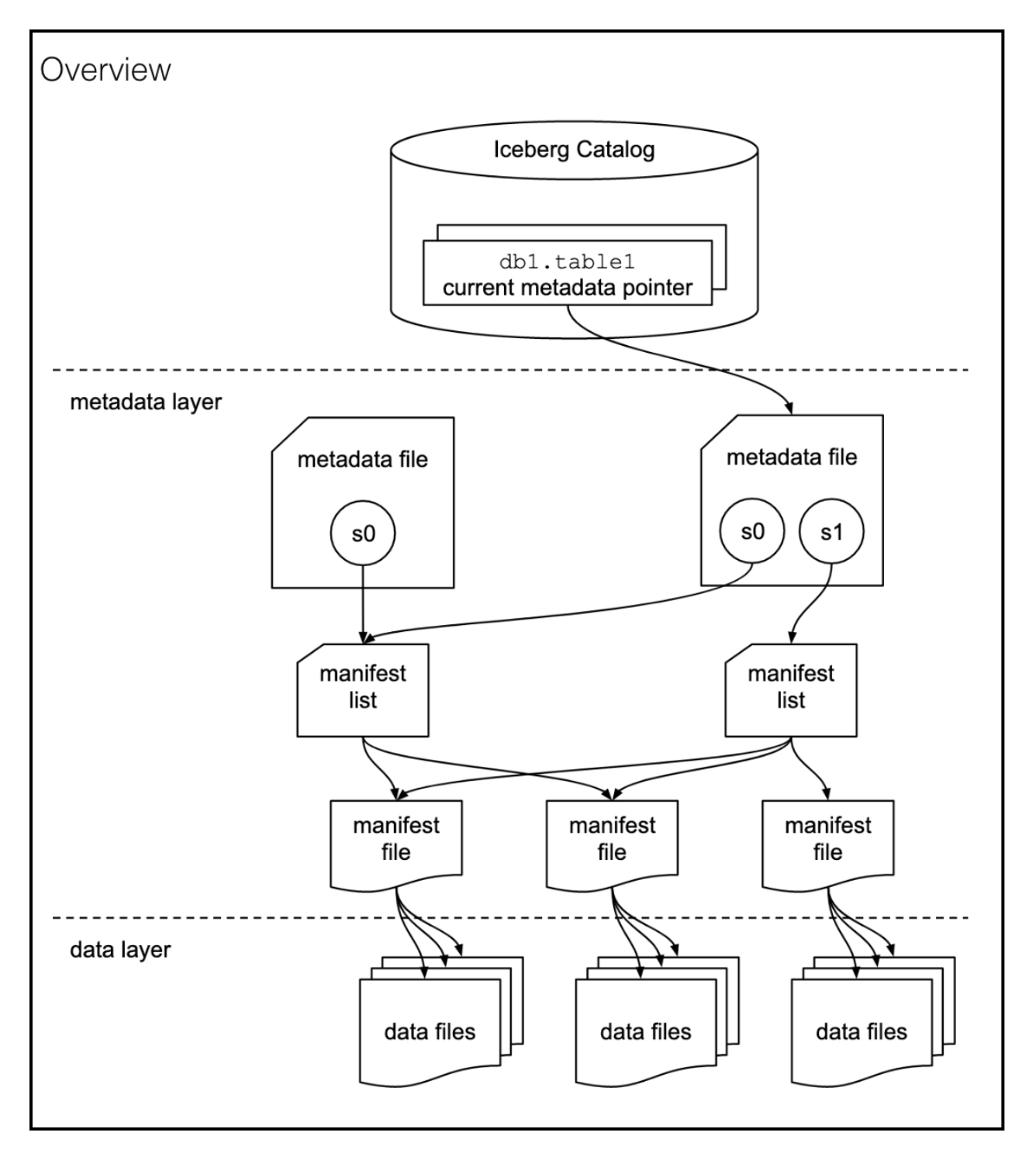
Figure 1: Apache Iceberg Anatomy
Key Advantages of Apache Iceberg Over Legacy Data Lake Formats:
-
ACID Transactions
Iceberg delivers full ACID (Atomicity, Consistency, Isolation, Durability) guarantees to your data lake. This means concurrent writes are handled reliably, and data integrity is maintained even during failures, a critical feature for production workloads.
-
Schema Evolution
Iceberg supports schema changes (adding, dropping, reordering, or renaming columns) without requiring costly data rewrites or downtime, simplifying data governance and adaptation to evolving business needs.
-
Partition Evolution
The ability to change partitioning strategies (e.g., from daily to hourly) without rewriting existing data is a game-changer. Iceberg allows new data to adopt the updated partition scheme while old data remains accessible under its original partitioning.
-
Hidden Partitioning
Iceberg abstracts the physical partition layout from users. Data engineers define partitioning rules (e.g., days(event_timestamp)), and Iceberg handles the underlying file organization, preventing common “partition mismatch” errors and simplifying query logic.
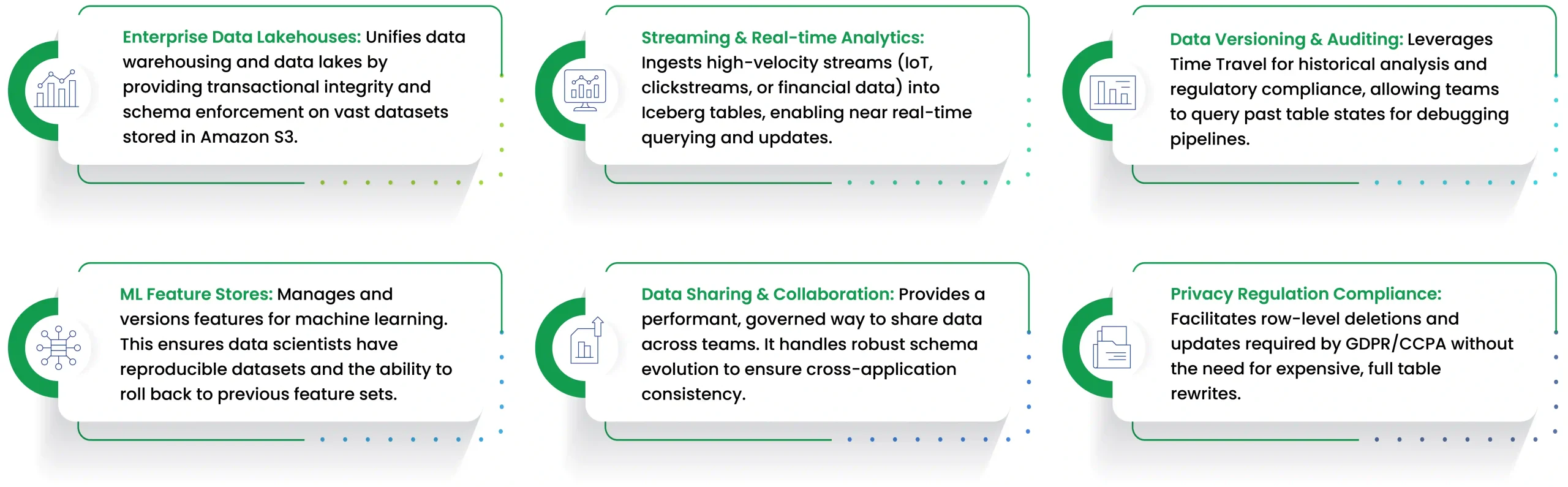
What are Common Use Cases for Apache Iceberg?
Apache Iceberg is ideally suited for scenarios demanding high reliability, performance, and flexibility in data lakes. Common use cases include:
Quantiphi’s Solution: Building an AWS-Native Iceberg Lakehouse
At Quantiphi, we understand that a robust data platform requires more than just a powerful table format; it demands seamless integration with a scalable, secure, and cost-effective cloud ecosystem. Our solution leverages the full power of AWS services to build production-grade Iceberg lakehouses.
AWS Glue Data Catalog: The Central Nervous System
The AWS Glue Data Catalog is central to our Iceberg implementations. It acts as the metadata repository for Iceberg tables and, crucially, as the Lock Manager for concurrent write operations. This ensures transactional integrity across your data lake.
-
Optimistic Locking
When multiple applications attempt to write to the same Iceberg table, Glue’s optimistic locking mechanism ensures that only one transaction succeeds, preventing data corruption.
-
Code Snippet: Configuring Spark for AWS Glue Catalog Integration
Our PySpark-based ETL pipelines are configured to seamlessly interact with Iceberg tables managed by the AWS Glue Data Catalog:
from pyspark.sql import SparkSession
# Initialize SparkSession with Iceberg and AWS Glue Catalog configurations
spark = SparkSession.builder \
.appName("QuantiphiIcebergLakehouse") \
.config("spark.sql.catalog.glue_catalog", "org.apache.iceberg.spark.SparkCatalog") \
.config("spark.sql.catalog.glue_catalog.catalog-impl", "org.apache.iceberg.aws.glue.GlueCatalog") \
.config("spark.sql.catalog.glue_catalog.io-impl", "org.apache.iceberg.aws.s3.S3FileIO") \
.config("spark.sql.catalog.glue_catalog.lock-impl", "org.apache.iceberg.aws.glue.GlueLockManager") \
.config("spark.sql.extensions", "org.apache.iceberg.spark.extensions.IcebergSparkSessionExtensions") \
    .getOrCreate()

# Example: Creating an Iceberg table using the Glue Catalog
# This table would typically be part of our Curated or Aggregated layers
spark.sql("""
CREATE TABLE glue_catalog.quantiphi_manufacturing_db.production_metrics (
metric_id BIGINT,
facility_id STRING,
timestamp TIMESTAMP,
value DOUBLE
    		) USING iceberg
PARTITIONED BY (days(timestamp), facility_id)
LOCATION   's3://quantiphi-data-lake-bucket/curated/production_metrics'""")
AWS Glue Automatic Table Optimization for Iceberg
A common challenge in data lakes is the “small file problem,” which degrades query performance. AWS Glue’s automatic table optimization for Iceberg is a cornerstone of our solution, ensuring optimal performance and cost efficiency.
-
Managed Compaction
Glue automatically merges numerous small data files into larger, query-optimized files (typically 128MB–512MB). This significantly reduces metadata overhead and improves query speeds.
-
Snapshot Retention
Old, unreferenced snapshots and their associated data files are automatically deleted, leading to substantial cost savings on Amazon S3 storage.
-
Orphan File Deletion
Glue cleans up “orphan” files—data files no longer referenced by any Iceberg snapshot—maintaining a clean and efficient data lake.
Comprehensive AWS Integration:
Quantiphi’s Iceberg Lakehouse solution integrates seamlessly with a suite of AWS services:

Amazon S3

Amazon Athena

Amazon EMR

AWS Glue ETL

AWS Lake Formation

Amazon Managed Workflows for Apache Airflow
Best Practices for a Production-Grade Iceberg Lakehouse on AWS
Drawing from our extensive experience at Quantiphi, these best practices are fundamental for building high-performance, reliable, and cost-efficient Iceberg lakehouses:
Data Storage and Performance Optimization
-
Optimal Compression
We recommend Zstandard (ZSTD) compression for Parquet files. It offers an excellent balance between compression ratio and read performance, outperforming Gzip or Snappy for most analytical workloads.
-
Leverage Hidden Partitioning
Always use Iceberg’s transform functions (e.g., days(timestamp_col), bucket(N, id_col)) for partitioning. This abstracts the physical layout, simplifies queries, and enables partition evolution without user intervention.
-
Iceberg v2 for Transactional Workloads
For tables requiring row-level UPDATE, DELETE, or MERGE operations, always create them as Iceberg v2 tables. This enables “Merge-on-Read” capabilities, essential for transactional data quality and compliance.
-
Target Optimal File Sizes
Aim for data file sizes between 128MB and 512MB. AWS Glue’s automatic optimization helps manage this, but initial ingestion strategies should also consider file size.
-
Consider S3 Express One Zone
For ultra-low latency access to frequently queried Iceberg tables, especially for metadata-intensive operations, S3 Express One Zone can significantly reduce latency and improve query performance.
Security, Governance, and Observability
-
AWS Lake Formation for Fine-Grained Access Control
Implement AWS Lake Formation to centralize security and provide granular access control. This is critical for multi-tenant environments and ensuring compliance with data privacy regulations.
-
IAM Roles and Policies
Adhere strictly to the principle of least privilege by using IAM roles for all AWS services interacting with your Iceberg lakehouse.
-
Comprehensive Monitoring
Utilize Amazon CloudWatch for detailed monitoring of ETL job health, S3 bucket metrics, Athena query performance, and Glue Catalog operations. Integrate with AWS X-Ray for distributed tracing in complex pipelines.
-
Automated Orchestration
Orchestrate your Iceberg ETL pipelines using AWS Step Functions or Amazon MWAA for robust error handling, retries, and dependency management, ensuring operational resilience.
How Quantiphi Modernized Manufacturing Data Platforms Using Apache Iceberg
Quantiphi recently partnered with a manufacturing leader facing significant data challenges. Their legacy infrastructure comprised multiple regional Oracle databases and complex, manually managed Talend ETL pipelines across seven manufacturing sites. This resulted in operational silos, limited global visibility, and severe scalability constraints.
The Quantiphi Solution: A Unified, Cloud-Native Data Lakehouse
Our team designed and implemented a unified, cloud-native lakehouse on AWS, powered by Apache Iceberg, enabling scalable, transactional analytics across the enterprise.
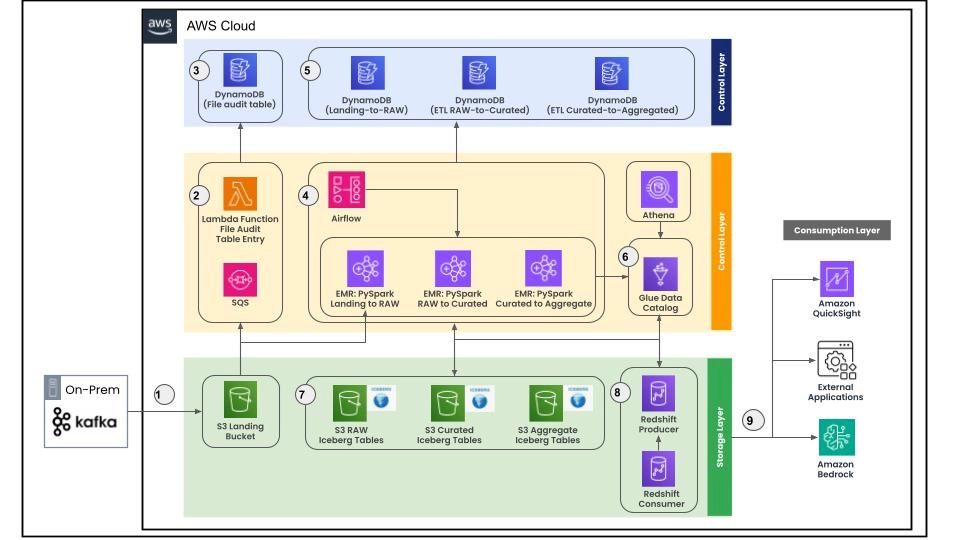
Figure 2: AWS Native Iceberg Data Lakehouse
Architecture Highlights:
-
Data Ingestion
We leveraged self managed Kafka Data Collector to securely stream operational data (production metrics, equipment telemetry, yield data) from on-premises facilities into dedicated Amazon S3 landing buckets. This decoupled on-premise systems and enabled near real-time data availability.
-
ETL Pipeline Modernization
We replaced the brittle Talend pipelines with a metadata-driven PySpark ETL framework running on AWS Glue ETL jobs and Amazon EMR. This framework used JSON configurations to define data sources, transformations, and target Iceberg tables, drastically reducing development time and operational overhead.
{ "pipeline_name": "manufacturing_yield_processing", "source_layer": "raw", "source_table": "raw_yield_data", "target_layer": "curated", "target_table": "curated_yield_metrics", "transformations": [ {"type": "filter", "condition": "yield_rate > 0"}, {"type": "deduplicate", "keys": ["batch_id", "sensor_id", "timestamp"]}, {"type": "enrich", "lookup_table": "facility_master", "join_key": "facility_id"} ], "iceberg_properties": { "write.format.default": "parquet", "write.metadata.delete-after-commit.enabled": "true", "format-version": "2" }, "write_mode": "upsert", "partition_strategy": "days(event_timestamp)" } -
This generic framework allowed us to rapidly onboard new datasets and apply consistent data quality rules across all manufacturing sites.
-
Medallion Architecture with Iceberg
We implemented a Medallion Architecture (Raw, Curated, Aggregated layers) using Iceberg tables:
- Raw Layer: Append-only Iceberg tables for raw, immutable data from landing s3 bucket.
- Curated Layer: Iceberg v2 tables for cleaned, validated, and schema-standardized data, supporting ACID updates for data quality fixes.
- Aggregated Layer: Iceberg v2 tables for business-ready datasets, optimized for high-performance analytics via Athena and Redshift Spectrum.
Transformative Business Outcomes:
The Quantiphi solution delivered significant improvements for the customer:
- Centralized Global Visibility: Seven regional data silos were consolidated into a single, unified cloud-native data platform, providing a holistic view of manufacturing operations worldwide.
- Enhanced Scalability: The architecture now effortlessly handles massive volumes of high-velocity telemetry data, which previously overwhelmed their on-premises Oracle instances, ensuring future growth without infrastructure bottlenecks.
- Improved Operational Efficiency: We achieved a 30-45 minute end-to-end SLA for data availability from source to analytics-ready tables. This enabled faster reaction times for identifying and addressing critical yield issues on the factory floor.
- Cost Optimization: Leveraging Amazon S3 with optimized Parquet storage and serverless query engines significantly reduced infrastructure and operational costs compared to their legacy systems.
- ACID Data Management: Apache Iceberg provided reliable data updates and transactional guarantees, ensuring data quality and consistency across all analytical datasets.
Summary
Apache Iceberg on AWS, when implemented with a strategic approach like Quantiphi’s, is a game-changer for modern data platforms. By combining Iceberg’s transactional capabilities with the scalability, security, and managed services of AWS, organizations can build true cloud-native lakehouses that are both infinitely scalable and database-reliable. This empowers businesses to unlock timely, accurate insights, driving operational efficiency, fostering innovation, and maintaining a competitive edge in today’s data-driven world.