Bridging the Gap: How AI Simplifies HL7 v2/v3 to FHIR Conversion for Healthcare Providers

Introduction
Healthcare systems are built on data. But in too many organizations, that data is locked in outdated HL7 v2 and v3 message formats—fragmented, inconsistent, and hard to scale. Meanwhile, FHIR (Fast Healthcare Interoperability Resources) has become the go-to standard for modern data exchange, driven by mandates from CMS and ONC and the need to support advanced health analytics platforms offered by major cloud providers like AWS HealthLake, Azure Health Data Services, and Google Cloud’s Health Data Engine.
But moving from HL7 v2/v3 to FHIR is no small task. It’s a complex, messy process that demands significant effort and resources. That’s where an AI-powered transition can make a difference—helping organizations move faster, work smarter, and get to a more interoperable data foundation without overhauling everything at once.
Why Moving from HL7 v2/v3 to FHIR is Critical for Modern Healthcare
FHIR isn’t just a compliance step—it’s a modern data standard designed for real-time insights, advanced analytics, and seamless data sharing across systems. Yet many health systems still rely on older HL7 v2 or v3 messages.
HL7 v2 is flexible but loosely structured, which leads to wide variation in how it’s implemented. Even within the same hospital, different departments often customize messages differently. That variation makes migrating to FHIR difficult. Poorly mapped data can result in duplicate work, incomplete analytics, or compliance issues.
HL7 v3 was created to be more consistent and structured than v2, but its complexity made real-world implementation difficult. While some national programs adopted v3—such as Canada Health Infoway—widespread adoption, especially in the U.S., was limited. Many organizations found it too rigid and hard to integrate with modern development workflows.
Moving to FHIR means shifting from fragmented, legacy data formats to a unified standard that supports modern interoperability goals. But mapping older HL7 data to FHIR—especially with custom v2 implementations—can be slow, manual, and resource-heavy without the right tools and support.
Smarter Mapping for HL7 v2/v3-to-FHIR Conversion
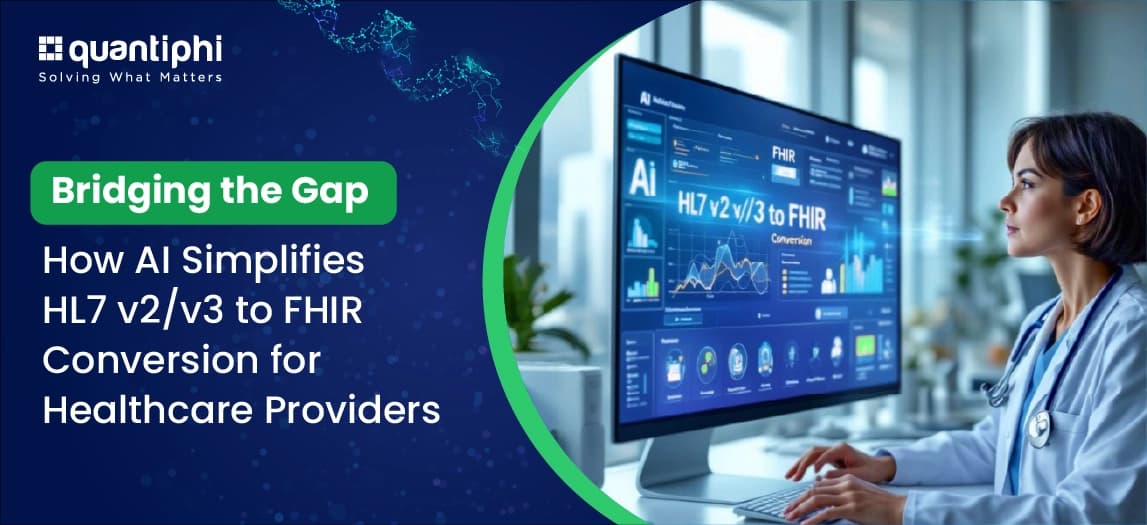
AI makes the conversion process faster and more adaptable by analyzing your historical HL7 v2 and v3 messages to generate accurate FHIR mapping specifications. This reduces weeks of manual work and helps account for the unique ways your systems handle data.
Our AI-powered workflows go beyond initial setup. They monitor for changes over time—like newly populated fields or format shifts—and help keep your mappings and documentation up to date, reducing maintenance burden and ensuring downstream systems remain reliable.
At Quantiphi, we combine pre-trained models with custom training on your data, and use proprietary tools like Codeaira to automate mapping logic and integration development—helping teams adopt FHIR efficiently and with confidence.
Enrichment and Compliance, Handled Responsibly
In some cases, a message alone may not contain everything needed to generate a complete FHIR resource. We’re able to create intelligent enrichment workflows that detect those gaps and automatically pull in missing information from the source system—helping meet requirements like patient summary generation for compliance use cases.
This approach is especially useful for health systems working with legacy EMRs or limited APIs. And we don’t just enrich—we maintain data provenance, so it’s always clear what came from the original message and what was added later. All enrichment is handled downstream, using clearly defined rules and guardrails—ensuring transparency, accountability, and patient safety remain at the forefront.
Ensuring Data Security and Compliance in HL7 to FHIR Conversion
At Quantiphi, data security isn’t an afterthought—it’s foundational. Our AI models are trained in secure, compliant environments that meet HIPAA, SOC 2, and HITRUST standards. During training, we apply strict access controls and data anonymization protocols to safeguard patient information.
Once the mappings are created, the conversion itself is executed by production-ready integration code—not the AI models. But that code runs in cloud environments architected for healthcare-grade compliance, with end-to-end security measures in place to protect data in transit and at rest.
Whether you’re mapping historical messages or integrating new real-time streams, we ensure the entire process—from AI training to deployment—is designed with security and compliance built in.
Real-World Impact: What AI-Enabled Conversion Delivers
- Faster Implementation: Automating mappings and validation cuts down the time needed to modernize your data exchange.
- Cost Savings: AI-driven workflows reduce the manual effort that’s typically the biggest driver of costs in HL7 v2/v3-to-FHIR projects.
- Improved Data Quality: AI can catch inconsistencies and fill gaps that might go unnoticed in manual efforts—giving you a cleaner, more accurate data foundation.
- A Better Platform for What’s Next: With your data in FHIR format, you’re set up to take advantage of modern analytics, unified patient data platforms, and longitudinal health insights—powering everything from real-time clinical decisions to population health management.
AI-Powered Solutions From A Proven, Trusted Partner
Our approach doesn’t just rely on off-the-shelf models. We work with you to integrate AI into your workflows, using your historical data and system nuances to build customized conversion pipelines. We also test and validate using synthetic data, so you can be confident in the integrity and completeness of your converted data before it’s put into use.
At Quantiphi, we bring the experience of 2,500+ implementations including healthcare and life sciences enterprises, along with the expertise that comes from being an award-winning preferred partner to AWS, Google Cloud, NVIDIA and Microsoft Azure. This means you’re working with a team that understands the unique challenges of health data modernization—and how to address them with secure, compliant, and adaptable AI solutions.
Get Started on Your FHIR Journey with Quantiphi
The move to FHIR isn’t just about meeting compliance deadlines. It’s about giving your teams the ability to work with modern data standards and take advantage of new analytics tools and interoperability platforms.
If you’re ready to modernize your clinical data exchange and move beyond legacy HL7’s limitations, Quantiphi can help you get there—faster, smarter, and more securely.
📩 Reach out to appliedai@quantiphi.com or visit quantiphi.com to learn more and request a discovery workshop.
Let’s start building your foundation for the next era of healthcare data.