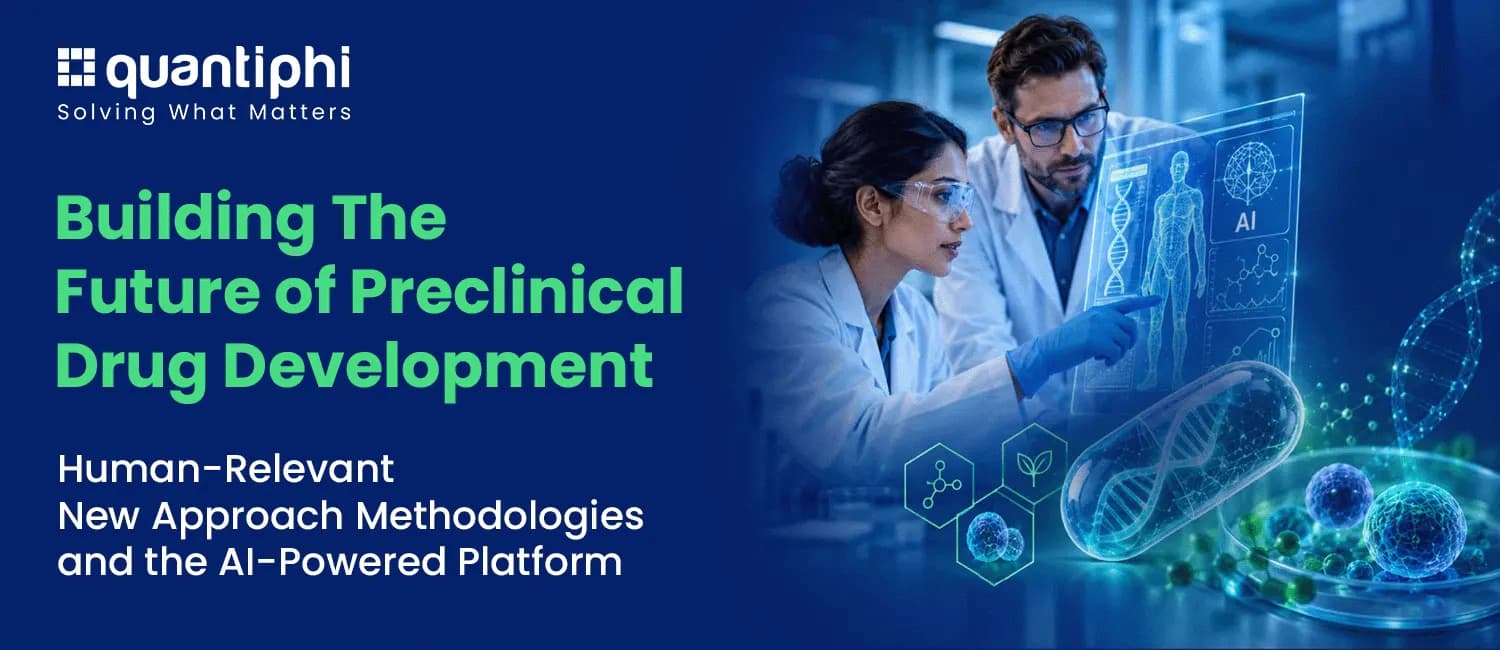
Building The Future of Preclinical Drug Development: Human-Relevant New Approach Methodologies and the AI-Powered Platform

Executive Summary
Preclinical drug development historically relies on animal testing, a process burdened by high costs, long timelines, and an attrition rate exceeding 90% in human clinical trials. To overcome this translation gap, Quantiphi and Transcell Biologics co-developed Digital Animal Replacement Technology (DART), a hybrid bio-computational platform that integrates stem cell-derived human Microphysiological Systems (MPS) with biology-informed, explainable AI architectures. This technological shift aligns with recent regulatory mandates, including the FDA Modernization Acts 2.0 and 3.0 and European Parliament resolutions, which phase out animal testing requirements and formally recognize New Approach Methodologies (NAMs) as valid nonclinical pathways.
DART directly resolves major industry adoption barriers—such as dataset variability across labs, small-data overfitting, and non-transparent “black box” predictions—by delivering mechanistic clarity, feature-level explainability, and pathway-informed modeling. Its applications span cardiotoxicity prediction, immunogenicity assessment, neurovirulence risk evaluation, and IND qualification using human-relevant models. As emerging innovations like organ-level digital twins and AI-driven inverse design continue to transform pharmaceutical R&D, adopting human-relevant bio-computational platforms enables organizations to minimize early pipeline risks, eliminate costly late-stage failures, and significantly compress development timelines.
What if we could accelerate preclinical drug safety and efficacy testing using human-relevant models instead of animals?
That question sits at the heart of a recent episode of Phi Moments, Quantiphi’s podcast exploring how AI is reshaping enterprise transformation in life sciences. In Episode 2, leaders from Quantiphi and Transcell Biologics examined one of the most consequential shifts in modern R&D: the move from traditional animal-based preclinical testing toward human-relevant platforms powered by artificial intelligence.
The conversation did not stay at a conceptual level. It tackled real-world barriers including fragmented biological datasets, explainability challenges in AI models, and regulatory requirements for validation and transparency. At the center of the discussion was DART, a next-generation platform integrating stem cell-based human models with explainable, hybrid AI architectures.
Watch the full conversation below to hear directly from the scientists and industry leaders shaping this transformation.
Why Preclinical Testing Is at an Inflection Point
Developing drugs historically relies heavily on preclinical animal testing, a process plagued by high costs, long timelines, and a major translation gap; over 90% of drugs that pass animal trials fail in human clinical studies due to unexpected toxicity or lack of efficacy.
Co-developed by Quantiphi and Transcell Biologics, Digital Animal Replacement Technology (DART) as a web solution addresses this bottleneck by combining stem cell-derived human Microphysiological Systems (MPS) with biology-informed, explainable AI architectures.
Recent Regulatory Momentum:
The regulatory landscape has fundamentally shifted. With the FDA passing the Modernization Act 2.0 in December 2022 and the European Parliament adopting a resolution to phase out animal testing in September 2022, the transition to human-relevant testing is no longer just scientific preference, it’s becoming a regulatory mandate. These landmark decisions recognize that New Approach Methodologies (NAMs) can provide superior human relevance while addressing ethical concerns.
FDA Modernization Act 3.0: The Latest Regulatory Evolution
Building on the momentum of the FDA Modernization Act 2.0, the U.S. Senate has now unanimously passed the FDA Modernization Act 3.0. This latest legislation aims to align FDA regulations with the nonclinical testing reforms established in 2.0, ensuring regulatory language reflects current law and scientific capabilities.
Key provisions of the FDA Modernization Act 3.0 include:
- Regulatory Language Update: The Act directs the FDA to update its regulations within one year, replacing references to “animal” tests with “nonclinical” tests throughout Title 21 of the Code of Federal Regulations.
- Comprehensive Coverage: This terminology change encompasses both traditional animal studies and newer methodologies, formally recognizing NAMs as equivalent regulatory pathways
- Legislative Continuity: As one of the Senators noted: “It has been nearly three years since Congress eliminated the legal requirement that animal testing be conducted as part of the new drug development process”
This progression from 2.0 to 3.0 demonstrates sustained Congressional commitment to modernizing preclinical testing frameworks. The Act ensures that the FDA’s regulatory language catches up with the scientific and ethical advances already codified in law, removing potential bureaucratic barriers to NAM adoption.
(NAMs) include organoids, microphysiological systems, stem cell-derived tissues, and computational models designed to better reflect human physiology.
This is not just an ethical evolution. It is a scientific necessity.
Animal systems frequently fail to replicate human-specific immune responses, metabolic pathways, and toxicity mechanisms. As a result, therapies that appear safe in animals sometimes fail in human trials. Conversely, promising therapies may be abandoned due to misleading animal signals.
Recent peer-reviewed research on human microphysiological systems and organoid models demonstrates increasing sophistication in replicating organ-level complexity, including tumor microenvironments, liver toxicity pathways, and immune interactions.
The implication is clear: biological relevance is no longer a limitation of in vitro systems. It is becoming their advantage.
Introducing DART: A Hybrid Human Models-AI Platform
DART is developed through collaboration between Quantiphi and Transcell Biologics, combining stem cell–derived human models with AI-driven predictive analytics in a hybrid bio-computational architecture.
Rather than relying solely on chemical structure-based predictive models, DART integrates:
- Stem cell-derived human microphysiological systems
- Multimodal biological data, including omics and imaging
- Hybrid AI models grounded in biological pathways
- Explainability frameworks for regulatory traceability
What differentiates DART is not just its biological model, but its layered design:
-
Biology-Informed Hybrid Modeling
Rather than relying solely on chemical structure predictions, DART integrates omics datasets, biological pathways, and contextual human data. This ensures predictions reflect mechanistic plausibility, not merely statistical correlation.
-
Explainability and Traceability
AI outputs are mapped to molecular features and known toxicity pathways. Rather than a black-box output, the system provides traceability. For regulatory-grade decisions, transparency is non-negotiable. Interpretability tools ensure predictions are explainable and defensible.
Suggested crosslink: Link explainable AI in preclinical testing to the Quantiphi DART blog page.
-
Regulatory Guardrails and Applicability Domains
The platform defines boundaries for model use, validates against benchmark datasets, and continuously monitors drift. This approach aligns with evolving regulatory expectations around NAMs adoption.
This layered design addresses three persistent industry barriers discussed during the podcast.
Scientific Innovation: Stem cell-based Human Microphysiological Systems at Scale
DART translates stem cell-based human Microphysiological Systems and AI-driven analytics into validated, scalable applications across safety, efficacy, regulatory, and manufacturing workflows. Its modular architecture enables mechanistically grounded, regulator-aligned insights with direct human relevance.
Applications include:
- Immunogenicity Assessment – DART’s human hematopoietic models and ImmunoGEN analytics generate fully human-relevant immune response data, enabling earlier detection of anti-drug antibodies and significantly reducing testing timelines compared to traditional animal approaches.
- Mechanism of Action Decoding – When animal data proved inconclusive, DART decoded immune pathway activation and potency signatures directly within human systems, supporting regulatory submissions and strengthening immunotherapy development programs.
- Cardiotoxicity Prediction – Through the CardioSIGHT module, DART simulates human cardiac biology to identify mechanistic toxicity pathways early, enabling faster and more confident go or no-go decisions with human species relevance.
- Neurovirulence Risk Assessment – Using the NeurASSURE module, DART replaces animal-based neurovirulence testing with human nervous system modeling, delivering regulatory-ready safety data aligned with global NAM expectations.
- IND Qualification and Clinical Surrogates – DART’s TransD and SpheroidD modules replicate human tumor microenvironments ex vivo to generate clinically surrogate efficacy data, strengthening IND selection and commercial readiness without animal studies.
- Cruelty-Free Potency Testing – By integrating human blood and neuronal models with AI-driven analytics, DART replaces animal-based ED50 assays with reproducible, scalable potency measurement embedded directly into manufacturing workflows.
- PD Biomarker Validation – DART identifies and validates predictive PD surrogate biomarkers ex vivo, reducing clinical timelines while enhancing regulatory alignment through mechanistically supported endpoints.
These capabilities allow earlier detection of mechanisms that traditional animal systems may miss.
The Three Structural Barriers to NAMs Adoption
-
The Consistency Chasm
Biological systems vary across labs. Even when using the same organoid protocol, slight differences in culture conditions or metadata standards can produce heterogeneous datasets.
AI systems trained on inconsistent data risk learning laboratory noise instead of biological signals.
DART addresses it via standardization across labs and ontologies. Recent academic reviews emphasize that harmonized metadata is foundational to regulatory acceptance of NAM-based approaches.
-
The Small Data Trap
While AI is often associated with massive datasets, human-relevant experimental data is expensive and limited. Models trained on small datasets risk overfitting.
Even more critically, failed experiments are rarely published. Yet negative data is essential for robust predictive modeling.
Industry commentary on AI in drug discovery increasingly highlights that curated, high-quality biological data matters more than sheer volume. DART provides multi-modal biological integration (omics, spatial imaging) to maximize signal quality over data volume.
The takeaway: Data discipline is as important as model sophistication.
-
The Regulatory Black Box
Regulatory bodies require mechanistic transparency. They cannot rely on opaque predictions for patient safety decisions. While agencies are increasingly open to NAMs, equivalency or superiority to established methods must be demonstrated rigorously.
DART’s hybrid architecture addresses this through:
- Pathway-informed modeling
- Feature-level explainability
- Defined applicability domains
- Continuous validation frameworks
Adoption will likely follow a phased approach, where human-relevant platforms complement traditional methods before progressively replacing them in specific contexts.
The Next Frontier: Digital Twins, Inverse Design, and the Transition Beyond Animal Models
The future of preclinical testing is being shaped by the convergence of computational modeling and human-relevant biology. Two innovations are leading this shift.
- Digital Twins: Digital twins enable organ-level computational simulations that model toxicity and efficacy before extensive laboratory testing. While full organism simulations are still evolving, organ-specific digital models combined with human Microphysiological Systems are already improving early risk detection and reducing costly late-stage failures.
- AI-Driven Inverse Design: AI-driven inverse design shifts drug discovery from reactive screening to proactive engineering. Instead of testing vast libraries sequentially, AI systems design molecules with predefined biological and safety constraints, embedding risk mitigation at the earliest stages of development.
While fully autonomous digital twins represent the next frontier, the immediate priority for industry leaders is bridging the gap between legacy processes and these next-generation methodologies. Scaling this transition requires a strategic partner capable of integrating human-relevant modules into existing workflows without disrupting your critical development paths.
From Possibility to Practice: Scaling Human-Relevant AI in Drug Development
Preclinical drug development has reached an irreversible tipping point, and the window for early-mover advantage is rapidly closing. Driven by the regulatory momentum of the FDA Modernization Acts 2.0 and 3.0, human-relevant New Approach Methodologies (NAMs) have shifted from experimental pilots to the benchmark for market competitiveness.
Biopharmaceutical organizations that integrate stem cell-derived models with explainable AI today will eliminate costly late-stage failures, compress development timelines, and gain a decisive edge in bringing therapies to market. Those clinging to legacy animal testing risk crippling pipeline delays, higher attrition rates, and losing ground to agile competitors who have modernized.
As an award-winning AI-first digital engineering enterprise, Quantiphi bridges the gap between complex biological research and scalable computational infrastructure. Backed by premier strategic partnerships across the cloud and AI ecosystem, including Amazon Web Services (AWS), Google Cloud (multi-category Partner of the Year), NVIDIA (3x Elite Service Delivery Partner of the Year), and Snowflake Quantiphi combines enterprise-grade data platforms with high-performance accelerated computing to scale platform capabilities smoothly.
With over 2,500 AI projects delivered and a team of more than 300 domain-dedicated healthcare and life sciences experts, Quantiphi turns high-stakes research challenges into scalable, regulator-aligned solutions.
Ready to accelerate your drug development pipeline?
We invite you to discuss your specific pipeline challenges with our team. Please reach out to us at appliedai@quantiphi.com to arrange a consultative session to explore how these advancements can support your research.