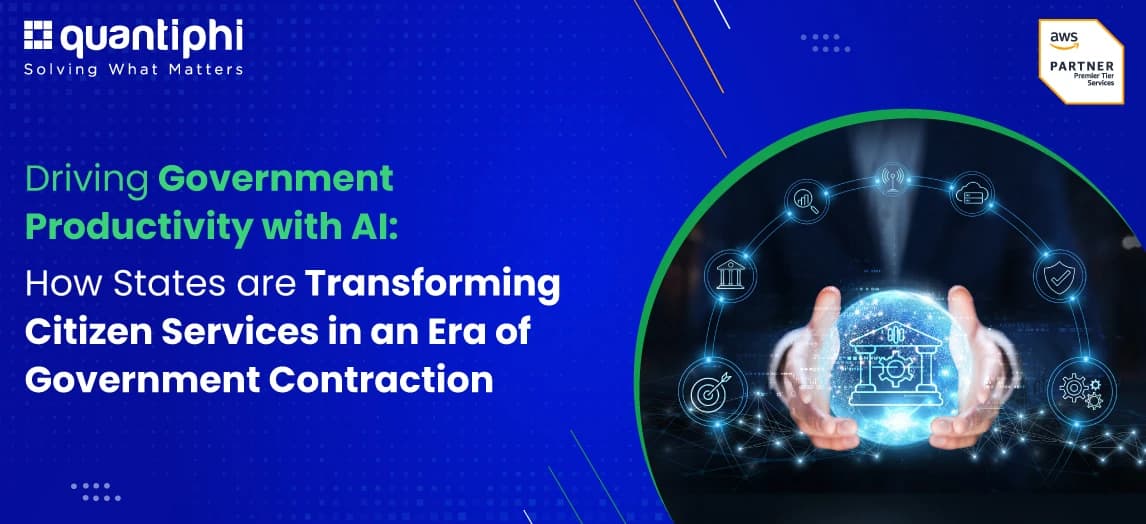
Driving Government Productivity with AI: How states are transforming citizen services in an era of government contraction

In an era where citizens expect faster, smarter, and more responsive public services, U.S. government agencies, forced to contract under budget constraints, are under increasing pressure to do more with less. Whether it’s processing citizen benefits, managing insurance claims, or handling public inquiries, manual workflows are no longer sustainable. To meet today’s expectations, state and local government agencies are modernizing and many are turning to intelligent automation to reduce operational burden, improve service delivery, and increase citizens’ satisfaction.
How Reductions in Federal Funding and State Revenue Could Impact Public Service Delivery
Several states—including California, Arizona, West Virginia, and Mississippi—are facing significant budget shortfalls, prompting reductions in critical public services across healthcare, education, and prison services. These financial challenges are compounded by the expiration of federal relief funds that previously supported staffing and essential services. As a result, many states are implementing hiring freezes, attrition policies, and voluntary separation programs to reduce workforce levels, ultimately risking service quality, accessibility, and operational continuity for citizens.
Examples highlighting the impact of staffing cuts include:
- Texas: Austin ISD eliminated 170 central office positions—over 20% of its administrative staff—to mitigate budget pressures. Leander ISD is facing similar cuts. Statewide, high turnover has led to a staffing crisis, especially in the Juvenile Justice System, which has lost nearly 46% of its staff.
- Florida: The Department of Health is eliminating 601 positions, potentially reducing capacity for emergency response, school health programs, and immunizations. The Department of Children and Families is also cutting 455 jobs.
- California: The 2024–25 revised budget proposed eliminating 10,000 currently vacant state jobs and cutting funding for 260 state programs to address their budget deficit. While large-scale modernization efforts are underway across agencies like EDD, DMV, and HHS, the magnitude of these cuts may impact foundational services relied on by millions of Californians.
Why Legacy Systems Can Exacerbate These Conditions
States’ reliance on outdated systems, including those requiring extensive manual review of high-volume documents such as unemployment forms, insurance claims, and citizen applications, threatens their ability to meet service demands in a time of staff reductions. Impacts can include processing delays, potential lags due to cross-silo data access, and compliance lapses due to reduced oversight.
To overcome these challenges, forward-thinking agencies are turning to AI-powered automation. Solutions like QDox, Quantiphi’s end-to-end intelligent document processing system built on AWS, are helping public sector teams eliminate manual work, improve accuracy, and accelerate response times. By automating document processing and information extraction, agencies can reduce operational burden, enhance compliance, and deliver faster, more reliable services to citizens—all while gaining real-time visibility into their workflows.
The Story of Kentucky’s Department of Labor and Education: Transforming Document Processing with GenAI
In Kentucky, the state agency responsible for protecting the rights and welfare of wage-earning employees sought to modernize its document processing operations with AI. Faced with large volumes of unemployment benefits and insurance claims, they needed a secure, AI-powered solution to automate document classification, extract key information, and redact personally identifiable information (PII).
To streamline how benefits and claims forms are managed, the agency implemented QDox, Quantiphi’s AI-powered document automation platform, built on Amazon. The solution intelligently reimagined document classification, critical information extraction, while redacting sensitive data, and routing information securely to the right departments.
Smart Features That Drive Smart Governance
Key features of the implementation included:
- Smart Notification Triggers: The system automatically alerts departments once all required fields are extracted and validated.
- Integrated BI Dashboards: Agencies gain visibility into peak processing times, benefits disbursement trends, and claim resolution statuses.
- PII Redaction: Personal information is automatically redacted, ensuring full compliance with data privacy regulations.
The Results: A Productivity Surge That Redefined Service Delivery
Since deploying QDox, the agency has achieved remarkable operational gains:
- 10,000+ benefit forms processed each month
- 1,600 man-hours saved monthly
- Today, with model training, 97% of forms are accurately reviewed without the need for human input
- Real-time insights into benefit trends, claims volume, and departmental performance
This transformation has not only improved internal efficiency, but it’s also elevated the citizen experience by speeding up benefit distribution and minimizing manual errors.
Key Takeaways for Government Leaders
This project serves as a roadmap for other government bodies seeking to modernize citizen services through AI and automation at scale. The most impactful insights include:
- Leverage AI for High-Volume Document Workflows: With platforms like Quantiphi’s QDox, these agencies can eliminate manual backlogs and dramatically increase processing speed.
- Adopt a Cloud-First Approach: AWS infrastructure ensures secure, scalable operations that grow with agency needs.
- Make Insights Actionable: With automated dashboards, leaders can track performance and make data-informed decisions faster.
- Protect Sensitive Data Proactively: PII redaction ensures that data privacy and compliance are never compromised.
A Model for Modern Governance
Digital modernization in the public sector is no longer optional—it’s essential. By embracing AI-powered automation, the Commonwealth of Kentucky’s Department of Labor and Education has set a precedent for how agencies can scale impact, improve service delivery, and empower employees to focus on what matters most, especially during times of budget tightening
Whether you’re looking to modernize citizen services, streamline internal operations, or unlock data-driven governance, Quantiphi helps public agencies solve what matters most—for their people, processes, and future.
Let’s build the next generation of government—together.