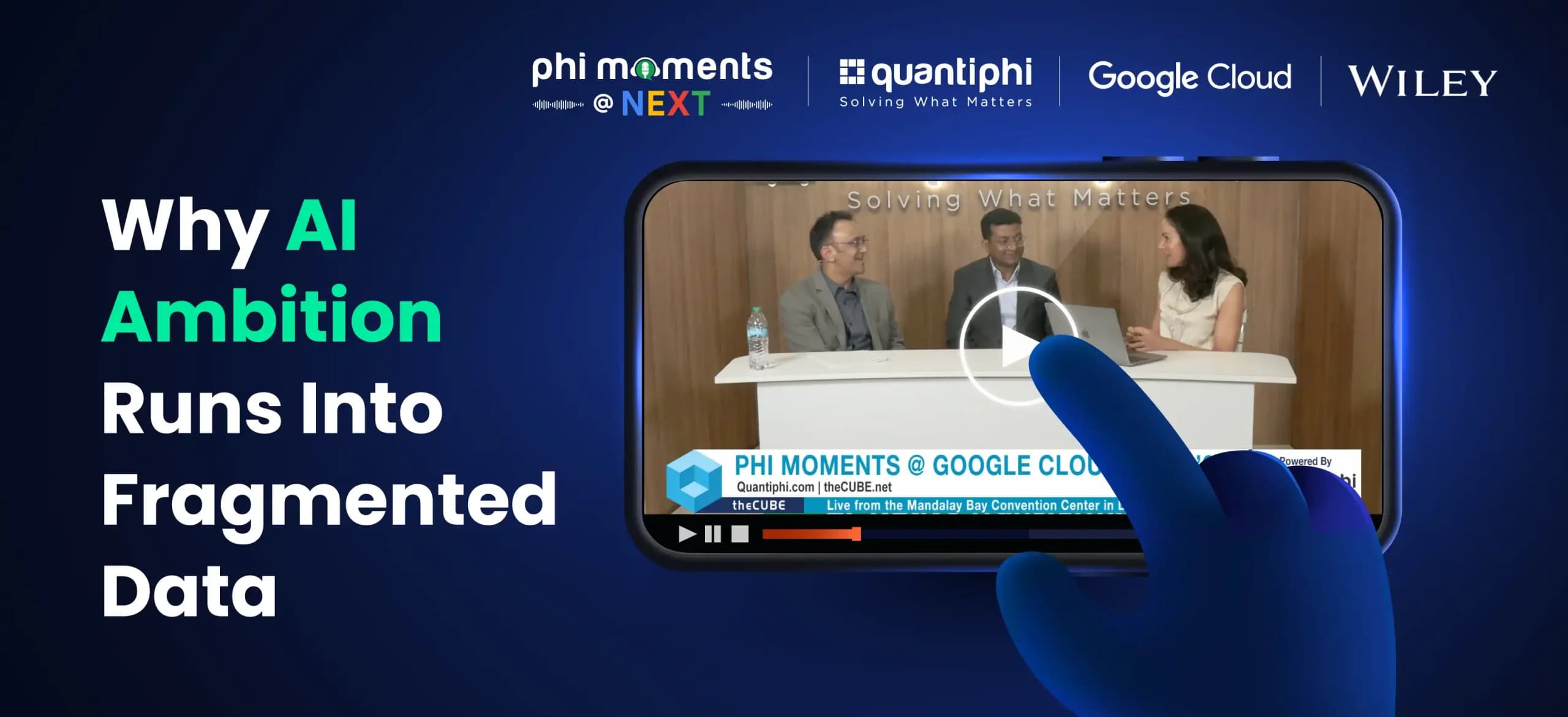
Why AI Ambition Runs Into Fragmented Data

Most enterprise AI strategies do not stall because the model is not powerful enough.
They stall because the data around the model is not ready.
For many organizations, that problem has been building for years. Different business units solve different problems. New platforms get added. Data warehouses multiply. Schemas evolve in different directions. What starts as practical, business-led decision-making eventually becomes a fragmented data estate that is difficult to govern, difficult to connect, and difficult for AI to use with confidence.
That pattern came through clearly in our Phi Moments @ NEXT conversation with Wiley, the 219-year-old global leader in publishing and education.
In the discussion at Google Cloud Next ‘26, Mehul Trivedi, Group Vice President of Technology at Wiley, and Debopriyo Nag, Practice Lead, Data Analytics at Quantiphi, unpacked what it takes to move from a fragmented data ecosystem to a unified, AI-ready foundation on Google Cloud.
Watch the full Phi Moments @ NEXT conversation with Wiley, then explore how Quantiphi helps enterprises build AI-native foundations through Digital Engineering on Google Cloud.
The real blocker is not always the model
AI has raised the stakes for enterprise data.
In the past, fragmented data often showed up as slower reporting, duplicated effort, or inconsistent business views. Those problems were real, but they were often manageable.
With AI, the consequences are bigger.
If data is scattered across systems, disconnected across domains, or difficult to trust, AI cannot reason over it effectively. The model may be powerful, but the output will still be limited by the quality, context, and accessibility of the data underneath it.
That is why data modernization is no longer just a backend technology initiative. It has become a business requirement for AI-native transformation.
For Wiley, the challenge was not small. The organization was working with a data ecosystem built over many years, across business units and use cases. As Debopriyo shared in the conversation, the landscape included roughly 30,000 tables spread across different units, creating data debt and making it harder to contextualize information for downstream AI and BI.
The lesson is simple, but often overlooked:
“You cannot build scalable AI on fragmented foundations.”
Why Wiley used modernization as a reset
Wiley’s transformation was not about moving data for the sake of moving data.
It started with a more fundamental question: is the current ecosystem the right one for the future?
That question matters. Many enterprises are under pressure to show progress with AI quickly. Boards are asking for it. Executive teams are asking for it. Customers are starting to expect it. But without the right foundation, AI programs can easily become a series of isolated experiments.
Wiley approached the moment as an opportunity to rethink the data ecosystem more holistically.
Google Cloud and BigQuery became central to that direction because they brought together storage, analytics, machine learning, and AI capabilities in one ecosystem. In the interview, Mehul pointed to three practical reasons behind the decision: economics, technology integration, and the flexibility to stay close to open-source formats and future-ready architecture.
That is an important point for enterprise leaders. The goal of modernization is not just to reduce complexity today. It is to create an architecture that can keep adapting as data, AI, and business needs evolve.
Migration is not enough. Context matters.
One of the strongest takeaways from the conversation came from Debopriyo’s point about lift-and-shift modernization.
Moving data to the cloud does not automatically make an organization AI-ready.
The harder work is making that data usable. That means understanding what the data represents, how it connects across domains, what decisions it can support, and how it can be validated for downstream use cases.
In other words, enterprises need to move from simply storing data to contextualizing data.
That shift is where the value starts to open up. A unified lakehouse can help teams work across structured and unstructured data, connect information across business units, and give researchers, analysts, and business users a stronger foundation for insight.
For AI, that context is critical. Without it, models retrieve information. With it, systems can start to support better decisions.
Explore Digital Engineering on Google CloudAI can also accelerate the modernization journey
There is another important layer to Wiley’s story: AI was not just the destination. It also helped accelerate the path.
A migration of this scale would typically take far longer using traditional engineering approaches alone. Wiley was working against an aggressive timeline of six to nine months for a data estate that had been built over many years.
To support that pace, Quantiphi brought in Codeaira, its AI-powered engineering platform, to help across the migration lifecycle — from discovery and execution to automated code translation and validation.
This is where the Quantiphi + Google Cloud partnership becomes practical. Google Cloud provided the modern data and AI foundation. Quantiphi helped engineer the path to get there with the architecture, sequencing, migration expertise, and AI-led acceleration needed to move at enterprise scale.
That combination matters because transformation is rarely blocked by vision. It is blocked by execution.
The human side of AI modernization
One of the most useful parts of the Wiley conversation was the discussion around people.
AI transformation often gets framed as a technology shift. But in practice, it changes how teams spend their time.
Mehul shared that much of his team’s effort had historically gone into building pipelines, bringing data into the lake, maintaining KPIs, and supporting reports. As AI tools started taking on more of the repetitive and mechanical work, the team had more room to focus on higher-value questions:
What more can we do with our data?
What new relationships can we build across datasets?
What semantic models will make future AI systems more useful?
What products and platforms can we build next?
That is a better way to think about AI in the enterprise. Not as a replacement for human expertise, but as a way to redirect that expertise toward work that creates more business value.
Wiley’s “Phi Moment” was not just a metric. It was a shift in how the team started thinking about the future state of the ecosystem.
What enterprise leaders can take from this
Wiley’s story offers a few practical lessons for leaders trying to move from AI ambition to AI execution.
1. Fix the foundation before scaling the model
AI cannot make up for disconnected, inconsistent, or poorly understood data. Before scaling AI use cases, leaders need to understand where data lives, how it is governed, and whether it can support the decisions the business wants AI to influence.
2. Treat modernization as an architecture decision, not a migration task
The goal is not just to move workloads from one environment to another. The goal is to create a foundation that can support analytics, AI, machine learning, governance, and future innovation.
3. Use AI to accelerate the hard work around AI
AI can support parts of the modernization journey itself — from discovery and translation to validation and engineering productivity. But it still needs the right oversight, architecture, and quality checks.
4. Build for the long game
The pressure to show AI progress is real. But the organizations that win will not be the ones that only optimize for the next demo or the next quarter. They will be the ones building the foundations, talent, and operating models that can support AI for the next decade.
Engineering AI-native transformation starts here
Wiley’s journey is a reminder that AI-native transformation does not begin with a model.
It begins with the foundations that allow AI to operate with context, trust, and scale.
That means modernizing fragmented systems. Creating unified data ecosystems. Building architectures that can evolve. Using AI to accelerate engineering work where it makes sense. And giving teams the tools and confidence to create new value from the data they already have.
This is what Quantiphi is focused on with Google Cloud: helping enterprises move from AI ambition to execution by engineering the data, cloud, and AI foundations that make transformation real.
Because the hard part is not just adopting AI.
It is making AI work inside the business.
Read the SiliconANGLE article
For the full interview recap and customer story.
Explore Digital Engineering on Google Cloud
See how Quantiphi helps enterprises modernize data, applications, and infrastructure for AI-native transformation.
Explore Quantiphi + Google Cloud
Learn more about our broader Google Cloud partnership.