What is Agentic AI Workflows: Designing Autonomous Task Execution Systems

In an era where speed, intelligence, and adaptability define success, businesses are shifting toward AI-driven systems that do more than automate, they think, learn, and act. Enter Agentic AI workflows, an evolution in automation where intelligent agents handle complex tasks autonomously, optimizing decisions, scaling operations, and freeing up human potential. These aren’t just futuristic concepts. They’re already reshaping how enterprises operate, turning static systems into dynamic ecosystems that adapt in real time.
What is an Agentic Workflow?
An agentic AI workflow is a structured series of steps carried out by an AI agent to achieve a specific goal. These workflows are characterized by their autonomy, adaptability, and continuous learning capabilities. What sets these workflows apart?
Unlike traditional workflows that rely on rigid rules and human intervention, agentic AI workflows allow AI agents to:
Perceive their environment
Gather data from various sources, such as sensors, databases, APIs, and digital interfaces.
Reason and make decisions
Analyze data, extract insights, and determine the optimal course of action using techniques like machine learning and deep learning.
Take action
Interact with systems and tools to execute tasks, ensuring compliance and efficiency through predefined guardrails.
Learn and adapt
Continuously refine their performance by analyzing past actions and outcomes, adapting to changing environments and optimizing their decision-making processes.
It’s a powerful upgrade from rigid rule-based automation. It mirrors human reasoning but operates at machine speed.
How Does an Agentic AI Workflow Work?
At its core, an agentic AI workflow is not a linear sequence of steps, but a dynamic, goal-driven loop that begins with a user request and evolves through reasoning, action, and continuous refinement. Unlike traditional AI systems that generate a single response, agentic workflows actively interpret intent, decide next steps, interact with tools, and iterate until the task is complete. This makes them far more adaptable, capable of handling complex, multi-step problems in real-world enterprise environments.
The Steps in an AI Agent Workflow
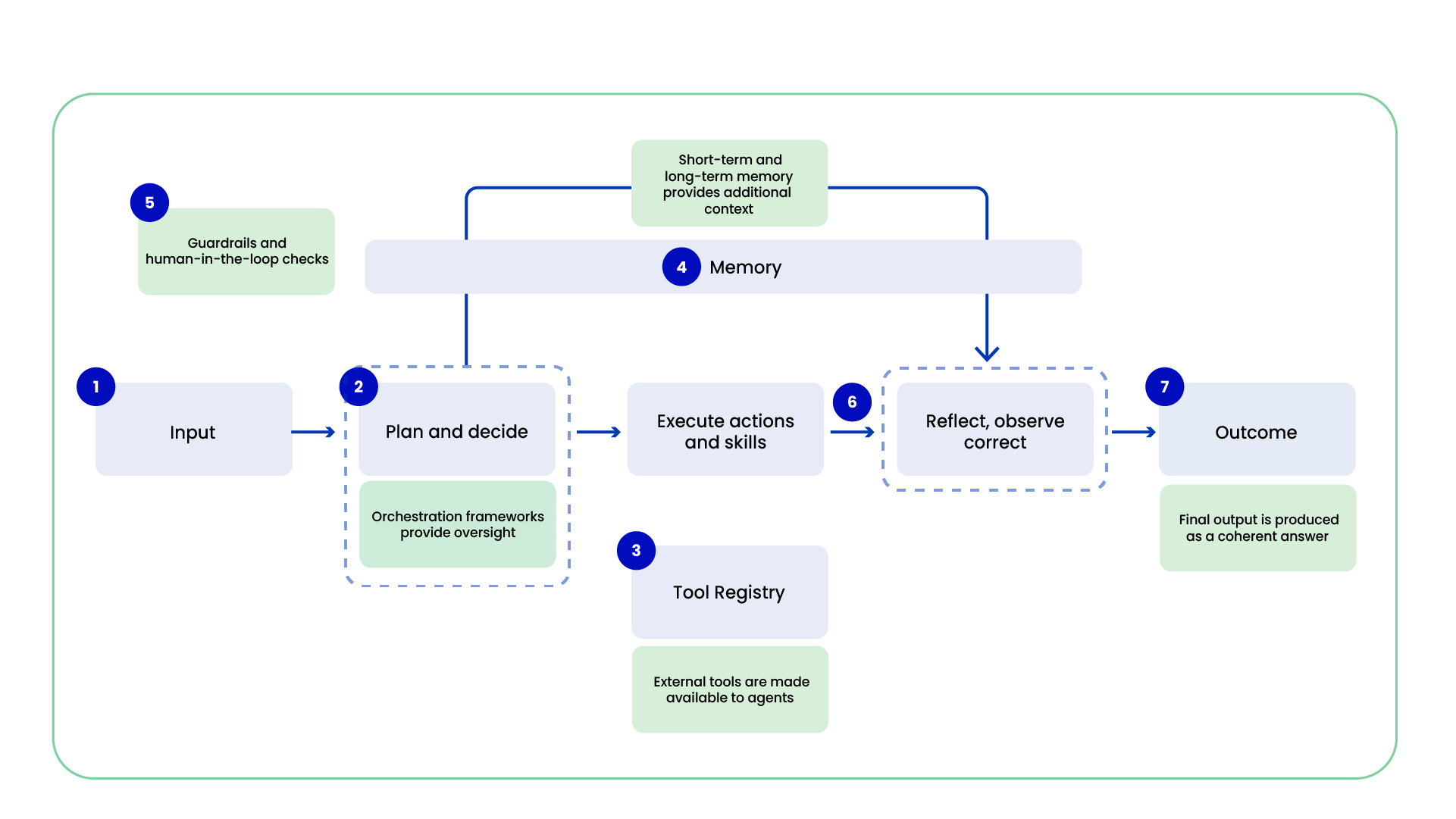
User Input
The workflow is initiated by a user query or system-triggered event, which serves as the primary input to the agent. This input is processed through natural language understanding layers to extract intent, entities, and contextual signals. In advanced systems, this step may also involve context enrichment through retrieval mechanisms (RAG), session memory, or enterprise data sources, enabling the agent to ground the request in relevant, real-time information.
Planning and Decision-Making
Once the input is interpreted, the agent enters a reasoning phase where it constructs a plan of action. This involves decomposing the task into smaller, manageable steps and determining the sequence of operations required. The model evaluates available tools, weighs possible approaches, and selects the most appropriate path forward.
Importantly, this process is not linear; this decision-making is dynamic. In many cases, the agent must handle uncertainty, incomplete information, or ambiguous intent, which requires it to consider multiple possible paths. Instead of committing to a single fixed plan, the agent can explore alternative approaches, reprioritize steps, or branch into different strategies based on evolving context.
This ability to dynamically navigate branching decision paths is what allows agentic systems to operate effectively in complex, real-world scenarios.
Example: AI Customer Support Agent (E-commerce)
Use Case: A customer asks: “Where is my order?”
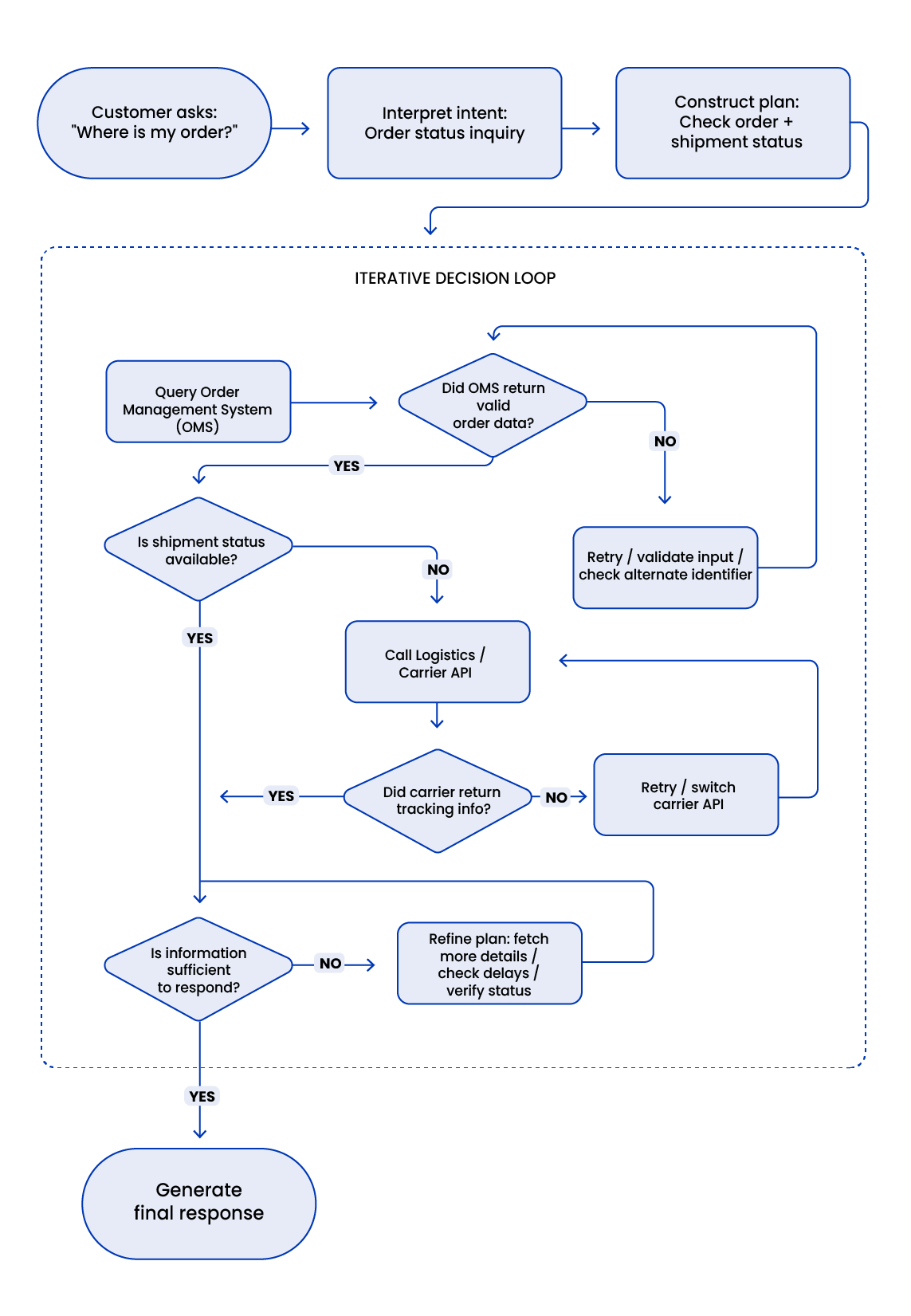
Figure: Iterative decision-making workflow
This diagram illustrates how an AI-powered customer support agent handles a query through an iterative decision-making workflow. The process begins with understanding the user’s intent and determining whether sufficient information is available to proceed. Based on this, the agent either gathers missing inputs (such as an order ID) or directly interacts with backend systems to retrieve data.
At the core of the workflow is a decision and feedback loop—if the required information is incomplete or retrieval fails, the agent dynamically adjusts its approach by retrying, switching data sources, or refining its actions. This loop continues until the agent successfully retrieves the necessary information and generates a final response.
Executing Actions Using Tools
In this phase, the agent operationalizes its plan by invoking tools, APIs, or external systems. These actions can include querying databases, calling services, retrieving documents, executing code, or triggering workflows within enterprise systems. The agent formats inputs for each tool, interprets outputs, and integrates the results into its working context. This step transforms the agent from a passive responder into an active system capable of interacting with its environment.
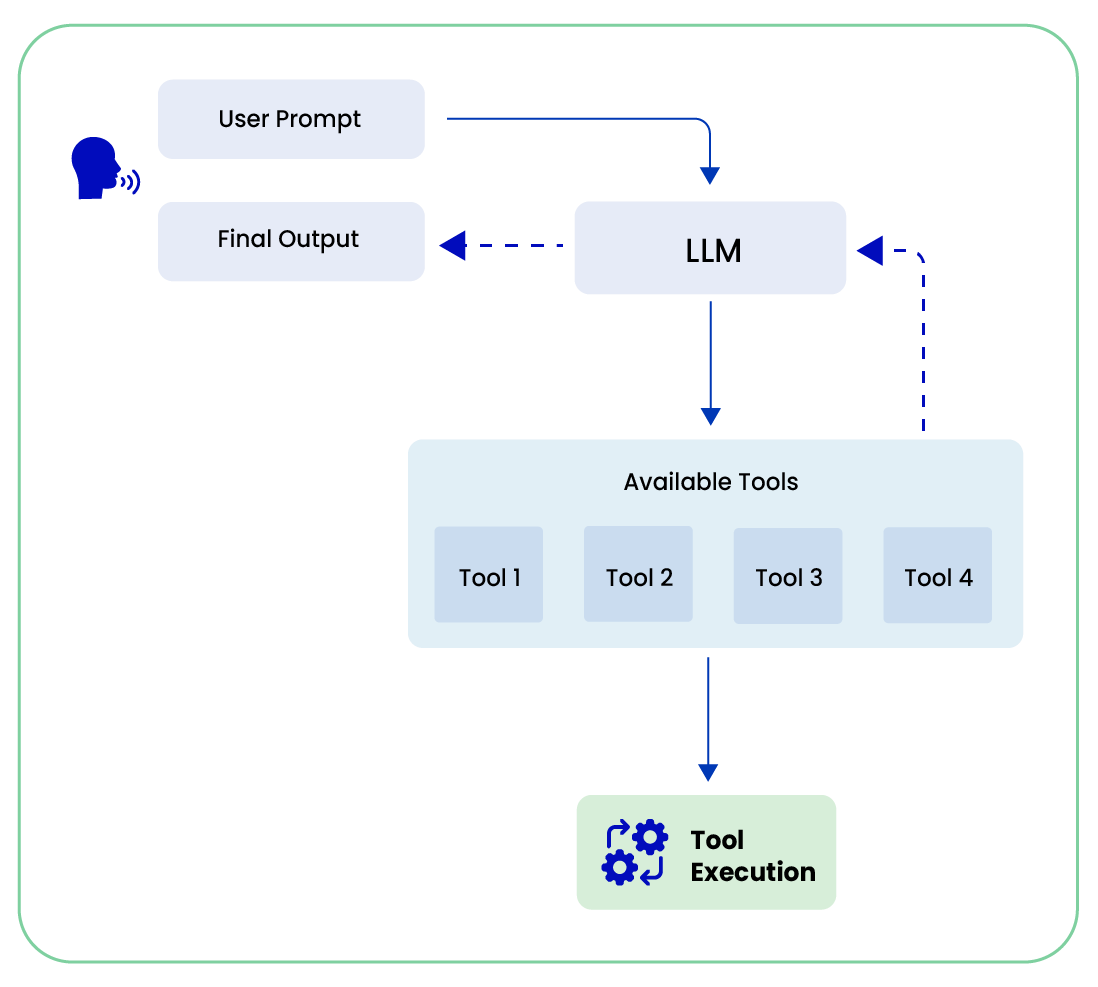
Figure: How tool usage works
Reflect, Observe, and Correct
After each action, the agent evaluates the outcome against the intended objective. It observes whether the result is complete, relevant, or accurate, and uses this feedback to refine its next step. This creates an iterative loop where the agent may re-plan, select alternative tools, or correct earlier assumptions. Techniques such as self-reflection, error checking, and intermediate validation are critical here, enabling the system to improve reliability and reduce hallucinations.
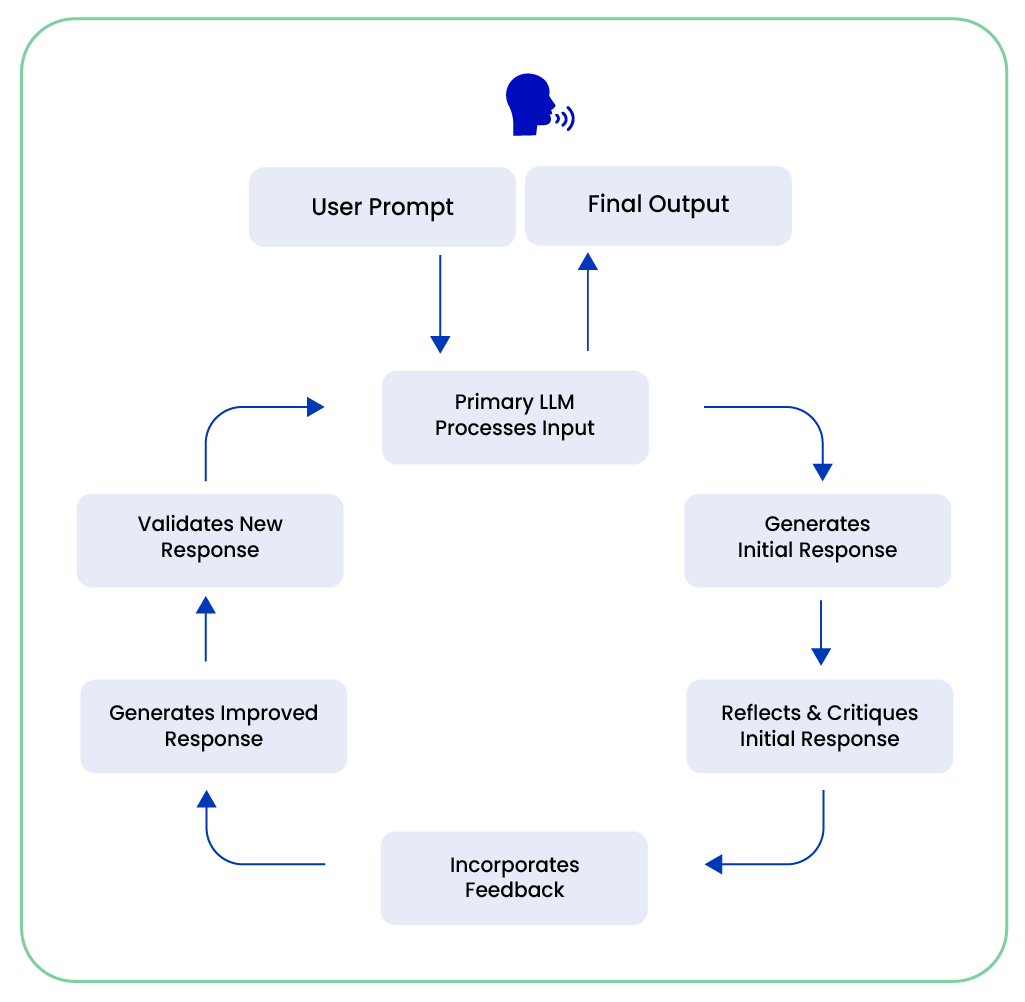
Figure: How a feedback loop works
Response
Once the agent determines that the task has been successfully completed—or cannot be improved further within defined constraints—it generates the final response or executes the final action. The output is typically synthesized from multiple intermediate steps and validated results, ensuring coherence and accuracy. In enterprise settings, this stage may also include confidence scoring, formatting for downstream systems, or human-in-the-loop escalation before delivery.
This 5-step structure captures the essence of agentic workflows as iterative reasoning-action systems with planning, execution, and reflection forming a continuous loop until the task is complete.
What Are the Different Types of Agentic AI Workflows?
Agentic AI workflows can be categorized based on how decisions are made, how tasks are structured, and how agents coordinate execution. While real-world systems often combine multiple patterns, understanding these core types helps in designing workflows that balance autonomy, control, and scalability.
Single-Agent Workflows
A single-agent workflow relies on one agent to handle the entire lifecycle of a task — from interpreting input to reasoning, acting, and generating the final response. The agent operates within an iterative loop, making decisions and invoking tools as needed.
This model is best suited for self-contained tasks with moderate complexity, where a single reasoning unit can effectively manage the workflow without requiring coordination across multiple agents.
Multi-Agent Workflows
Multi-agent workflows distribute responsibilities across multiple specialized agents. Each agent is designed for a specific function like retrieval, analysis, validation, or execution, and they collaborate to complete the overall task.
This approach is ideal for complex, multi-domain problems, enabling modularity, parallelism, and improved accuracy through specialization.
Sequential (Pipeline) Workflows
Sequential workflows follow a predefined sequence of steps, where each stage passes its output to the next. The structure is deterministic, with limited flexibility in execution order.
These workflows are effective for predictable, repeatable processes such as document processing, ETL pipelines, or standardized report generation, where consistency is more important than adaptability.
Conditional Workflows
Conditional workflows introduce decision points where the execution path changes based on rules, thresholds, or model-driven judgments. Instead of a fixed sequence, the workflow dynamically selects different paths depending on the situation.
This pattern is particularly useful for routing, exception handling, and governance-heavy scenarios, allowing systems to enforce business logic while still benefiting from AI-driven flexibility.
Iterative (Loop-Based) Workflows
Iterative workflows are built around continuous loops of reasoning, action, and refinement. The agent repeatedly evaluates its progress and adjusts its approach until a stopping condition is met.
This is the defining pattern of agentic systems and is best suited for tasks involving uncertainty, exploration, or multi-step problem-solving, such as research, troubleshooting, and decision support.
Hierarchical Workflows
Hierarchical workflows introduce a controller agent that decomposes a high-level goal into sub-tasks and assigns them to subordinate agents. The controller then aggregates results and ensures alignment with the overall objective.
This model is effective for large-scale, complex workflows, where coordination, task decomposition, and oversight are critical.
Human-in-the-Loop Workflows
Human-in-the-loop workflows integrate human intervention at key decision points, such as validation, approval, or exception handling. The agent performs most of the execution but defers to humans when confidence is low or risk is high.
This approach is essential in enterprise and regulated environments, ensuring trust, compliance, and accountability.
Sequential vs. Conditional Workflow in AI Agents
AI agent workflows can follow different execution patterns depending on how decisions are handled during runtime. A sequential workflow operates in a linear, predefined manner where each step follows the previous one in a fixed order. The flow of execution does not change based on context or intermediate results, making it highly predictable and easy to manage. This approach is well-suited for structured, repeatable tasks where variability is minimal.
In contrast, a conditional workflow introduces decision points that allow the agent to choose different paths during execution. Instead of following a single fixed sequence, the workflow adapts based on factors such as user input, data availability, confidence levels, or intermediate results. This makes conditional workflows more flexible and better suited for real-world scenarios where uncertainty and variability are common.
| Aspect | Sequential Workflow | Conditional Workflow |
| Execution Style | Linear, fixed sequence | Dynamic, decision-based |
| Flexibility | Low | High |
| Adaptability | Does not adapt to intermediate results | Adapts based on context and outcomes |
| Complexity | Simpler to design and implement | More complex due to branching logic |
| Use of AI Reasoning | Minimal or predefined | High, often driven by model decisions |
| Handling Uncertainty | Limited | Strong, can adjust paths dynamically |
| Use Cases | ETL pipelines, report generation | Customer support, fraud detection, routing |
| Control & Governance | High (predictable flow) | Balanced with flexibility |
| Error Handling | Predefined error paths | Dynamic retries, alternate paths |
Example Comparison
Consider a document processing use case:
- In a sequential workflow, the system might always follow the same steps: extract text → classify document → store output. Every document goes through the same pipeline regardless of its content or quality.
- In a conditional workflow, the system adapts its path. If the document quality is low, it may trigger an OCR enhancement step. If classification confidence is low, it may route the document for human review. If the document type is recognized early, it may skip unnecessary steps. The workflow dynamically adjusts to ensure better outcomes.
How Do Multi-Agent Workflows Operate?
Multi-agent workflows operate by distributing a complex task across multiple specialized agents, each responsible for a specific function such as data retrieval, analysis, validation, or execution. Instead of relying on a single agent to handle everything, these systems delegate tasks, coordinate actions, and often execute steps in parallel, enabling greater scalability, efficiency, and accuracy. A central orchestrator or lead agent typically manages the workflow, ensuring that outputs from one agent are passed to others, dependencies are maintained, and the overall objective is achieved.
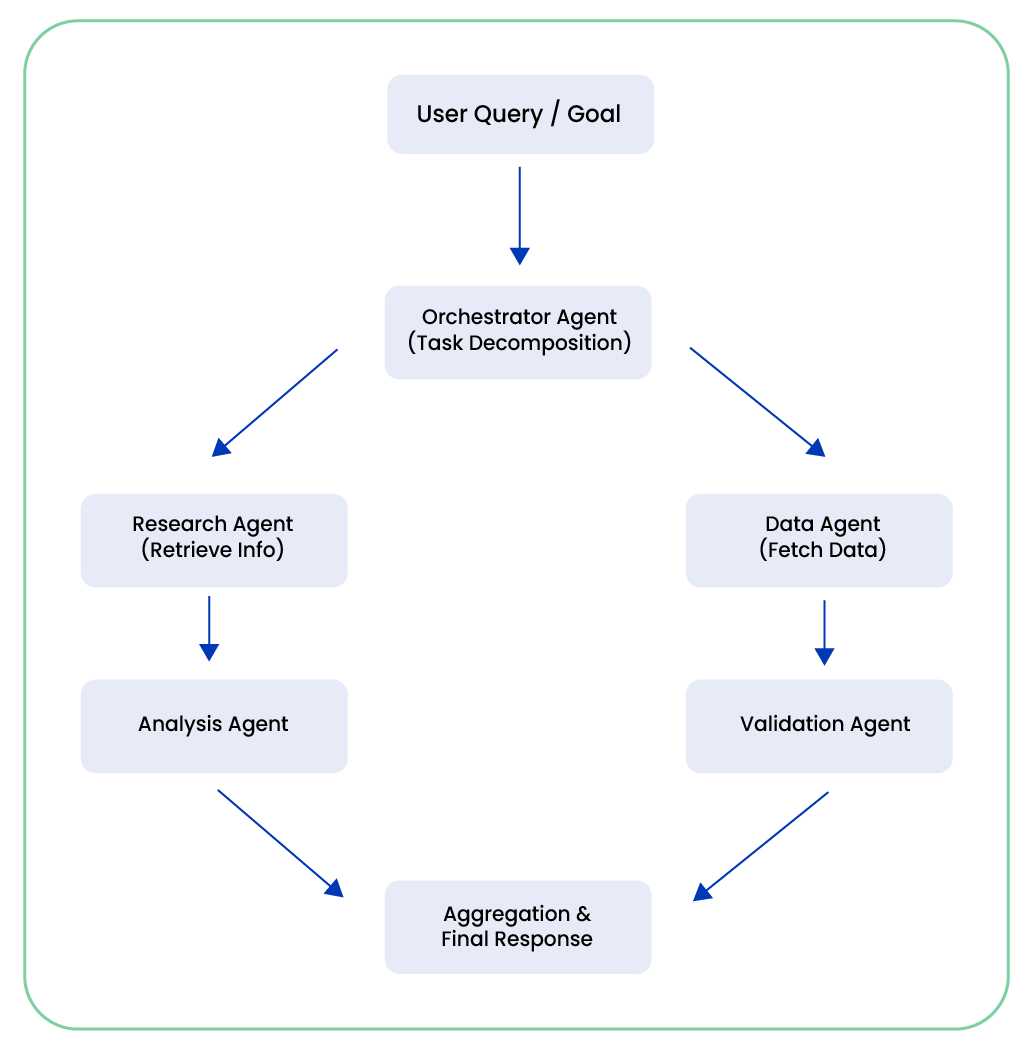
Figure: Simple multi-agent workflow
This diagram illustrates how a multi-agent workflow distributes a task across specialized agents coordinated by a central orchestrator. The orchestrator decomposes the user’s request and assigns subtasks to different agents, such as research and data retrieval, which can operate in parallel. Their outputs are then processed by downstream agents for analysis and validation before being aggregated into a final response.
What Are Real-World Examples of Agentic AI Workflows?
Agentic AI workflows are already being applied across industries to automate complex, multi-step tasks that require reasoning, decision-making, and adaptability. From customer interactions to enterprise analytics, these systems enable organizations to move beyond static automation toward more intelligent, goal-driven execution.
Customer Support Automation:
AI agents handle customer queries by understanding intent, retrieving relevant data (e.g., order status), and iteratively resolving issues or escalating when needed.
AI Copilots:
AI copilots assist users in real time by breaking down tasks, suggesting actions, executing workflows (like writing code or drafting content), and refining outputs based on feedback.
Research Assistants:
Agentic systems gather information from multiple sources, synthesize insights, validate findings, and iteratively refine outputs to support decision-making or content creation.
Data Pipelines:
AI-driven pipelines dynamically process, clean, enrich, and route data, adapting workflows based on data quality, anomalies, or downstream requirements.
Designing and Implementing Agentic AI Workflows
Implementing agentic AI workflows requires careful planning and execution. Key considerations include:
Identify suitable use cases
Start by identifying processes that can benefit most from automation and intelligent decision-making. An agentic workflow example could be automating customer service inquiries or optimizing supply chain logistics.
Defining clear objectives and metrics
Establish specific goals for the workflow and define measurable metrics to track its performance.
Selecting appropriate AI technologies
Choose the right AI tools and technologies that align with the specific needs of the workflow. Effective agentic workflow tools should enable seamless integration and execution of tasks.
Ensuring data quality and security
Maintain high-quality data and implement robust security measures to protect sensitive information.
The implementation process typically involves data preparation, AI model development, workflow orchestration, and continuous monitoring and optimization. A well-defined agentic workflow framework is crucial for successful implementation and management of these workflows.
Best Practices for Designing Agentic Workflows
Designing effective agentic AI workflows requires balancing autonomy with control, ensuring that systems are both adaptive and reliable. The following best practices help in building workflows that scale efficiently while maintaining accuracy, performance, and governance.
Agentic Workflow Design Checklist
Keep Workflows Modular
Break down workflows into smaller, reusable components or agents with clearly defined responsibilities, making the system easier to scale, debug, and maintain.
Use Iterative Loops for Complex Tasks
Design workflows to support continuous reasoning, action, and refinement, enabling agents to handle uncertainty and improve outcomes over multiple steps.
Optimize Decision Points
Clearly define where and how decisions are made—whether rule-based or model-driven—to ensure the workflow adapts intelligently without becoming unpredictable.
Minimize Latency
Reduce unnecessary steps, optimize tool calls, and leverage parallel execution where possible to ensure fast and efficient responses in real-time applications.
Incorporate Guardrails and Validation
Implement checks for accuracy, compliance, and safety throughout the workflow to prevent errors and ensure outputs meet required standards.
Enable Observability and Logging
Track agent decisions, tool usage, and workflow paths to improve transparency, debugging, and continuous optimization.
Design for Human-in-the-Loop When Needed
Introduce escalation points for low-confidence scenarios or high-risk decisions to maintain trust and reliability in enterprise environments.
Benefits of Agentic AI Workflows
Agentic AI workflows offer a multitude of benefits:
Increased Efficiency and Productivity
Automation eliminates manual tasks, freeing up human workers to focus on more strategic initiatives.
Improved Accuracy and Reduced Errors
AI agents can process information and execute tasks with greater accuracy than humans, minimizing errors and improving quality.
Enhanced Decision-Making
AI-powered insights enable better and faster decision-making, leading to improved outcomes.
Greater Scalability and Flexibility
Agentic AI workflows can easily adapt to changing demands and scale operations up or down as needed.
Continuous Optimization and Learning
The inherent learning capabilities of AI agents ensure that workflows are constantly optimized for peak performance.
Challenges and Considerations of Agent AI Workflow
While agentic AI workflows offer tremendous potential, it’s crucial to address potential challenges:
Ethical Considerations:
Ensure AI agents operate ethically and fairly, avoiding bias and discrimination.
Security and Privacy Concerns:
Implement robust security measures to protect data and prevent unauthorized access.
Need for Human Oversight:
Maintain human oversight to ensure AI agents align with business goals and values.
Complexity of Implementation:
Integrating AI agents with existing systems can be complex and require specialized expertise.
The Future of Agentic AI Workflows
The agentic AI revolution is just getting started. With advances in LLMs, real-time learning, and autonomous decision-making, tomorrow’s AI agents will be collaborators, not just tools. As businesses embrace this shift, they’ll unlock agility, insight, and innovation on a scale never seen before.
But intelligent automation isn’t about replacing people; it’s about empowering them with systems that think, adapt, and evolve alongside them.
Solving What Matters with Agentic AI: Quantiphi’s Perspective
At Quantiphi, we’re not just building AI agents, we’re architecting intelligent systems that solve what matters. As an AI-first digital engineering company, Quantiphi empowers global enterprises with agentic AI workflows that combine:
- Advanced reasoning and orchestration through LLMs and decision engines
- Real-time adaptability and autonomy
- Enterprise-grade deployment across use cases in BFSI, Healthcare, Retail, and more
- Built-in responsibility via explainability, human-in-the-loop designs, and compliance-ready guardrails
From streamlining customer service to accelerating life sciences breakthroughs and optimizing financial operations, Quantiphi’s AI agents are designed to think, learn, and act securely and at scale.
With Quantiphi’s strategic expertise and technical depth, harness Agentic AI securely, responsibly, and at scale. Want to explore how agentic workflows can transform your enterprise? Let’s connect.
By embracing agentic AI workflows, businesses can unlock new levels of efficiency, productivity, and innovation. As AI technology continues to evolve, we can expect even more transformative applications of Agentic AI in the years to come.