Building Quantum Solutions: Charting a Path From Exploration Towards Engineering

Executive Summary
Quantum computing is entering a new phase, moving from exploratory experiments to engineered, outcome-driven solutions. To guide this transition, this post introduces a structured, five-layer solution stack (Application, Algorithm, Mapping, Runtime, and Evaluation). Its objective is to provide a clear pathway from business problem to proven solution, enabling organizations to systematically de-risk development, rigorously measure performance against classical baselines, and strategically build a scalable, solutions-driven quantum capability.
Key Takeaways
- From Exploration to Engineering: Quantum computing is maturing from research experiments into a structured, engineering-driven discipline.
- A Disciplined Path to Value: A solution-stack approach provides this discipline, systematically connecting business problems to performance-benchmarked solutions.
- Build Reusable Capability: This stack is designed to help organizations manage complexity, measure progress, and build scalable, reusable capabilities for future quantum initiatives.
The development of practical quantum applications is transitioning from a phase of exploratory research to one requiring disciplined engineering. Our previous post provided the strategic importance of building early capability to gain a first-mover advantage. Turning strategic goals into working applications is a difficult endeavor. The demanding nature of this field makes a structured and reproducible process essential for success.
The process of developing a functioning quantum program from a high-level business problem is a multi-stage endeavor, encompassing domain-specific formulation, abstract algorithm design, and low-level hardware optimization. To navigate this effectively, we introduce a structured methodology termed the Quantum Solution Stack. This breaks down the monolithic process into distinct, manageable components. This is helpful in applying focused expertise, tracking progress, and understanding how each part contributes to the whole.
This methodology is ‘stack-like’ because it is layered and hierarchical, but it is distinct from a software product stack. Instead, it functions as an engineering workflow that provides a path from an initial business problem to a specific hardware implementation and, finally, to a measured value.
The Quantum Solution Stack
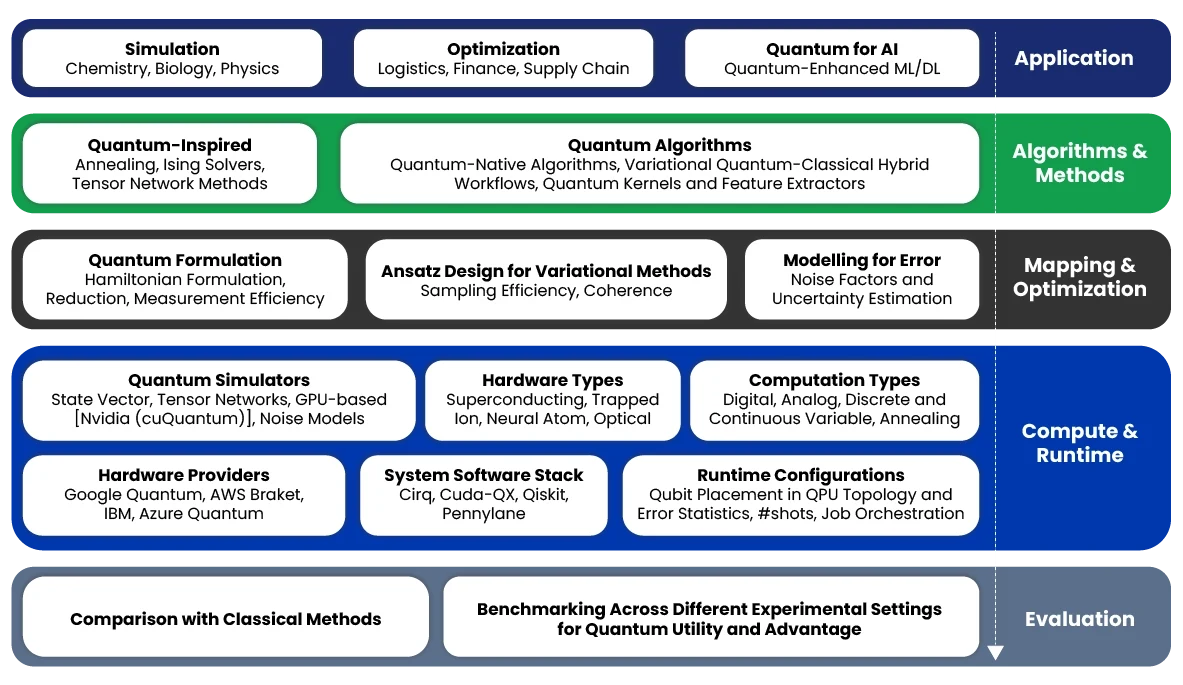
We can deconstruct this complex engineering workflow into five distinct and manageable layers:
Layer 1: Application
Identify and translate a high-value business problem into a computational class where classical methods are reaching their limits. Choosing the right application is crucial, since quantum computing adds value in the present by combining with classical to enhance performance and address scenarios where classical-only approaches alone fail to deliver the desired performance against metrics of scale or precision. The outcome is a clear problem statement defining the objective, constraints, data, and success metrics — the what, not the how.
While the broader field of quantum technology also includes sensing, hardware development, and post-quantum cryptography, this solution stack is focused specifically on building applications with quantum computing. The primary problem classes are:
- Simulation: Problems focused on understanding the properties or time evolution of a quantum mechanical system, such as modeling new molecules for drug discovery.
- Optimization: Problems that seek to find the optimal solution from a vast set of possibilities, such as optimizing logistics routes or financial portfolios.
- Quantum for AI: Problems where quantum computation could enhance machine learning tasks, for example by finding novel patterns in complex datasets.
Layer 2: Algorithms & Methods
For a given problem, a computational method is selected by balancing theoretical promise with hardware realities, leading to carefully justified algorithms tailored to its specific requirements. The choice must account for limitations in qubit count, fidelity, and coherence times. The primary categories are:
- Quantum-Inspired Methods: These are classical algorithms that run on classical hardware (CPUs/GPUs) but use principles from quantum mechanics (like superposition or tunneling) to solve hard problems. They are often used for Optimization and provide a low-barrier entry to quantum-style thinking. Examples include Simulated Quantum Annealing (SQA), as well as quantum-inspired techniques used in machine learning (like tensor networks for data compression or quantum-inspired neural networks) and various simulation tasks.
- Quantum Annealing: This approach uses specialized quantum hardware (annealers) designed exclusively for Optimization problems. It works by finding the lowest energy state of a problem mapped to an Ising or QUBO model.
- Variational Hybrid Workflows: The current paradigm for gate-based quantum computers, using a classical optimizer in a loop with a shallow, parameterized quantum circuit (“ansatz”) to mitigate noise. This approach enables applications like the Variational Quantum Eigensolver (VQE) for finding molecular ground-state energies and the Quantum Approximate Optimization Algorithm (QAOA) for combinatorial problems. It also facilitates a wide range of AI applications through Quantum Machine Learning (QML). This includes well-known methods like Quantum Kernels, where the quantum computer acts as a co-processor to enhance classical machine learning models (like SVMs) for classification. This hybrid paradigm extends to other key areas like regression (VQR), and generative modeling (QGAN, QCBM). Furthermore, advanced techniques explore the fusion of quantum features with classical models like learning quantum circuits with classical deep learning architectures like LSTMs or other recurrent networks to potentially improve their performance on temporal data. Separately, other methods like Quantum Walks show promise for graph-based problems, which can be relevant for accelerating certain types of search and structured data analysis.
- Quantum-Native Algorithms: These algorithms are designed to run end-to-end completely on a quantum computer, requiring high-fidelity, error-corrected hardware. While largely a future goal, they promise significant speedups over classical methods. Examples include Shor’s factoring, Grover’s unstructured search, Quantum Phase Estimation.
Layer 3: Mapping & Optimization
In this layer, the identified abstract algorithm is reformulated into quantum principles by means of quantum operations that can function within the constraints of the simulator and hardware.
3A. Quantum Formulation
Translate the problem’s abstract mathematics into the operational language of qubits while preserving linearity and coherence. Because quantum operators must remain linear and unitary, every transformation must maintain superposition and avoid measurement until the final readout. Premature measurement collapses the circuit and destroys the quantum correlations we need for the solution.
- Data Encoding: Every quantum workflow begins with encoding classical information into quantum states. This step defines how data, parameters, or constraints are represented on qubits and determines the structure of the state space that the circuit explores. Effective encoding enables relevant relationships to be captured between inputs through superposition and interference. Across Simulation, Optimization, and Machine Learning, encoding defines how classical structure enters the quantum domain, setting the foundation for what the system will compute and what observables can be meaningfully measured.
- Angle (rotation) encoding: Writes numerical features into gate rotation angles; simple, scalable, and hardware efficient. Example: In financial anomaly detection, standardized transaction features such as amount deviation, frequency irregularity, or merchant risk score are encoded as Ry(θ) rotations, allowing qubit interactions to capture nonlinear correlations between behavioral patterns and potential fraud signals.
- Phase encoding: Represents data as phase shifts (e.g., Rz(ϕ)); useful when relationships are periodic or time-dependent. Example: In supply chain forecasting, encode seasonal demand or price fluctuation cycles as phase shifts so that interference patterns highlight recurring trends.
- Amplitude encoding: Loads weighted coefficients of a vector into the state amplitudes; highly expressive but requires more complex state preparation. Example: In route optimization or logistics, represent the probability distribution of route transitions or shipment flows as amplitudes, enabling the circuit to explore many possible configurations simultaneously.
- Basis encoding: Maps discrete identifiers or categories directly to computational basis states (e.g., ∣011⟩ represents a binary pattern of three qubits); straightforward for categorical or combinatorial data. Example: In resource scheduling or portfolio selection, assign each basis state to a specific asset, task, or machine, allowing the quantum system to explore combinations that optimize allocation or cost.
- Observables: Once information is encoded, the next step is to determine what to measure. Quantum systems produce probabilistic measurement outcomes rather than fixed results; i.e. measure the expectation value of a problem-specific observable (e.g., the Hamiltonian itself is an observable) or the probability distribution across eigenstates to produce a single bitstring answer. These measurements are defined to be problem-specific quantities: in simulation, expectation values correspond to physical quantities like energy or magnetization, in optimization, the measured observable represents the cost encoded in the Ising Hamiltonian, providing feedback on solution quality. In Quantum Machine Learning, observables capture correlations acting as quantum-derived features or kernel estimates.
- Hamiltonian Transformation: After defining how data is encoded and what observables to measure, the problem’s objective must be expressed in a form that the quantum system can represent and manipulate. For many scientific and optimization tasks, this takes the shape of a Hamiltonian, an operator whose energy landscape defines the objective to be minimized. In simulation, the Hamiltonian captures molecular or material interactions originally described by fermionic operators, which are then mapped to qubit operators through transformations such as Jordan Wigner or Bravyi Kitaev. In optimization, objectives and constraints are often expressed as QUBO formulations and then converted into equivalent Ising Hamiltonians, where the ground state represents the most favorable configuration or lowest cost solution.
Thus, data encoding defines what information enters the quantum system, observables define what quantities are measured, and the Hamiltonian formalism defines the structure being optimized. Together, they form the bridge between classical problems and quantum computation.
3B. Ansatz Design for Variational Methods
In variational algorithms (such as VQE and QAOA), the ansatz is a parameterized quantum circuit that defines a mapping from parameters to quantum states, guiding the optimization process toward favorable regions of the solution space, and requires careful design. A poorly chosen ansatz can make a problem untrainable because of challenges like barren plateaus, where gradients vanish and optimization stalls.
Traditional approaches rely on domain-informed ansätze, such as UCCSD in chemistry, or hardware-efficient forms designed for near-term devices. More recently, new strategies aim to improve convergence and efficiency. Transformer-based generative models such as the Generative Quantum Eigensolver (GQE) are trained to generate the circuit structures directly from limited samples, improving convergence and reducing the number of required measurements. The practical objective across all these methods is the same: to refine the ansatz so that useful results can be obtained with fewer shots, shorter circuit depth, and faster convergence, making variational algorithms both practical and scalable on real hardware.
3C. Modelling for Error and Uncertainty
Errors are an unavoidable part of current quantum hardware. Devices in the present-day NISQ era operate under physical limitations such as qubit decoherence, gate infidelity, and readout noise. These effects are not anomalies but intrinsic properties of present architectures, making an explicit error strategy essential for credible results. Error mitigation techniques compensate for these effects without full fault tolerance. A practical example is Zero Noise Extrapolation (ZNE), which executes circuits at varying noise levels and extrapolates the outcomes toward a zero-noise estimate, a tradeoff of more measurements for higher accuracy. Similar calibration and probabilistic rescaling methods are also used to recover cleaner expectation values.
In addition to hardware noise, quantum computations carry inherent uncertainty, arising from two sources: (i) Aleatoric uncertainty, which is fundamental and stems from the probabilistic nature of quantum mechanics. Even an ideal system produces a distribution of outcomes rather than a single deterministic answer. (ii) Epistemic uncertainty, which results from limited information, such as using a finite number of measurement shots or imperfect parameter tuning in variational algorithms. A robust error model must account for both noise and uncertainty, ensuring that each measured result reflects not just accuracy, but also confidence in its reliability.
Layer 4: Compute & Runtime
This layer focuses on executing the compiled quantum program. It involves selecting the compute backend, either a simulator or physical hardware, and defining all runtime parameters for a reliable and reproducible experiment.
Quantum Simulators: Development and testing usually begin on classical simulators. These range from exact state vector simulators, which require large memory, to more scalable tensor network methods. GPU accelerated frameworks such as NVIDIA cuQuantum are often used for gaining speedup over multicore CPU based backends. Many simulators also include configurable noise models, allowing early validation under realistic hardware conditions.
Computation and Hardware Types: The backend choice depends on the computation model. Digital or gate based systems use a universal set of quantum gates, while analog systems directly manipulate the system’s Hamiltonian for certain simulations. Hardware technologies include superconducting circuits, trapped ions, neutral atoms, and photonic processors. Each offers different levels of fidelity, connectivity, and scalability. For instance, trapped ion systems provide near full connectivity, while superconducting devices rely on fixed couplers, making qubit placement and routing more critical.
Software and Access Layers: Execution depends on the software environment and integration platform. Open toolkits such as Qiskit, Cirq, PennyLane, and Cuda-Q/QX support circuit design and hybrid workflows. Access to hardware backends is available through major cloud providers including AWS Braket, Azure Quantum, Google Quantum AI, and IBM Quantum, each offering interfaces to multiple device types and simulators.
Runtime Configuration: Before execution, the runtime must be configured carefully. Logical qubits are mapped to physical qubits considering topology and error rates. The number of measurement shots is defined as a balance between statistical accuracy and run cost. Job orchestration then manages circuit submission, monitoring, and result collection. A reproducible codebase or notebook that documents backend selections and parameters ensures results can be validated and repeated across different configurations.
Layer 5: Evaluation
Evaluation is where quantum results are validated. It turns experiments into evidence by comparing outcomes against trusted classical references and confirming that results are reliable, repeatable, and meaningful. Without structured evaluation, progress is anecdotal; with it, teams can understand where quantum methods add genuine value.
A rigorous evaluation helps provide context on how quantum results measure up to the best classical approaches. Apart from quantitative evaluation that measures accuracy, speed, and cost factors, the integration potential with existing classical solutions is also of consideration. The distinction between quantum utility and quantum advantage defines the maturity of results: Quantum utility captures the stage where quantum methods enhance or accelerate real-world tasks, working alongside classical systems to deliver measurable improvements in accuracy, runtime, or cost. Quantum advantage marks the threshold where quantum becomes decisively superior, solving problems that are practically unreachable by classical computation.
Meaningful evaluation does more than validate a result; it defines readiness. Demonstrating utility through transparent, reproducible benchmarks is the bridge between exploratory research and practical adoption, marking the moment when quantum begins to matter in the real world.
Together, these five layers turn experimentation into engineering discipline—building the foundation for organizational readiness, technical maturity, and eventually, sustained quantum capability.
Conclusion
The path to valuable quantum outcomes is not sudden; it evolves through purposeful design and iterative progress. Our solution stack approach provides the structure to move from a business problem to a benchmarked result: formalize the application (Layer 1), choose methods pragmatically (Layer 2), map and encode with observables in mind (Layer 3), execute reproducibly (Layer 4), and evaluate against strong baselines (Layer 5). With this structure in place, organizations can iterate with clarity and purpose, building cumulative insight and technical maturity over time. One pass through the stack yields a data point; repeated cycles build understanding. This article focuses on the stack itself. A following post will explore the Quantum Adoption Lifecycle, the practical guide for progressing from early demonstrations to stable, scalable quantum capability.
Glossary
Annealing (Quantum Annealing): A metaheuristic optimization algorithm that uses quantum-mechanical effects, primarily quantum tunneling, to find the global minimum of a given objective function.
Ansatz: A parameterized quantum circuit that acts as a “trial wavefunction” or an “educated guess” for a problem’s solution. In hybrid algorithms, a classical optimizer iteratively tunes its parameters.
Hamiltonian: A mathematical operator that describes the total energy of a quantum system. Problems are encoded into a Hamiltonian such that its lowest energy state (its ground-state eigenvalue) corresponds to the problem’s solution.
QAOA (Quantum Approximate Optimization Algorithm): A hybrid quantum-classical algorithm designed to find approximate solutions to combinatorial optimization problems (like Max-Cut or routing) by optimizing a specific problem-inspired ansatz.
QUBO (Quadratic Unconstrained Binary Optimization): A mathematical model for representing complex optimization problems. A QUBO’s goal is to find the optimal {0, 1} value for binary variables to minimize a quadratic function. A common format for submitting problems to quantum annealers and is mathematically equivalent to the Ising model.
UCCSD (Unitary Coupled-Cluster Singles and Doubles): A powerful, chemically-inspired ansatz derived from classical computational chemistry. It is a go-to trial wavefunction for VQE when simulating molecular ground-state energies.
VQE (Variational Quantum Eigensolver): A hybrid quantum-classical algorithm that uses the variational principle to find the lowest energy eigenvalue (ground state) of a Hamiltonian by classically optimizing the parameters of a quantum ansatz.