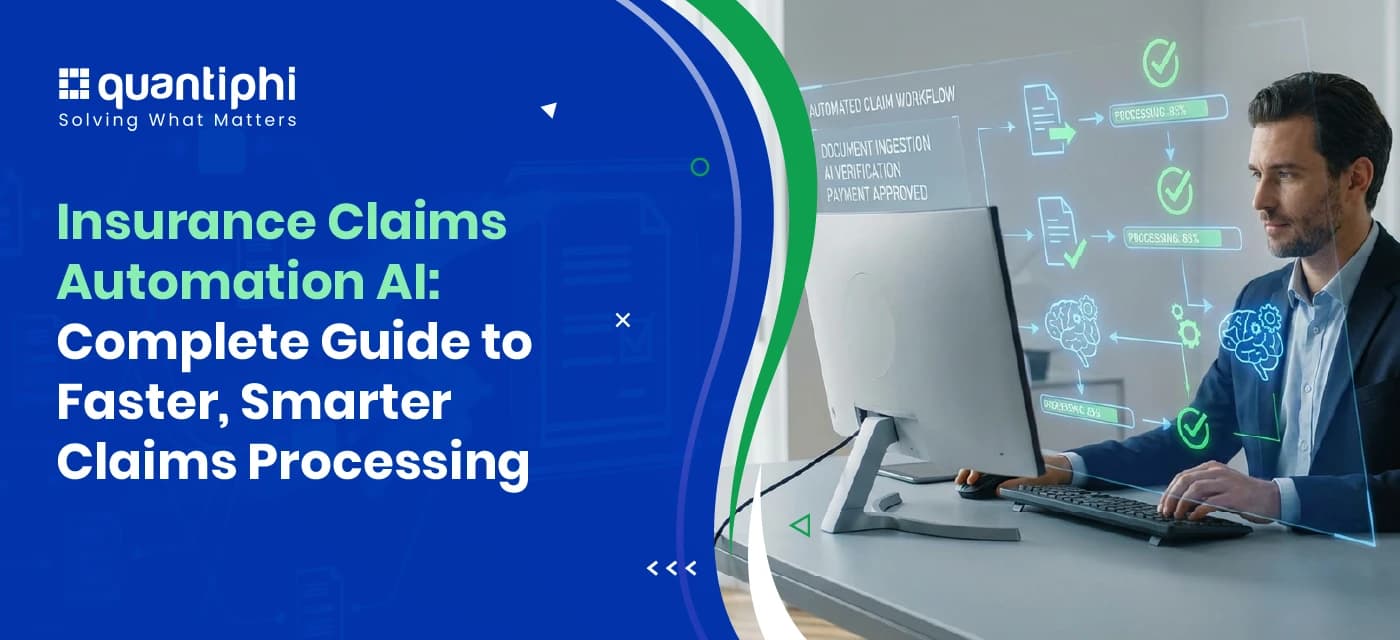
Insurance Claims Automation AI: Complete Guide to Faster, Smarter Claims Processing

The insurance industry is currently undergoing a seismic shift. with market valuations expected to climb from $13.45 billion in 2026 to a staggering $154 billion by 2034. This trajectory represents a compound annual growth rate (CAGR) of 35.7%. This signals that AI is no longer a peripheral tool but the core engine of future insurance operations.
As customer expectations pivot toward “instant gratification” and operational costs climb, the traditional, paper-heavy claims process is no longer sustainable.
Insurers are increasingly turning to claims automation powered by artificial intelligence (AI), machine learning (ML), intelligent document processing (IDP), and workflow orchestration platforms.
Insurance claims automation enables insurers to streamline the entire claims lifecycle from First Notice of Loss (FNOL) to final settlement while improving accuracy, reducing operational costs, and enhancing customer experience.
This article explores what claims automation is, how it works, the technologies powering it, real-world use cases, benefits, challenges, and the future of automated claims processing in insurance.
What is Insurance Claims Automation AI?
Insurance claims automation refers to the use of digital technologies, AI, and workflow automation to streamline and automate various stages of the insurance claims lifecycle.
Instead of relying heavily on manual processes such as manual data entry, document review, and decision-making claims automation systems use intelligent algorithms, rules engines, and integrated workflows to process claims faster and more accurately.
In traditional claims processing, adjusters manually review documents, verify policy details, assess damages, and determine payouts. This approach often leads to longer processing times, inconsistent decisions, and higher operational costs.
In contrast, automated claims processing enables insurers to:
- Automatically capture claim information from digital channels
- Extract and validate data from submitted documents
- Detect fraud using AI models
- Route claims to the appropriate teams
- Automatically approve straightforward claims
The result is a faster, more scalable, and data-driven claims management process. With Dociphi we help insurers extract key information, identify discrepancies & validate claims instantly
We helped a leading U.S. Insurer, automate claims end to end with Dociphi to achieve faster turnaround times and reduce operational costs. Read how Dociphi achieved over 90% extraction accuracy, increased operational efficiency by ~30%, and reduced claims processing turnaround time to within one day.
Why is Claims Automation Important Today?
According to a report by Intel Market Research, AI-driven systems process claims up to 70% faster than traditional manual methods. Automation reduces overall claims handling costs by 35–40%. The need for claims automation has grown significantly in recent years due to several industry trends.
-
Rising Claims Volumes
Natural disasters, cyber incidents, and increasing insurance adoption have significantly increased claim volumes across many insurance segments. Manual systems often struggle to scale during peak claim events.
-
Increasing Customer Expectations
Policyholders today expect fast, transparent, and digital-first experiences, similar to those offered by leading technology companies. Waiting weeks for claim resolution can negatively impact customer satisfaction and retention.
-
Cost Pressures
Claims processing is one of the most expensive operational functions for insurers. Manual processing, rework, and inefficiencies can drive up costs significantly.
-
Need for Operational Efficiency
Automation allows insurers to handle higher claim volumes while reducing manual workload and enabling claims professionals to focus on complex, high-value claims instead of repetitive tasks.
How Does Insurance Claims Automation AI Work?
A modern automated claims lifecycle follows a structured digital path:
-
FNOL (First Notice of Loss)
FNOL is the first step in the claims process, where a policyholder reports a loss or incident. Automation enables FNOL through multiple digital channels including Mobile apps, Customer portals, Chatbots, and Call center integrations. AI systems can automatically capture claim details and create a claim record in the claims system.
-
Claims Intake & Registration
Once the claim is submitted, automated systems verify policy information and register the claim in the insurer’s claims management platform. Automation helps Validate policy coverage, Check policy limits, Assign claim IDs and Route claims to appropriate workflows
-
Document Collection and Validation
Claims often require documents such as invoices, medical records, police reports, or repair estimates. Intelligent document processing (IDP) tools can Automatically extract data from documents, Validate document completeness, Flag missing information and Reduce manual data entry
-
Claims Assessment & Adjudication
AI and rules engines help assess claims by analyzing Policy coverage rules, Historical claims data, Damage estimates and Risk indicators. Claims can then be automatically routed to adjusters or processed automatically if they meet predefined conditions.
-
Fraud Detection
Fraud detection models analyze patterns and anomalies across claims data. Machine learning models can identify suspicious claim patterns, Duplicate claims and Abnormal payout requests. Potentially fraudulent claims are flagged for further investigation.
-
Approval & Settlement
For low-risk and straightforward claims, automated systems can approve claims instantly using straight-through processing (STP). Payments can then be triggered automatically via integrated payment systems.
-
Customer Communication
Automation platforms also enable real-time communication with policyholders through Email updates, SMS notifications, Customer portals and Chatbots. This improves transparency and customer satisfaction. A report by Intel Market Research says personalized AI interactions and faster payouts have led to a 25–30% increase in customer satisfaction scores.
Key Components of an Insurance Claims Automation AI System
A modern claims automation system typically consists of several interconnected components.
-
Workflow Orchestration
Workflow orchestration tools manage the flow of claims through different processing stages and ensure tasks are routed to the right teams or automated systems.
-
Rules Engine
Rules engines enforce policy conditions, coverage validation, and decision logic required for claim adjudication.
-
AI and Machine Learning Models
AI models support Fraud detection, Claims triaging, Risk scoring and Predictive analytics
-
Intelligent Document Processing (IDP)
IDP systems like Dociphi extract structured data from unstructured documents such as invoices, forms, medical records, and images.
-
Integration with Core Systems
Claims automation platforms integrate with key insurance systems including Policy administration systems, Claims management platforms, Customer relationship management (CRM) systems and Payment platforms
The Technologies Behind Claims AI Automation
Several advanced technologies enable automated claims processing-
-
Artificial Intelligence and Machine Learning
AI models analyze large volumes of claims data to detect patterns, identify risks, and automate decision-making.
-
Robotic Process Automation (RPA)
RPA automates repetitive tasks such as data entry, system updates, and claims registration.
-
Intelligent Document Processing (IDP)
IDP platforms combine OCR, natural language processing, and machine learning to extract data from complex insurance documents.
-
APIs and System Integrations
APIs allow insurers to integrate automation platforms with external services, internal systems, and partner ecosystems.
-
Cloud Platforms
Cloud infrastructure enables scalable claims processing and allows insurers to handle surge events such as natural catastrophes.
-
Low-Code Automation Platforms
Low-code tools enable insurers to rapidly design and deploy automated workflows without extensive development.
Real-World Use Cases of AI Claims Automation
Insurance claims automation can be applied across multiple operational areas.
-
Fraud Detection
AI models detect suspicious patterns and flag high-risk claims for investigation.
-
Claims Triaging
Automation helps prioritize claims based on severity, risk level, and complexity.
-
Damage Assessment
Computer vision models analyze images and videos to estimate damages in auto or property claims.
-
Automated Document Extraction
IDP tools automatically extract key information from claim documents.
-
Real-Time Claims Tracking
Customers can track claim status through digital portals or mobile applications.
-
Automated Customer Communication
Automated notifications keep customers informed about claim status and next steps.
AI Automation Across Insurance Types
Claims automation is used across various insurance lines.
-
Auto Insurance
Automation helps process accident reports, analyze vehicle damage images, and estimate repair costs.
-
Health Insurance
Automated systems process medical claims, verify coverage, and validate billing codes.
-
Life Insurance
Automation assists with claims verification, beneficiary validation, and document processing.
-
Property and Casualty (P&C)
P&C insurers use automation to manage catastrophe claims, property damage assessments, and large claim volumes.
The Benefits of Insurance Claims Automation : Why Make the Switch?
Implementing claims automation offers several advantages for insurers.
-
Faster Claim Processing
Automation significantly reduces claim cycle times and enables faster settlements.
-
Reduced Operational Costs
By minimizing manual work, insurers can reduce processing costs per claim.
-
Improved Accuracy
Automated systems reduce human errors in data entry and claim evaluation.
-
Better Customer Experience
Faster and transparent claim processing improves policyholder satisfaction.
-
Scalability
Automation allows insurers to scale operations during high claim volumes.
-
Reduced Manual Workload
Claims professionals can focus on complex claims that require human expertise.
Challenges and Limitations of Insurance Claims Automation
Despite its benefits, implementing claims automation presents several challenges.
-
Legacy System Integration
Many insurers operate on legacy systems that are difficult to integrate with modern automation platforms.
-
Poor Data Quality
Automation systems rely on high-quality structured data, which may not always be available.
-
Regulatory and Compliance Requirements
Insurance regulations require transparency and explainability in automated decisions.
-
AI Bias and Explainability
AI models must be carefully designed to avoid biased decision-making.
-
Change Management
Transitioning from manual to automated workflows requires training and organizational change.
Manual vs. Automated Claims Processing
| Feature | Manual Processing | Automated Processing |
|---|---|---|
| Processing Speed | Slow | Fast |
| Accuracy | Prone to human errors | Higher accuracy |
| Cost | High (Labor-intensive) | Low (Per-claim cost drops) |
| Scalability | Linear (Need more people) | Exponential (Software-driven) |
| Customer Experience | Delayed updates | Real-time communication |
Claims Automation vs. Claims Management Systems (CMS)
Claims management systems are designed to manage claims workflows, whereas claims automation focuses on automating the tasks within those workflows.
In practice, automation tools typically integrate with existing claims management platforms to enhance their capabilities.
Claims automation platforms provide additional features such as AI-powered decisioning, automated document processing, workflow orchestration and predictive analytics.
What is Straight-Through Processing (STP) in Insurance Claims Automation?
Straight-through processing (STP) refers to a fully automated claims workflow where claims are processed without human intervention.
In STP-enabled systems:
- Claims are submitted digitally
- Documents are automatically processed
- Policies are verified automatically
- Fraud checks are performed by AI models
- Claims are approved instantly
STP works best for low-value, low-risk, and standardized claims.
How to Implement Claims Automation
Implementing claims automation typically involves several stages.
-
Identify Automation Opportunities
Insurers must first identify high-volume processes that can benefit from automation.
-
Select Automation Technologies
Organizations should evaluate platforms offering AI, IDP, workflow automation, and integration capabilities.
-
Integrate with Legacy Systems
Automation tools must integrate with policy administration and claims management systems.
-
Run Pilot Programs
Insurers often begin with pilot projects to validate performance and ROI.
-
Scale Across Operations
Successful automation initiatives can then be scaled across multiple lines of business.
Read how agentic intelligence can help in boosting claims operational excellence here
Measuring Success: KPIs and ROI of Insurance Claims Automation
Insurers evaluate the success of automation initiatives using several key metrics.
-
Claim Cycle Time
Measures the time required to process a claim from FNOL to settlement.
-
Cost Per Claim
Indicates operational efficiency improvements.
-
Automation Rate
The percentage of claims processed automatically.
-
Accuracy Improvements
Measures reduction in processing errors.
-
Customer Satisfaction
Metrics such as Net Promoter Score (NPS) help track customer experience improvements.
-
Return on Investment (ROI)
Evaluates financial benefits of automation initiatives.
Latest Trends in Claims Processing: AI-First and Hyperautomation
-
AI-First Claims Processing
Insurers are shifting from rule-based workflows to AI-first models where machine learning drives decisioning, risk scoring, and claims adjudication.
-
Generative AI-Powered Claims Operations
Generative AI in Insurance is being used to summarize claims, generate reports, and enable faster, more contextual decision-making across the claims lifecycle.
-
LLM-Driven Document Understanding
Retrieval-Augmented Generation (RAG) are improving the ability to interpret unstructured data such as policy documents, medical records, and adjuster notes with higher accuracy.
-
Agentic AI and Autonomous Workflows
Emerging agentic AI systems are enabling end-to-end automation by orchestrating tasks, making decisions, and executing claims workflows with minimal human intervention.
-
Hyperautomation at Scale
A combination of AI, RPA, and workflow orchestration is enabling insurers to automate complex, multi-step processes across the claims value chain.
-
Self-Service and Digital FNOL
Customers can initiate and track claims through digital channels, chatbots, and voice interfaces, reducing dependency on manual touchpoints.
-
AI-Powered Fraud Detection
Advanced models are leveraging real-time data and behavioral patterns to detect fraud earlier and more accurately.
-
Computer Vision for Damage Assessment
Image and video analytics are being used to assess damages in auto and property claims, enabling faster and more accurate estimations.
-
Real-Time Decisioning
Insurers are increasingly enabling instant claim approvals and settlements using real-time data processing and AI-driven decision engines.
-
Embedded and Ecosystem-Based Claims
Claims processing is becoming more integrated with external ecosystems (repair networks, healthcare providers, IoT devices) for seamless, end-to-end experiences.
The Future of Claims Processing: Fully Autonomous Ecosystems
The future of claims processing will be defined by fully autonomous, AI-driven claims ecosystems. Advancements in artificial intelligence—particularly Large Language Models (LLMs), Generative AI, and emerging Agentic AI systems—are enabling insurers to move beyond rule-based automation toward systems that can understand unstructured data, generate insights, and execute end-to-end workflows with minimal human intervention.
LLMs are enhancing claims automation by interpreting complex policy documents, extracting insights from unstructured data such as medical reports and adjuster notes, and enabling conversational claims intake through chat and voice interfaces. At the same time, Generative AI is transforming how insurers process and communicate claims by automatically summarizing claim files, generating reports, and delivering real-time, personalized customer interactions.
Building on this, Agentic AI introduces a new paradigm where intelligent agents can autonomously plan, decide, and act—handling the entire claims lifecycle from FNOL to settlement by orchestrating multiple systems, performing fraud checks, and triggering payments.
As these technologies evolve, insurers will move closer to zero-touch claims processing, real-time decisioning, and continuous learning systems that improve with every interaction. While human expertise will remain critical for complex and sensitive cases, the overall claims function will become significantly faster, smarter, and more customer-centric, redefining the future of insurance operations..